By Global Sports Konnect (GSK) | February 2026
| KEY HIGHLIGHTS Pro Wrestling League India returned in 2026 after a seven-year hiatus, featuring 63 international-calibre wrestlers from 16 nations across 6 franchise teams — representing the most competitive field in the league’s 11-year history.Haryana Thunders won the PWL 2026 title 5-4 over Delhi Dangal Warriors in one of the most dramatic finals in Indian sports this year, with the championship decided by a 16-0 technical superiority win by Paris Olympic silver medallist Iryna Koliadenko in the final bout.PWL 2026’s revival model — WFI-led governance, ONO Media execution, centralized venue, ₹2 Crore per-franchise auction, and 44% women’s bout representation — offers a practical blueprint for how India’s Olympic sports leagues can build sustainable professional structures.With 300 wrestlers registering for 54 auction spots, significant investor backing from groups including EaseMyTrip, APCO Group, and the Sanraj Group, and ministerial attendance at the final, PWL 2026 signals a genuine commercial reset for wrestling in India. |
The Comeback That Indian Wrestling Needed
On the night of February 1, 2026, the Noida Indoor Stadium was the loudest venue in Indian wrestling history. With the Pro Wrestling League final tied 4-4 after eight bouts, 63 wrestlers from 16 nations had delivered one of the most gripping team competitions the country had seen. Everything came down to a single women’s 62kg bout.
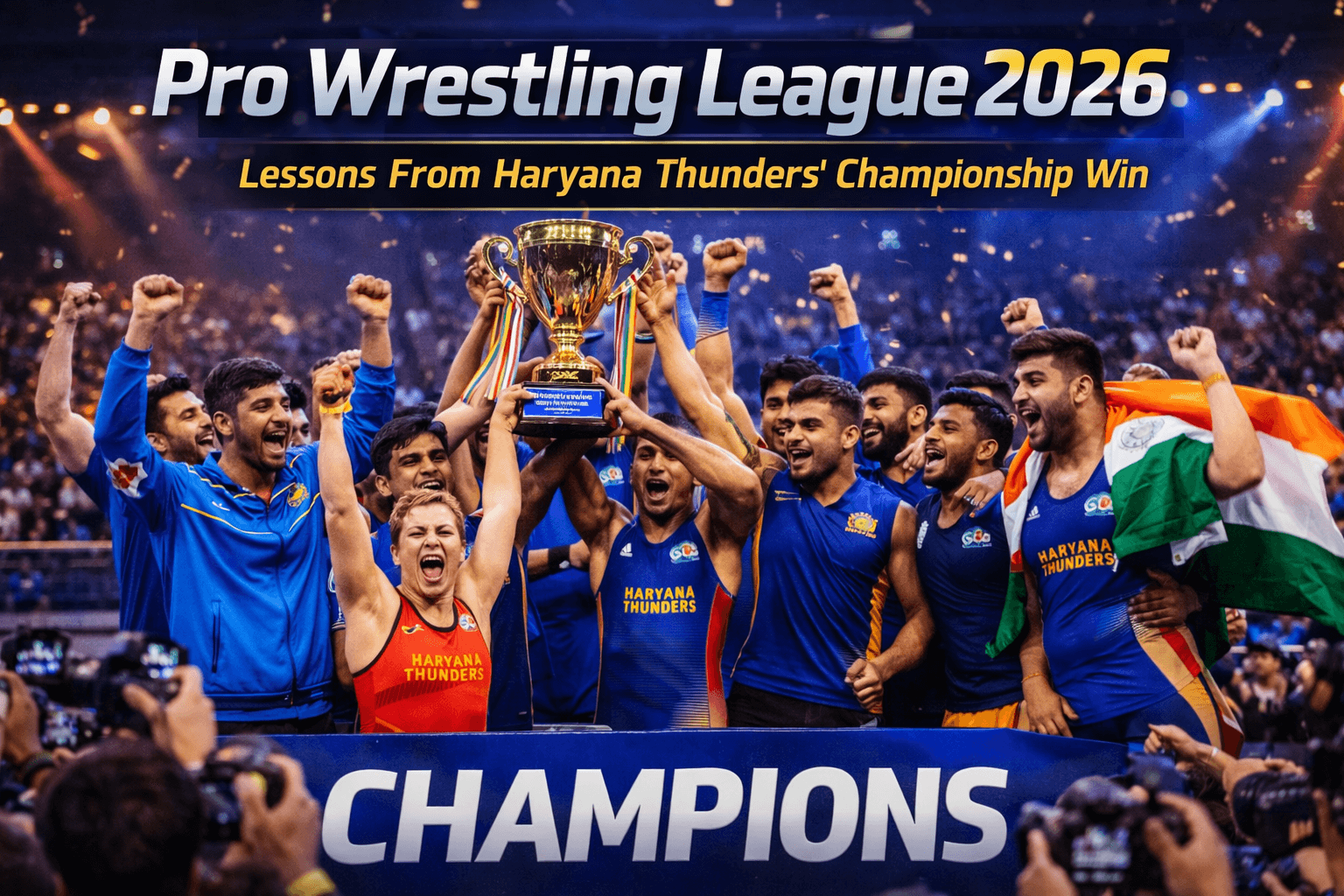
Iryna Koliadenko, a Paris 2024 Olympic silver medallist representing Haryana Thunders, walked onto the mat. What followed was not just a sporting moment — it was a 16-0 technical superiority statement that sealed the championship for Haryana Thunders and, in many ways, validated a seven-year wait for the Pro Wrestling League India to return.
This blog is not just about the result. It is about what the PWL 2026 revival reveals about how India’s Olympic sports can build professional leagues that last — with the right governance structure, the right franchise economics, the right gender equity mandate, and the right commercial logic. There are genuine lessons here for everyone building or investing in Indian sports.
The Seven-Year Gap: What Went Wrong and Why 2026 Is Different
Why PWL Went Dark After 2019
The Pro Wrestling League was launched in 2015 by the Wrestling Federation of India (WFI) and quickly became India’s premier professional wrestling competition. At its peak, the league showcased Olympic-level wrestling to a mainstream audience and created unprecedented visibility for Indian wrestlers beyond the four-year Olympic cycle. But after Season 4 in 2019, administrative instability, non-payment disputes, and governance failures led to the league’s suspension.
The core problem was structural: the original private-promoter model lacked centralized financial controls, creating athlete payment disputes that eroded trust and eventually made the league commercially unviable. Seven years of silence followed — until November 2025, when WFI announced the league’s return under a fundamentally different framework.
What the 2026 Model Actually Changed
The PWL 2026 revival, executed by ONO Media under Dayaan Farooqui and Akhil Gupta in coordination with WFI, corrected the foundational flaws of the original iteration. WFI took direct ownership of the league rights in 2022, meaning the federation now controls all payments to wrestlers and franchises — eliminating the payment dispute risk that killed the earlier version. The entire 2026 season was hosted at a single venue (Noida Indoor Stadium), a deliberate cost-control measure that reduced logistical complexity while ensuring broadcast consistency.
The franchise auction model was retained but disciplined: each of the six franchise teams operated under a strict ₹2 Crore player budget, with 300 wrestlers listed for 54 available roster spots. The oversubscription — over 5.5 applicants per spot, from 16 countries — immediately validated the league’s global standing before a single bout was contested.
| PWL 2026 Final Bout-by-Bout | Weight Category | Winner | Score | Score After Bout |
| Bout 1 | Men’s 74kg | Turan Bayramov (Delhi) | 8-2 | Delhi 1 – Haryana 0 |
| Bout 2 | Women’s 76kg | Kajal Dhochak (Haryana) | 3-1 | 1-1 |
| Bout 3 | Men’s 65kg | Sujeet Kalkal (Delhi) | 8-6 | Delhi 2 – Haryana 1 |
| Bout 4 | Women’s 53kg | Yui Susaki (Haryana) | Technical Sup. | 2-2 |
| Bout 5 | Men’s 86kg | Hadi Bakhtiar (Delhi) | 11-0 | Delhi 3 – Haryana 2 |
| Bout 6 | Men’s 57kg | Akshay Dhere (Haryana) | Technical Sup. | 3-3 |
| Bout 7 | Men’s 125kg | Ronak (Delhi) | 12-2 | Delhi 4 – Haryana 3 |
| Bout 8 | Women’s 57kg | Neha Sangwan (Haryana) | Pin | 4-4 |
| Bout 9 (Decider) | Women’s 62kg | Iryna Koliadenko (Haryana) | 16-0 Tech. Sup. | HARYANA WINS 5-4 |
The PWL 2026 Business Model: Five Things Brands and Investors Should Know
1. WFI-Led Governance Creates Stability That Private Promoters Couldn’t
The most important change in PWL 2026 is not the format — it is the governance structure. With WFI directly controlling the league’s financial flows, wrestler payments are now backed by the credibility of a national federation rather than the solvency of a private promoter. This is the same structural shift that took Pro Kabaddi League from a niche concept to India’s second-most-watched sport: institutional accountability at the centre, with private enterprise managing execution.
For brands evaluating sponsorship in Pro Wrestling League India, WFI governance is the most important risk reduction signal. Non-payment controversies do not just hurt athletes — they generate negative press that erodes sponsor confidence. The 2026 model eliminates this vulnerability.
2. The Centralized Venue Strategy — Smart Cost Management
Staging all PWL 2026 matches at the Noida Indoor Stadium was a deliberate financial strategy. Multi-venue leagues carry higher logistics costs, inconsistent broadcast quality, and travel fatigue for athletes — all of which inflate operating expenses without proportionate revenue upside. ONO Media’s decision to centralize operations allowed tighter quality control, lower production costs, and a consistent fan experience. For a league returning after a seven-year break, demonstrating financial discipline before commercial confidence is the right sequencing.
3. Franchise Ownership Profile — Strategic and Diverse
The six franchise owners in PWL 2026 represent a commercially credible investor mix. EaseMyTrip backed Delhi Dangal Warriors, bringing travel industry distribution and digital reach. APCO Group partnered with Aspect Sports on Tiigers of Mumbai Dangals, connecting infrastructure sector investment to sport. Vikas Parasrampuria’s ownership of Haryana Thunders directly links India’s wrestling heartland — Haryana produces more Olympic wrestlers than any other Indian state — to industrial-scale sports management. Maharashtra Kesari’s Sanraj Group backing reflects a technology-driven approach. Across the board, franchise owners bring commercial expertise beyond sport.
4. The Matri Shakti Commitment 44% Women’s Bouts Is Industry-Leading
Nearly 44% of all PWL 2026 bouts were contested by women wrestlers — a gender equity mandate that is structurally unmatched in Indian professional sport. This is not symbolic representation; the highest auction prices in PWL 2026 went to female wrestlers, including world champions and Olympic medallists like Yui Susaki (multiple-time world champion, Haryana Thunders) and the tournament’s decisive performer, Iryna Koliadenko. For brands investing in women’s sports — which is the fastest-growing sponsorship segment in India, with female athlete engagement running 35% higher per follower than male equivalents (Nielsen Sports) — PWL offers rare structural access.
5. Prize Money and Athlete Economics Building the Incentive Ladder
Haryana Thunders took home ₹1.5 Crore in prize money; runners-up Delhi Dangal Warriors received ₹75 Lakh. Individual awards included the Player of the Tournament prize of ₹2.5 Lakh — won by an undefeated Turan Bayramov of Delhi, who won all seven of his bouts in the men’s 57kg category with 59 total points. These prize pools, combined with auction-based player salaries, create the financial incentive structure that professional sports leagues require to attract and retain elite talent. As the league scales, these figures must grow — but the architecture is in place.
PWL 2026 vs Other Indian Non-Cricket Sports Leagues: A Commercial Snapshot
| Metric | Pro Wrestling League (PWL 2026) | Pro Kabaddi League (PKL) | Hockey India League (HIL) |
| Season | 5th edition (after 7-yr hiatus) | 11th/12th season ongoing | Revived 2025 |
| Teams | 6 franchise teams | 12 franchise teams | 8 franchise teams |
| Governing body | WFI + ONO Media | Mashal Sports (Star Sports) | Hockey India |
| International athletes | 16 nations, 63 wrestlers | Limited (domestic focus) | International + Indian |
| Women’s bout % | 44% (structural mandate) | No women’s league yet | N/A |
| Venue model | Centralized (Noida) | Travelling caravan + home | Multiple venues |
| Champion prize | ₹1.5 Crore | Not publicly disclosed | Not publicly disclosed |
| Key investor type | Industrial groups + digital | Sports-focused PE / corporate | State-backed + private |
| Olympic sport link | Direct — Paris 2024 medallists | Kabaddi (Asian Games) | Paris 2024 bronze medal |
Five Lessons From PWL 2026 for Indian Sports Builders
The PWL 2026 revival contains practical lessons for anyone designing, investing in, or managing Indian sports properties. GSK’s work across league creation, franchise structuring, and event management — including the Chhattisgarh Hockey League 2026 — draws from exactly this kind of real-world evidence.
Lesson 1: Governance Before Growth
Every major Indian sports league that has failed did so because of governance problems, not lack of fan interest. Wrestling has fans. So did the previous PWL iteration. What it didn’t have was financial accountability and institutional credibility. Fixing this before growing — even if it means a slower, centralized, more conservative first season back — is the right call. The same principle applies to any new sports property in India.
Lesson 2: Women’s Sport Is Not Optional; It’s Strategic
PWL 2026’s 44% women’s bout commitment is not charity — it is commercial strategy. India’s highest-profile recent wrestling moments have been female: Vinesh Phogat’s Paris 2024 controversy, Bajrang Punia’s protest, Sakshi Malik’s story. Female wrestlers hold enormous cultural capital in India’s wrestling belt states. Leagues that build women’s wrestling into their structure from day one capture both the audience and the sponsor premium that women’s sport commands in 2026.
Lesson 3: International Talent Raises the Entire Product
300 wrestlers from over 20 countries registering for PWL roster spots means the world’s wrestling community treats India as a destination worth competing in. Yui Susaki (Japan, multiple-time world champion), Iryna Koliadenko (Ukraine, Paris Olympic silver medallist), and Turan Bayramov (tournament’s best performer) elevate the quality of every bout they participate in — and they serve as international marketing for the league. Leagues that mix elite Indian talent with world-class international athletes create a product that can build global media value over time.
Lesson 4: Cost Discipline in Year One Enables Year Three
The Noida Indoor Stadium centralized model, the ₹2 Crore franchise cap, the single-venue broadcast — these are all conservative choices that signal financial maturity. A league that spends beyond its revenue in Year 1 is a league that struggles to attract investors in Year 3. PWL 2026’s model preserves the capital needed to grow the prize purse, expand venues, and improve production quality in subsequent seasons — exactly the growth curve that PKL followed on its way to 200 million+ season viewership.
Lesson 5: Political and Celebrity Endorsement Amplifies Commercial Legitimacy
Sports Minister Mansukh Mandaviya attended the PWL 2026 final. Digital creators including Elvish Yadav — one of India’s largest YouTube presences — were regulars at Haryana Thunders fixtures. This convergence of political, celebrity, and sports authority signals is not cosmetic; it translates directly into media coverage, social media amplification, and sponsor confidence. League builders who underestimate the value of high-profile attendance are leaving marketing budget on the table.
Frequently Asked Questions
What is Pro Wrestling League India and who runs it?
Pro Wrestling League India (PWL) is India’s premier franchise-based professional wrestling competition, sanctioned by the Wrestling Federation of India (WFI) and adhering to United World Wrestling rules. The 2026 season was the league’s 5th edition, operated by ONO Media under the leadership of Akhil Gupta (CEO) and Dayaan Farooqui (Chairman), with WFI retaining full rights ownership and financial oversight. The league returned in 2026 after a seven-year hiatus following the 2019 season.
Who won Pro Wrestling League 2026 and how was the final decided?
Haryana Thunders won the PWL 2026 championship, defeating Delhi Dangal Warriors 5-4 in one of the most dramatic finals in Indian sports this year. With scores locked at 4-4 after eight bouts, the title was decided in the final women’s 62kg contest where Paris 2024 Olympic silver medallist Iryna Koliadenko defeated Anjli by a 16-0 technical superiority margin to seal the win. Haryana received ₹1.5 Crore prize money, while Delhi earned ₹75 Lakh as runners-up.
Who won the individual awards at PWL 2026?
Turan Bayramov of Delhi Dangal Warriors was named Player of the Tournament after winning all seven of his bouts in the men’s 57kg category, accumulating 59 total points and earning a ₹2.5 Lakh award. Chandermohan of Punjab Royals was the highest overall point scorer. Neha Sangwan (Haryana Thunders) won Player of the Match for the final, Ronak (Delhi Dangal Warriors) won Fighter of the Match, and Akshay Dhere (Haryana Thunders) was named Impact Player of the Match.
How does PWL 2026 compare to Pro Kabaddi League in terms of commercial model?
PWL 2026 is at an earlier stage of commercial development than the Pro Kabaddi League, which has 11 seasons of institutional knowledge, a multi-year Star Sports/JioStar broadcast deal, and 200 million+ season viewership. PKL’s title sponsorship history includes a ₹262 Crore five-year deal with vivo. PWL’s advantage is its direct Olympic sport connection — every wrestler competing at the league level is a potential Olympics or Asian Games athlete — which creates a unique brand association premium that kabaddi cannot replicate. Both leagues demonstrate the viability of the franchise model for traditional Indian sports.
What does PWL 2026 mean for brands looking to enter wrestling sponsorship?
PWL 2026 offers brands early-mover access to a restructured league with institutional governance, Olympic-level talent, and a genuine women’s sport platform — all at pre-growth pricing. The league’s 44% women’s bout mandate, its international talent depth (16 nations), and WFI institutional backing make it a credible medium-term sports property. Brands entering wrestling sponsorship now benefit from lower entry costs and the ability to build genuine brand affinity in the sport before commercial premiums reflect the league’s post-revival growth.
| Building the Next Generation of Indian Sports Leagues Whether you’re designing a franchise-based sports league from scratch, evaluating sponsorship investment in emerging Indian sports properties, or structuring events with the governance discipline that attracts investors — GSK’s end-to-end sports management capability covers every aspect of the process. We’re currently building the Chhattisgarh Hockey League 2026 on exactly these principles. Explore our Events & Tournaments and Sports Marketing services: globalsportskonnect.com/services/events/ | globalsportskonnect.com/services/sports-marketing/ Book a free intro call: calendly.com/globalsportskonnect | info@globalsportskonnect.com |
© 2026 Global Sports Konnect | globalsportskonnect.com