KEY HIGHLIGHTS
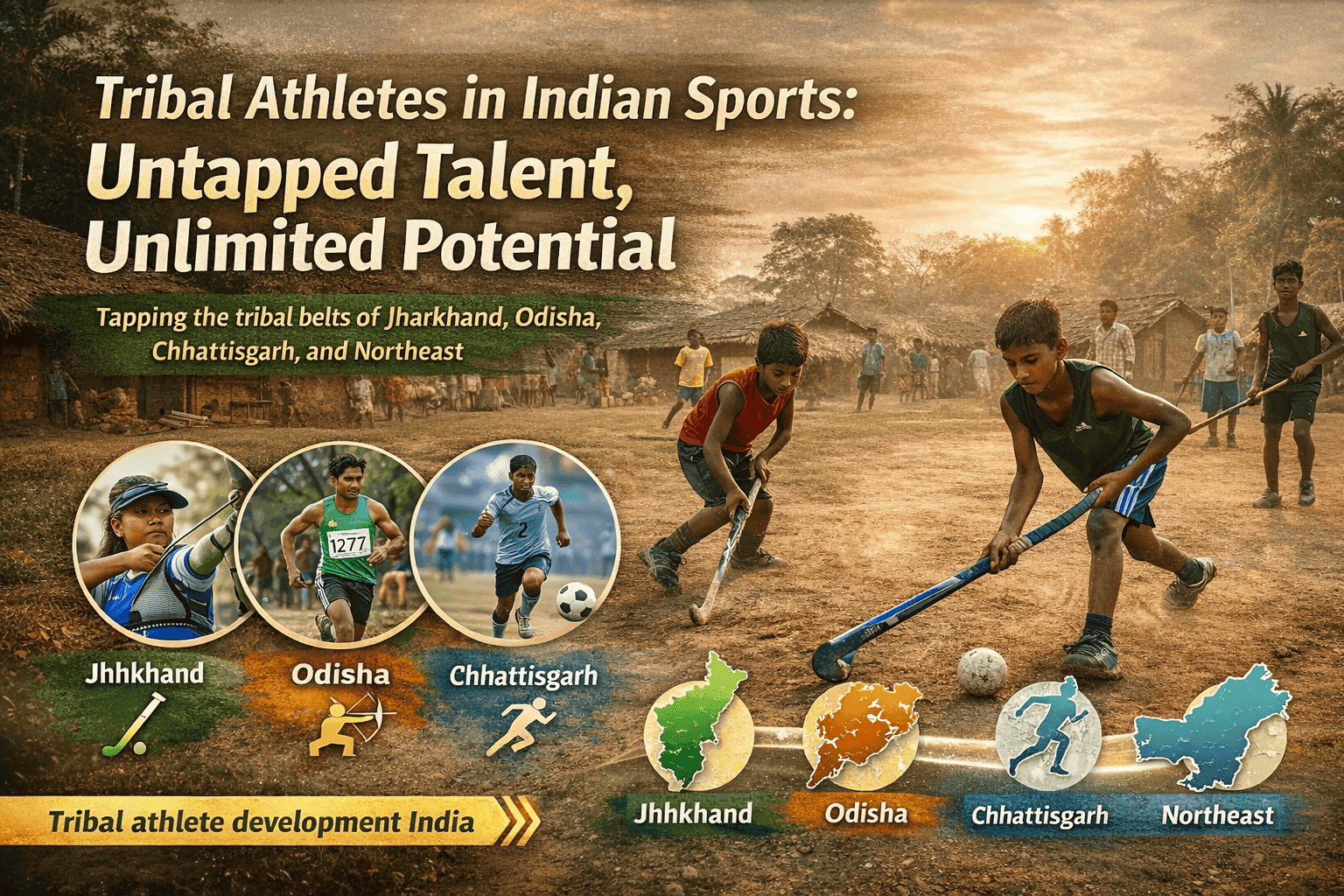
- India’s tribal communities — over 10 crore Scheduled Tribe citizens across Jharkhand, Odisha, Chhattisgarh, MP, and the Northeast — produce a disproportionate share of the country’s elite hockey, athletics, archery, and football talent.
- Despite this proven output, fewer than 5% of tribal athletes ever access structured coaching, professional pathways, or brand endorsement deals — leaving an enormous talent pipeline untapped.
- The Khelo Bharat Niti 2025 (launched July 2025) and a ₹1,000 Cr Khelo India budget allocation now formally mandate dedicated tribal sports development — creating a policy window that clubs, leagues, and brands can capitalise on.
- CHL 2026’s 30% tribal inclusion mandate is India’s first instance of a professional sports league making tribal representation a structural, non-negotiable condition — a model the wider sports ecosystem needs to replicate.
In 1928, Jaipal Singh Munda captained India to its first-ever Olympic gold medal in hockey. Almost a century later, India’s tribal belts — Jharkhand, Odisha, Chhattisgarh, Madhya Pradesh, and the Northeast — continue producing a remarkable concentration of the country’s finest athletes. And yet, for every tribal athlete development India success story that makes the national headlines, hundreds of equally gifted players never get the structured pathway they need to go from village field to national stage.
That gap is not a talent problem. It is a systems problem. And in 2026, with India’s most ambitious sports policy in a generation now live, and leagues like the Chhattisgarh Hockey League (CHL) formally embedding tribal inclusion into their operating structure, there has never been a more urgent — or more exciting — moment to close it.
Table of Contents
- The Case That Cannot Be Ignored: Tribal Talent by the Numbers
- Why the Pathway Breaks Down
- What the Policy Landscape Now Offers
- The CHL 2026 Model: Inclusion as Architecture
- What Brands and Investors Can Do Right Now
- Frequently Asked Questions
- Conclusion
The Case That Cannot Be Ignored: Tribal Talent by the Numbers
India’s Scheduled Tribe population numbers over 10.4 crore people, representing approximately 8.6% of the national population (Census 2011; updated projections suggest 11+ Crore by 2026). But in certain elite sports disciplines, tribal representation at the national level has historically been far higher than that share would predict.
Hockey is the clearest example. Players like Birendra Lakra (Oraon tribe, Odisha), Sylvanus Dung Dung, Michael Kindo, Manohar Topno, and Vimal Lakra have all represented India at the Olympics, World Cup, Asian Games, and Asia Cup. Simdega district in Jharkhand — with a tribal majority population of around 70% — has produced more Indian hockey internationals per capita than virtually any other district in the country. The region where those players trained had no paved roads to many of their villages. Several had no electricity at home. They learned hockey with sticks carved from bamboo and kendu wood.
The pattern repeats in athletics. Ashtam Oraon from Gumla district, Jharkhand, captained India’s FIFA U-17 Women’s Football World Cup squad in 2022, while her parents worked as daily wage labourers. Ashakiran Barla secured gold at the Asian Under-18 Athletics Championship in Kuwait — from a family without basic sanitation. Dutee Chand, from the Jajpur district of Odisha, became the third Indian woman ever to qualify for the 100m event at the Summer Olympics. Two-time Olympic bronze medallist Saina Nehwal is a notable exception; in most non-cricket sports, the tribal belt is where the raw material lives.
The point is not that tribal athletes succeed despite their circumstances — though many do. The point is that they succeed because tribal communities culturally embed physical discipline, endurance, and competitive spirit into daily life from childhood. As a Jharkhandi proverb puts it: ‘Senge Susun Kajige Durang’ — walking itself is dance, and speaking, music. Movement is not an activity; it is a way of being. The raw athletic foundation is already there. What is missing is the infrastructure to build on it.
Why the Pathway Breaks Down
If the talent density is so high, why does the sports system consistently fail tribal athletes? The breakdown happens at four structural points that are well understood but under-addressed.
Discovery
Zonal talent hunts rarely penetrate deep enough into tribal geographies. Most scouting infrastructure sits in district headquarters and state capitals — not in the blocks and panchayats where the talent actually lives. Scouts have timetable constraints and travel budgets. Tribal villages, often at the end of poor road networks, don’t fit those constraints.
Infrastructure and Continuity
Even when a tribal athlete is identified, local training facilities in these regions are minimal. The state hockey stadiums, athletics tracks, and football grounds with qualified coaches are in cities. A 14-year-old from Bastar or Simdega either relocates or gives up. Most give up — not for lack of desire, but for lack of a viable path forward.
Financial Vulnerability
Tribal households are disproportionately below the poverty line. When a young athlete faces the choice between attending a distant training camp and supporting family income, sport loses. Even when sports scholarships exist, delays in disbursement — which are common in government schemes — can force athletes to drop out of the system entirely.
Institutional Awareness
Brand managers, sports agencies, and IPL-era sports professionals are concentrated in metros. Their awareness of the talent pipeline flowing from Jharkhand, Chhattisgarh, and Odisha’s tribal belts is academic at best. Without that awareness, there is no commercial demand signal — no endorsement interest, no camp invitation, no agent relationship — that pulls young tribal athletes into the formal sports economy.
| State | Tribal Population (approx.) | Key Sports Strength | Notable Tribal Athletes |
| Jharkhand | ~86 Lakh (26% of state) | Hockey, Athletics, Football | Sylvanus Dung Dung, Michael Kindo, Ashtam Oraon |
| Odisha | ~95 Lakh (23% of state) | Hockey, Athletics, Weightlifting | Birendra Lakra, Dutee Chand, Dipa Karmakar* |
| Chhattisgarh | ~78 Lakh (31% of state) | Hockey, Kabaddi, Archery | Multiple national-level hockey players |
| Madhya Pradesh | ~1.53 Cr (21% of state) | Archery, Athletics, Hockey | Deep talent pipeline, underexposed nationally |
| Northeast (combined) | ~50%+ tribal across states | Football, Boxing, Weightlifting | Mary Kom, Bembem Devi, Dingko Singh |
*Note: Dipa Karmakar (Tripura) is from a tribal-dominant state though herself non-tribal. Listed to indicate regional context.
What the Policy Landscape Now Offers
2025 was the most significant year in Indian sports policy in two decades. The government launched the Khelo Bharat Niti 2025 on July 1, replacing the 24-year-old National Sports Policy of 2001 and making tribal communities an explicit, named priority group for the first time.
The policy is backed by real money. The Ministry of Youth Affairs and Sports received a budget allocation of ₹3,794 Crore for FY 2025-26 — a 130.9% increase from FY 2014-15 levels — with ₹1,000 Crore ring-fenced for the Khelo India programme alone. Over 1,045 Khelo India Centres are now active across 679 districts, and the KIRTI (Khelo India Rising Talent Identification) programme deploys AI-based testing across 174 Talent Assessment Centres to identify athletes aged 9-18. Critically, these centres are now being pushed into tribal geographies specifically.
The policy mandates dedicated facilities, tailored training programmes, and regular leagues for tribal communities, Scheduled Castes, women, persons with disabilities, and economically weaker sections. It also formally recognises the revival of indigenous tribal games as a sporting development priority — acknowledging that traditional disciplines like archery, kabaddi-adjacent games, and athletics are natural bridges into the formal sports system for tribal youth.
This policy environment creates a multiplier effect for any private sector initiative — leagues, academies, brands, or sports management firms — that moves quickly to align with it. The government is building the discovery infrastructure. The commercial sports ecosystem now needs to provide the professional pathways that convert that discovery into careers.
The CHL 2026 Model: Inclusion as Architecture
The Chhattisgarh Hockey League, launching June 10-22, 2026 in Raipur, is the most structurally significant tribal sports inclusion initiative in Indian professional sports today — not because of the words in its mission statement, but because of how inclusion is built into the operating rules of the league itself.
Every one of the six franchise teams is mandated to carry a minimum of 30% tribal athletes in their squad of 20 players. This is not aspirational language. It is a contractual condition. A franchise that does not meet the threshold does not participate. This changes the incentive structure completely — it makes tribal talent scouting a competitive necessity for every team owner, not a CSR checkbox.
To feed this mandate, CHL 2026 is running a zonal talent hunt across all 33 districts of Chhattisgarh — including the deeply tribal Bastar and Surguja divisions — with a dedicated budget of ₹40-63 Lakhs for scouting operations. Players identified through this hunt go through proper trials, are exposed to professional coaching standards for the first time, and if selected, receive professional player salaries (₹25 Lakhs per team in the player pool) with ₹10 Lakh individual insurance coverage.
For many tribal athletes from Chhattisgarh’s 78+ Lakh strong Scheduled Tribe population, CHL 2026 will be the first time they encounter a professional sports structure — proper facilities, qualified coaching staff, broadcast coverage, and the commercial infrastructure of a franchise league. That first exposure creates a career trajectory that did not previously exist.
The CHL model is designed to be replicable. It proves that a professional league can be financially viable — with ₹13.5-17 Crore projected Year 1 revenue and ₹38.6 Crore in economic impact for Chhattisgarh — while making tribal inclusion a non-negotiable structural feature. If it works in hockey in Chhattisgarh, the blueprint applies to kabaddi in Jharkhand, football in Odisha, archery in Madhya Pradesh.
What Brands, Investors, and Sports Administrators Can Do Right Now
The tribal athlete development opportunity is not just a social impact story. It is a commercial one. Here is where the action should be:
For Brands
Non-cricket tribal athletes are the most undervalued endorsement assets in India today. A Jharkhand hockey player with genuine grassroots credentials, a compelling personal story, and improving national-level performance can deliver authentic engagement in Tier-2 and Tier-3 markets at a fraction of the cost of a mainstream cricket endorsement. The window to build these relationships before the athlete reaches peak national visibility — and peak price — is now.
For League Developers and Franchise Investors
The CHL model demonstrates that structured inclusion mandates do not reduce league quality — they expand the talent pool and create differentiated narrative value. State-level leagues in Jharkhand, Odisha, and MP’s tribal belts have unmet demand from both audiences and sponsors. The economics work. What has been missing is a credible operating template. CHL 2026 is building that template in real time.
For Sports Academies and Grassroots Organisations
The Khelo Bharat Niti 2025 creates significant co-funding opportunities for private academies willing to operate in tribal geographies. Government infrastructure investment, private coaching expertise, and an inclusive league system that provides destination pathways for graduating talent — this three-part model is now available for the first time. GSK’s grassroots development practice has been designed with exactly this architecture in mind.
Frequently Asked Questions
Why do tribal communities produce such strong sports talent in India?
Tribal communities in India’s Jharkhand, Odisha, Chhattisgarh, and Northeast regions culturally emphasise physical activity, endurance, and competitive play from childhood. The physical demands of rural life — walking long distances, farming, traditional games — build natural athletic foundations. Hockey, in particular, has deep roots in the tribal belts of Simdega and Sundargarh going back to the pre-Independence era, when missionaries and administrators introduced the sport and found eager players with exceptional natural coordination.
What is the 30% tribal inclusion mandate in CHL 2026?
The Chhattisgarh Hockey League’s operational rules require every franchise team to field a minimum of 30% tribal athletes in their squad — at least 6 of the 20 players per team. This is a contractual condition for franchise participation, not an optional target. It ensures that tribal scouting becomes a competitive necessity for team owners, and that tribal athletes have guaranteed professional opportunities regardless of commercial preferences.
How does the Khelo Bharat Niti 2025 help tribal athletes?
The Khelo Bharat Niti 2025, launched July 1, 2025 with a ₹3,794 Crore ministry budget for FY 2025-26, explicitly names tribal communities as a priority group. It mandates dedicated facilities, specialised training programmes, and structured leagues for tribal athletes. The KIRTI talent identification programme — using AI-based testing at 174 Assessment Centres — is being expanded into tribal geographies to ensure that geography no longer limits discovery.
Which sports have the highest tribal athlete representation in India?
Field hockey has historically had the highest tribal representation at the national level, particularly from Jharkhand and Odisha’s Simdega and Sundargarh districts. Athletics (especially sprints and middle distances), archery, women’s football, boxing (particularly in Northeast states), and weightlifting also have strong tribal pipelines. Kabaddi’s tribal grassroots are strong but less formally channelled into professional structures.
How can brands engage with tribal athletes for endorsements?
The most effective approach for brands is to work with a sports management partner with genuine grassroots presence — someone who has relationships with state sports academies, zonal talent hunts, and emerging athlete networks in tribal geographies. Endorsement structures for emerging tribal athletes typically involve lower rights fees and longer tenure commitments, delivering better brand equity value per rupee than established celebrity deals. GSK’s athlete management practice specifically includes non-cricket and emerging sports athletes.
Can CHL 2026’s tribal inclusion model be applied to other sports and states?
Yes — and this is precisely the intent behind the CHL design. The franchise fee structure (₹1.5 Crore per team), government VGF co-funding model, and tribal inclusion mandate are all replicable components. A similar model could be applied to kabaddi in Jharkhand, football in Odisha, or archery in Madhya Pradesh with adjustments for the local sports culture and government priorities. GSK designed CHL 2026 as a replicable blueprint, not a one-off event.
Conclusion: The Most Urgent Opportunity in Indian Sports
Jaipal Singh Munda led India to Olympic gold in 1928 with a team of largely tribal players. Nearly 100 years on, the tribal belts of Jharkhand, Odisha, Chhattisgarh, and the Northeast are still producing exceptional athletes — and still watching most of them disappear into structural invisibility before they reach the professional level. That is not an acceptable state of affairs. And in 2026, it is finally a solvable one.
The Khelo Bharat Niti 2025 provides the policy foundation. CHL 2026 provides the commercial model. The talent has always been there. What the Indian sports ecosystem now needs is the institutional will to meet it halfway — with proper scouting infrastructure, structured professional pathways, and a commercial culture that recognises tribal athletes not as a social obligation but as an extraordinary, largely untapped asset.
For brands looking to build authentic connections in India’s fastest-growing markets. For investors looking for the next wave of sports properties before the mainstream catches on. For administrators who want to build something that genuinely matters. The opportunity is the same: tribal athlete development India is the most compelling, most underserved, and most consequential story in Indian sport right now.
Partner with GSK to build India’s most inclusive sports future.
Whether you are interested in CHL 2026 sponsorship, grassroots development programmes, or tribal athlete representation, GSK’s team is ready to help you build something that matters.
Contact: info@globalsportskonnect.com | +91 9873777697
Intro call: https://calendly.com/globalsportskonnect
Grassroots development: https://globalsportskonnect.com/services/academy-grassroots/
Athlete representation: https://globalsportskonnect.com/services/athlete-representation/