KEY HIGHLIGHTS
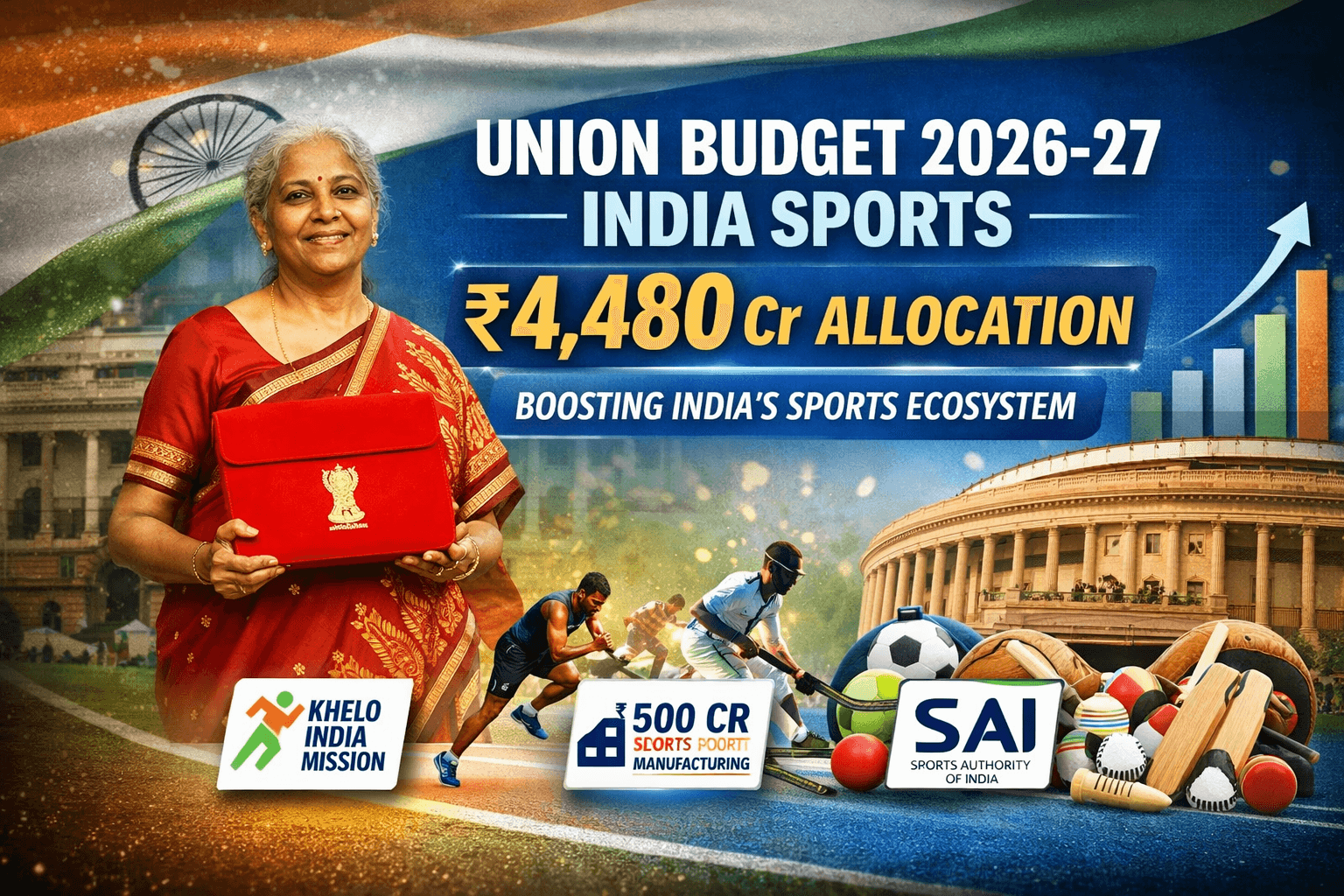
- ₹4,479.88 Cr allocated to the Ministry of Youth Affairs and Sports in Budget 2026-27 — an 18% jump from the previous year’s Budget Estimates and the highest sports budget in India’s history.
- The Khelo India Mission (10-year roadmap) is the headline announcement, with ₹924.35 Cr earmarked and five structural pillars covering talent, coaching, sports science, competitions, and infrastructure.
- ₹500 Cr for sports goods manufacturing is the first-ever dedicated allocation of this kind — positioning India to become a global hub for high-quality, affordable sports equipment.
- One note of caution in the budget: anti-doping allocations have been reduced — both NDTL and NADA see cuts — which deserves attention from India’s sports governance community.
When Finance Minister Nirmala Sitharaman presented the Union Budget 2026-27 on February 1, she made a statement that would have been unthinkable a decade ago: the sports sector, she said, “provides multiple means of employment, skilling and job opportunities.” In most previous budgets, sport was treated as a welfare expenditure. In 2026-27, it has been explicitly reframed as an economic growth driver — and the numbers back that framing.
The Ministry of Youth Affairs and Sports received ₹4,479.88 Crore — the largest sports allocation in India’s history, an 18% increase from the previous year’s Budget Estimates and a ₹1,133 Cr jump from the revised estimates. Five years ago, this number was ₹2,596 Cr. In five years, India’s sports budget has grown over 72%. The direction of travel is unmistakable.
This blog breaks down what each major announcement actually means — for athletes, for leagues, for brands, for the sports manufacturing industry, and for the private sports ecosystem that GSK operates within.
Table of Contents
- The Headline Numbers: Reading the Budget Correctly
- The Khelo India Mission: A 10-Year Structural Shift
- ₹500 Cr for Sports Goods Manufacturing: What It Unlocks
- The Full Budget Breakdown: Where the Money Goes
- What the Budget Does Not Address
- What This Means for the Private Sports Ecosystem
- Frequently Asked Questions
- Conclusion
The Headline Numbers: Reading the Budget Correctly
The ₹4,479.88 Crore figure covers the entire Ministry of Youth Affairs and Sports — not pure sports spend alone. A meaningful share goes to youth affairs programmes like the National Service Scheme (₹357.39 Cr), the Mera Yuva Bharat platform (₹655 Cr, nearly 10x last year), and youth hostels. This context matters: the actual sports-specific outlay is smaller, though still significantly increased.
Within that total, the three largest sports-focused line items are: Khelo India at ₹924.35 Cr, Sports Authority of India (SAI) at ₹917.38 Cr, and the new Sports Goods Manufacturing initiative at ₹500 Cr. National Sports Federations receive ₹425 Cr — a modest increase from ₹400 Cr previously. Commonwealth Games preparation (Glasgow 2026) gets ₹50 Cr, up 78% from ₹28 Cr last year.
The five-year trajectory is the most important data point for understanding the significance of this budget. India’s sports allocation has grown from ₹2,596 Cr in 2021-22 to ₹4,480 Cr in 2026-27 — a 72.6% increase in half a decade, averaging 11.3% annual growth. After a near-stagnant 2023-24 (just 1.32% growth), the government has delivered back-to-back double-digit increases. The 18% jump in 2026-27 is the highest single-year increase in five years.
| Budget Line Item | 2025-26 (RE) | 2026-27 (BE) | Change |
| Ministry Total (MYAS) | ₹3,346.54 Cr | ₹4,479.88 Cr | +₹1,133 Cr (+34%) |
| Khelo India Programme | ~₹750 Cr (est.) | ₹924.35 Cr | Significant increase |
| Sports Authority of India (SAI) | ₹880 Cr | ₹917.38 Cr | +₹37 Cr |
| National Sports Federations (NSFs) | ₹400 Cr | ₹425 Cr | +₹25 Cr |
| Sports Goods Manufacturing | ₹0 (no prior allocation) | ₹500 Cr | First-ever allocation |
| Commonwealth Games (CWG 2026) | ₹28.05 Cr | ₹50 Cr | +₹22 Cr (+78%) |
| Mera Yuva Bharat | ~₹65 Cr | ₹655 Cr | ~10x increase |
| NDTL (Anti-Doping Lab) | ₹28.55 Cr | ₹23 Cr | -₹5.55 Cr (Cut) |
| NADA (Anti-Doping Agency) | ₹24.30 Cr | ₹20.30 Cr | -₹4 Cr (Cut) |
| Sports Science (NCSSR) | ~₹15 Cr | ₹15 Cr | Flat |
| Athlete Awards & Welfare | ~₹40 Cr | ₹40 Cr | Flat |
Sources: Union Budget 2026-27 Demands for Grants (Demand No. 102), Ministry of Youth Affairs and Sports; PIB press release; KPMG Budget Analysis 2026-27.
The Khelo India Mission: A 10-Year Structural Shift
The announcement of the Khelo India Mission is the single most significant structural development in Indian sports policy in at least a decade. The original Khelo India programme, launched in 2017, was primarily a competition-identification platform — find young talent, run youth games, give scholarships. Valuable, but limited in scope.
The Khelo India Mission is a fundamentally different animal. It is a 10-year, end-to-end athlete development framework built on five explicit pillars:
- Integrated talent development pathways — foundational, intermediate, and elite training centres linked into a coherent progression system
- Systematic coach and support staff development — for the first time, coach development gets formal mission-level priority, addressing India’s persistent shortage of qualified coaches below the national level
- Sports science and technology integration — embedding data-driven training, injury management, and performance analytics into the national training system
- Competition and league promotion — expanding structured competitive exposure that bridges the gap between junior success and senior international performance
- Infrastructure development — upgrading and better utilising existing facilities rather than large new construction projects
For the private sports ecosystem, this mission creates a very specific opportunity. The government is building the pipeline infrastructure. What it cannot efficiently provide is the commercial activation layer — the brands, leagues, sponsorships, media rights, merchandise, and athlete management frameworks that convert state-identified athletes into professional sports careers. That is precisely what companies like GSK exist to deliver.
The alignment between the Khelo India Mission’s competition promotion pillar and initiatives like the Chhattisgarh Hockey League is direct. CHL 2026 — India’s first professional state-level franchise hockey league — is exactly the kind of domestic competition structure the Mission aims to proliferate. It provides athletes from Khelo India pathways their first exposure to professional sports environments, which is where government infrastructure ends and private ecosystem investment begins.
₹500 Cr for Sports Goods Manufacturing: What It Unlocks
This allocation has no precedent. In every previous Union Budget, sports goods manufacturing received exactly ₹0 in dedicated central funding. The sector — largely concentrated in Jalandhar, Meerut, and Ludhiana — has historically operated as a collection of MSMEs producing for domestic consumption, with limited innovation investment and significant import dependence for high-performance equipment.
The ₹500 Cr allocation is explicitly framed around research, innovation, equipment design, and material science — not just production subsidies. The Finance Minister specifically mentioned high-strength composites, carbon fibres, and specialised polymers. This signals intent to move India up the sports equipment value chain: from commodity production to performance manufacturing that can compete internationally.
India already exports sports goods worth approximately $546 Mn annually (FY2022), primarily cricket equipment, footballs, and fitness gear. A ₹500 Cr innovation push, combined with the Make in India framework and the domestic demand stimulus from Khelo India, creates a credible pathway to significantly grow that export number while simultaneously reducing the import dependency that limits how many Indian athletes can access world-class training equipment.
For brands active in sports, this allocation matters for a different reason. Domestic sports merchandise — jerseys, fan apparel, training gear — is currently a fragmented, import-heavy, quality-inconsistent space. As manufacturing quality improves and domestic supply chains strengthen, the sports merchandise economics for leagues like CHL 2026 and the broader franchise sports model improve dramatically. GSK’s sports merchandise practice is positioned directly in this evolving supply landscape.
What the Budget Does Not Address: The Anti-Doping Blind Spot
No honest analysis of this budget can avoid its most concerning element. Both India’s anti-doping institutions — the National Dope Testing Laboratory (NDTL) and the National Anti-Doping Agency (NADA) — have had their budgets cut.
NDTL goes from ₹28.55 Cr to ₹23 Cr. NADA goes from ₹24.30 Cr to ₹20.30 Cr. This is happening at the precise moment that India is investing record amounts in athlete development, expanding competitive structures, and preparing for the Commonwealth Games 2026 and the 2028 Olympics. The logic is difficult to reconcile.
KPMG’s budget analysis noted that reduced anti-doping allocations pose a risk to both effective athlete protection and to maintaining India’s credibility in international sport. This is worth tracking carefully. A well-funded talent pipeline that produces athletes who face doping bans due to inadequate education and testing infrastructure would be a self-defeating outcome for the larger mission.
The sports industry — brands, leagues, athlete managers, and sports administrators — has a shared interest in raising this issue. Clean sport is the foundation on which commercial sports value is built. The anti-doping infrastructure is not a peripheral expense; it is a core component of the sports ecosystem’s long-term credibility.
What This Budget Means for the Private Sports Ecosystem
Budgets create policy environments. They do not, on their own, build sports properties, sign sponsorship deals, develop athlete brands, or run leagues. That is the private sector’s role. And in 2026-27, the policy environment for private sports investment in India has never been more favourable.
For Leagues and Event Organisers
The Khelo India Mission’s competition promotion pillar creates an explicit government mandate to proliferate domestic leagues and structured competition. This is institutional momentum that private league operators should align with — seeking government co-investment, VGF mechanisms, and policy support for new properties. CHL 2026’s government VGF model (₹3.5 Cr from Chhattisgarh state) is a template that is now explicitly encouraged at the national level.
For Brands
The combination of record sports budget allocation, a 10-year mission framework, and ₹500 Cr in manufacturing investment signals a government that is treating sports as a serious economic sector. Brands that align their sports marketing investment with this policy direction — through state-level leagues, athlete endorsements in emerging sports, and grassroots activation — will find both commercial opportunity and institutional tailwinds behind their investment.
For Sports Management Companies
The gap between government talent identification and professional career creation is precisely the space that full-service sports management companies occupy. As the Khelo India Mission expands the pipeline of identified and partially-developed athletes, the demand for professional athlete management, career planning, and commercial representation services will grow proportionately. The addressable market for sports management in India is expanding with every rupee of this budget.
Frequently Asked Questions
What is the total sports budget allocation in Union Budget 2026-27?
The Union Budget 2026-27 allocates ₹4,479.88 Crore to the Ministry of Youth Affairs and Sports. This is an 18% increase from the previous year’s Budget Estimates of ₹3,794.30 Cr and a ₹1,133 Cr increase from the revised estimates of ₹3,346.54 Cr. However, this figure covers both sports and youth affairs — the sports-specific allocation includes Khelo India (₹924.35 Cr), SAI (₹917.38 Cr), NSFs (₹425 Cr), and the new sports goods manufacturing initiative (₹500 Cr).
What is the Khelo India Mission announced in Budget 2026-27?
The Khelo India Mission is a 10-year national sports transformation plan, replacing the earlier Khelo India programme which focused primarily on talent identification competitions. The Mission is a comprehensive, end-to-end athlete development framework built on five pillars: integrated talent pathways (foundational to elite training centres), systematic coach development, sports science and technology integration, competition and league promotion, and infrastructure development. It received an allocation of ₹924.35 Cr in 2026-27.
What is the ₹500 Crore sports goods manufacturing allocation for?
This is the first-ever dedicated central budget allocation for sports goods manufacturing in India. The ₹500 Cr is directed at promoting manufacturing, research, and innovation in sports equipment design and material sciences — including high-performance materials like carbon fibres and specialised composites. The goal is to position India as a global hub for high-quality, affordable sports goods, reduce import dependence for athlete training equipment, and support MSME manufacturers in clusters like Jalandhar, Meerut, and Ludhiana.
How does Budget 2026-27 affect private sports leagues and franchise operators?
Positively and significantly. The Khelo India Mission explicitly identifies competition and league promotion as a core pillar, creating institutional support for private leagues that operate within this framework. Government VGF co-funding mechanisms, which CHL 2026 already uses (₹3.5 Cr from Chhattisgarh state), are now more firmly supported by national policy direction. Private league operators who align their structures with Mission outcomes — talent pathways, regional participation, inclusive access — are in a strong position to access co-investment and policy support.
What does the anti-doping budget cut mean for Indian sport?
Both NDTL (National Dope Testing Laboratory) and NADA (National Anti-Doping Agency) have seen budget reductions in 2026-27, to ₹23 Cr and ₹20.30 Cr respectively. This is a concern highlighted by sports analysts including KPMG, who noted it poses risks to athlete protection and India’s international credibility. At a moment when India is scaling up athlete development investment, ensuring robust anti-doping infrastructure is not optional — it is the governance foundation on which all other investment depends.
How does India’s sports budget compare historically?
India’s sports budget has grown significantly over the past five years: from ₹2,596 Cr in 2021-22 to ₹4,480 Cr in 2026-27 — a 72.6% increase averaging 11.3% annually. The 2026-27 increase of 18% is the highest single-year jump since 2021-22 and comes after a near-flat 2023-24 (1.32% growth). For further historical context, the 2004-05 allocation was ₹466 Cr — the 2026-27 figure is nearly 10 times that level in nominal terms.
Conclusion: Policy Commitment, Private Sector Execution
The Union Budget 2026-27 is the most ambitious sports budget India has ever produced — not just because of the headline ₹4,480 Cr figure, but because of the philosophy it encodes. Sport is no longer being funded as a social programme. It is being invested in as an economic sector, a manufacturing opportunity, a talent pipeline, and a vehicle for India’s emergence as a global sporting power by 2036.
The Khelo India Mission creates a 10-year government infrastructure. The ₹500 Cr manufacturing push creates an industrial foundation. The SAI and federation funding sustains the elite pipeline. The Commonwealth Games preparation investment signals ambition on the international stage.
But budgets are intentions, not outcomes. The history of Indian sports policy is littered with well-funded schemes that underperformed on execution. What converts this budget into actual sporting progress — athletes on podiums, leagues in stadiums, brands with meaningful sports connections, manufacturers competing globally — is private sector partnership, professional management, and commercial ecosystem development. That is precisely what GSK is building, match by match and league by league.
Want to capitalise on India’s record sports investment cycle?
GSK helps brands, leagues, and investors navigate India’s sports ecosystem with strategy, structure, and execution. From event management and sponsorship consulting to athlete representation and sports marketing — we do all ten.
Contact: info@globalsportskonnect.com | +91 9873777697
Book a call: https://calendly.com/globalsportskonnect
Explore our services: https://globalsportskonnect.com/services/