
| ⭐ Key Highlights Sheetal Devi, 18, from Kishtwar, J&K: Paralympic bronze medallist (Paris 2024), World Para Archery Champion (Gwangju 2025), Arjuna Awardee — the first and only armless female archer to win both a Paralympic medal and a World Championship titleA single bullseye video at Paris 2024 generated nearly 50 million views on X — organic viral reach most brands spend crores trying to manufactureIndia’s athlete endorsement market hit ₹1,224 Cr in 2024, a 32% YoY surge; non-cricket endorsements grew at 46% YoY — the fastest segment in Indian sports (GroupM Sporting Nation Report 2024)Despite an Arjuna Award, a World Championship gold, a World No. 1 ranking, a KBC appearance alongside Vidya Balan, and a selection for India’s able-bodied national archery team — no major commercial brand has publicly partnered with herThis is not a gap in Sheetal Devi’s marketability. It is a gap in how India’s brand industry thinks about para-athletes — and it is a gap that is closing faster than most marketing departments realise |
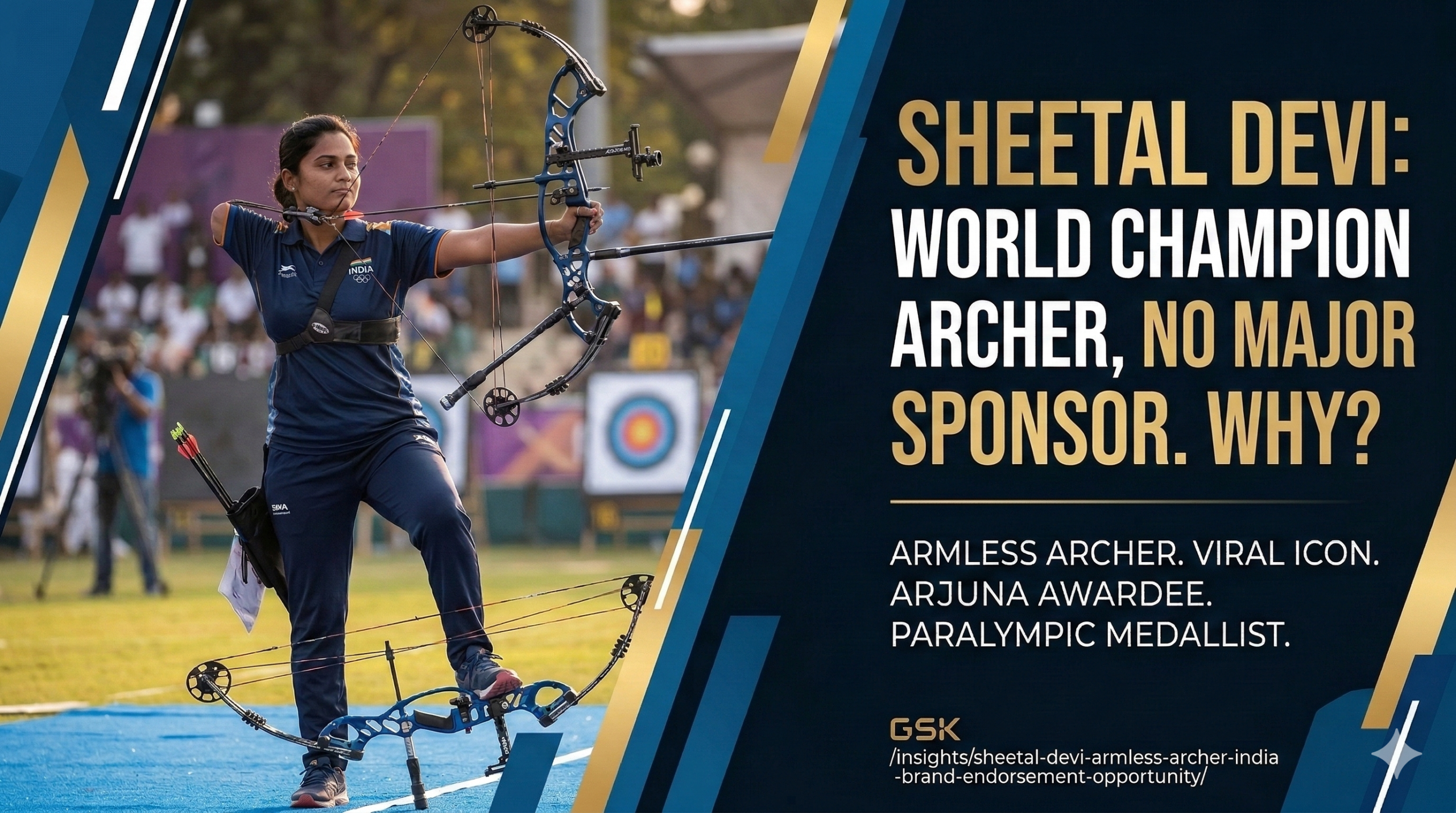
On September 2, 2024, during the 1/8 elimination round of the women’s individual compound archery event at the Paris Paralympics, Sheetal Devi raised her foot, nocked an arrow with her toes, drew the bow using her shoulder and neck, and released a perfect bullseye. The crowd erupted. French footballer Jules Koundé posted about it. Piers Morgan called it extraordinary. The clip went to nearly 50 million views on X within days.
Sheetal Devi was 17 years old. She had been shooting competitively for less than two years. She was born without arms in a village in Kishtwar, Jammu and Kashmir, with a rare congenital condition called phocomelia. She had never seen another armless archer compete before she became one.
She is now 18. She is the World Para Archery Champion. She is a Paralympic bronze medallist. She is an Arjuna Awardee. She has been selected for India’s able-bodied national archery team — the first para-athlete in Indian history to earn that distinction. She has appeared on KBC. She has 50 million organic video views.
She does not have a single major commercial brand partner.
This piece is about why that is. And why it won’t can’t remain true for much longer.
The Record, Stated Plainly
Let us be precise, because precision is what makes this story commercially remarkable. Here is Sheetal Devi’s competitive record, assembled over roughly 36 months of international competition:
| Year / Event | Achievement | Historical Significance |
| 2023 | Asian Para Games, Hangzhou — Individual Gold + Mixed Team Gold + Women’s Doubles Silver | First Indian woman athlete to win 2 gold medals in a single Asian Para Games edition |
| 2023 | World Para Archery Championships — Individual Silver | First female armless archer to win a medal in World Para Championship history |
| Jan 2024 | Arjuna Award — conferred by President Droupadi Murmu | India’s highest sports honour for outstanding achievement over 4 years |
| Sept 2024 | Paris Paralympics — Mixed Team Bronze; World record 703 points in ranking round | India’s youngest-ever Paralympic medallist at age 17; second armless archer in Paralympic history to win a medal |
| Sept 2025 | World Para Archery Championships, Gwangju — Individual Gold + Team Silver + Mixed Team Bronze | First armless woman in history to be crowned World Para Archery Champion; defeated World No.1 Oznur Cure Girdi in the final |
| Nov 2025 | Selected for India’s able-bodied national compound team — Asia Cup, Jeddah | First para-athlete in Indian sports history selected for an able-bodied national team; finished 3rd among 60+ able-bodied archers at national trials |
Sources: Olympics.com, World Archery, Wikipedia, The Logical Indian, November 2025
50 Million Views. Zero Major Brand Partner. Do the Math.
Brands spend enormous sums engineering reach. Social media campaigns are planned for months, tested across audiences, and optimised through multiple creative iterations to break through. A 50 million view clip on X organic, unsolicited, generated by the act of being extraordinary — is not a marketing asset that money can reliably replicate.
The Paris 2024 viral bullseye was not a campaign. It was not a PR push. It was an 18-year-old girl from a village in Kishtwar shooting a perfect bullseye at the Paralympics with her foot, on the world’s biggest stage, and the world deciding spontaneously, globally that it needed to watch.
| ~50M Views on X — single Paris 2024 bullseye clip Source: Today.com / World Archery, Sept 2024 | ₹1,224 Cr India athlete endorsement market, 2024 — 32% YoY growth Source: GroupM Sporting Nation Report 2024 |
In the same fortnight as Paris, Indian brands moved swiftly to endorse Manu Bhaker (shooting, double bronze medallist), Neeraj Chopra (javelin, silver medallist), and a wave of other Olympic achievers. Non-cricket endorsements grew 46% year-on-year in 2024 — the fastest growth segment in Indian sports (GroupM, 2024). The Olympics genuinely moved the commercial needle on non-cricket athletes.
Sheetal Devi was at the same Games. She won a medal. She generated more viral organic attention than arguably any other Indian athlete in Paris. And the brand enquiries the ones that should have flooded in did not arrive at anywhere near the scale her achievement warranted.
| 🪞 The Mirror Test for Every Brand Marketing Director Take Sheetal Devi’s CV Paralympic medal, World Championship gold, Arjuna Award, 50 million views, KBC appearance, national able-bodied team selection, age 18 and replace her name with a hypothetical cricket or football player with identical commercial indicators. Would that athlete be unsponsored? The answer tells you everything about the para-athlete commercial bias that still exists in India’s brand industry. |
Why Indian Brands Still Undervalue Para-Athletes And Why That Logic Is Failing
The commercial bias against para-athletes in Indian endorsement culture has three pillars. All three are collapsing.
Pillar 1: ‘Para-sport doesn’t have a large enough audience’
This was true five years ago. It is demonstrably false today. India’s Paris 2024 Paralympic coverage on JioStar generated record viewership for para-sports in India. The Paralympics’ own broadcast data showed sustained engagement across Indian digital platforms throughout the Games. Sheetal Devi’s individual viral moment aside, Indian viewership of the Paralympic archery events was categorically higher than any prior Games. The audience is there. The argument that it isn’t is outdated by at least two Paralympic cycles.
Pillar 2: ‘Para-athletes don’t have mainstream cultural visibility’
Sheetal Devi appeared on the 100th episode of Kaun Banega Crorepati alongside Bollywood star Vidya Balan and announced, on national television, that her dream was to compete alongside able-bodied archers. She then went and did exactly that — making national headlines in November 2025. Her story has been carried by Times of India, NDTV, the BBC, Time magazine, TODAY (NBC), and every major Indian sports outlet. The ‘no mainstream visibility’ argument does not apply to Sheetal Devi.
Pillar 3: ‘Para-athlete partnerships don’t deliver ROI’
The ROI argument against para-athlete partnerships rests on engagement data that no longer reflects reality and never reflected the specific case of a viral para-athlete with a genuinely extraordinary story. Female athlete sponsored posts generate 2.8 times the engagement of male equivalents per follower (Nielsen Sports). Athletes with genuine origin narratives — real struggle, real geography, real identity — consistently outperform aspirational celebrities on brand recall studies. Sheetal Devi has all of this simultaneously: female, para-athlete, J&K origin, Army discovery story, global viral moment, youngest Paralympic medallist, World Champion. The ROI case is not weaker than a typical cricket endorsement. For the right brand category, it is stronger.
The Commercial Case: Which Brand Categories Should Move First
Sheetal Devi’s story maps to specific brand categories with exceptional precision. The brands that understand this first capture category exclusivity at pre-fame pricing the single most valuable position in sports marketing. Here is the category-by-category case:
| Brand Category | Why Sheetal Devi Fits | Specific Campaign Territory |
| Insurance & Financial Services | Her story embodies resilience against uncertainty — the core emotional territory of insurance. Born without arms in a remote village; now World Champion. The narrative arc writes itself. | ‘Every risk is worth taking when you have the right cover’ — human truth anchored in an extraordinary life |
| Sportswear & Footwear | She shoots with her feet. Literally. A sportswear or footwear brand whose athlete wins world championships using the product’s core category is a creative and commercial gift. | The most literal possible product-athlete connection in Indian sports marketing |
| FMCG / Nutrition | Strength, discipline, physical performance from a non-standard body — the nutrition brand narrative that goes beyond ‘fuel your workout’ into something genuinely human | Body-positive performance story; reaches J&K, tier-2 and rural India authentically |
| Government / PSU / Banking | Arjuna Award, Indian Army backing, J&K origin the national pride narrative is already established. A PSU bank or insurance company investing in Sheetal Devi is investing in a symbol of sovereign India. | Khelo India, Viksit Bharat, national development messaging — perfect brand-cause alignment |
| Education Technology | Born in a remote village; educated under Army initiative; self-taught a world-class skill. The ed-tech story of ‘learning changes everything’ has no better living proof. | Rural India aspiration; 600 million digital learners; authentic non-metro origin story |
| Disability & Accessibility Brands | The obvious category. An athlete who competes at Olympic and world standard despite the absence of arms is the most credible voice in India for any product or service in the accessibility space. | Global scope: this campaign travels to every country with a disability advocacy community |
Framework: GSK Sports Management analysis, March 2026
| “She is the future of the sport.” Matt Stutzman American armless archer, Paris 2024 Paralympic Gold Medallist, and the athlete whose technique Sheetal learned to shoot |
The Window Is Closing. Here Is When.
Sheetal Devi is 18 years old. She has already been selected for able-bodied international competition. The LA 2028 Olympics includes archery as a confirmed event and while para archery operates on its own track, Sheetal’s selection for India’s able-bodied junior compound team signals that the conversation about her potential able-bodied Olympic qualification is no longer hypothetical. It is a live discussion in Indian archery administration.
Her idol — the Turkish archer Oznur Cure Girdi, whom she defeated in the 2025 World Championship final — competes in both para and able-bodied events internationally. Sheetal has stated publicly that this is her ambition. If she achieves it — an Indian armless archer competing at the able-bodied Olympics — the commercial story becomes a once-in-a-generation narrative that every brand in India will want access to.
The brands that sign her before that moment buy access at today’s prices. The brands that wait will compete in an auction environment where an Olympic-qualified armless World Champion archer from J&K will command a very different commercial valuation than she does right now.
| ⏱️ The Manu Bhaker Comparison — And What It Teaches Before Paris 2024, Manu Bhaker was a decorated shooter with limited mainstream brand presence. After Paris — double bronze medal, viral celebration moments — brands moved within weeks. The ‘post-achievement rush’ drove up her endorsement value significantly. Sheetal Devi already has a World Championship gold and a Paralympic medal on her CV. The brands that waited for ‘the next big moment’ before signing Manu are making the same calculation about Sheetal. The next big moment for Sheetal Devi may be an able-bodied Olympic appearance. At that point, the waiting strategy will have cost those brands dearly. |
Frequently Asked Questions
Q: Who is Sheetal Devi and what has she achieved?
Sheetal Devi is an 18-year-old para-archer from Kishtwar, Jammu and Kashmir, born with phocomelia — a rare congenital condition that resulted in the absence of arms. She shoots using her feet, legs, and shoulder. In roughly three years of international competition, she has won: two gold medals at the 2023 Asian Para Games, a silver medal at the 2023 World Para Championships (first female armless archer to medal), a bronze at the Paris 2024 Paralympics (India’s youngest-ever Paralympic medallist at 17), and a gold medal at the 2025 World Para Archery Championships — making her the first armless woman ever to be crowned world champion in archery. She is also an Arjuna Awardee and the first para-athlete selected for India’s able-bodied national archery team.
Q: Why is Sheetal Devi commercially significant for brands?
Sheetal Devi combines multiple commercial signal strengths rarely found in a single athlete: a globally viral moment (approximately 50 million views from a single Paris 2024 clip), a World Championship title, a Paralympic medal, an Arjuna Award, a KBC appearance, an origin story from a remote J&K village, Indian Army backing, age 18 with a decade-long career ahead, and a historic selection for India’s able-bodied team. She reaches rural India authentically, resonates globally on disability inclusion messaging, and is — unusually — available before the commercial market has priced in her full value.
Q: What brand categories are the best fit for a Sheetal Devi partnership?
The strongest category fits are: insurance and financial services (resilience narrative), sportswear and footwear (she shoots with her feet — an extraordinary literal fit), FMCG and nutrition (strength from a non-standard body), PSU/government brands (national pride, J&K, Arjuna Award), education technology (village origin, Army-supported learning), and disability and accessibility brands (the most credible possible ambassador). Each category has access to a distinct narrative territory that Sheetal’s story occupies uniquely.
Q: What is phocomelia and how does it affect Sheetal Devi’s archery?
Phocomelia is a rare congenital condition resulting in underdeveloped or absent limbs. Sheetal was born without arms. Her shooting technique — nocking arrows with her toes, drawing the bow using her shoulder and neck — was developed under coaches Kuldeep Vedwan and Gaurav Sharma, inspired by American armless archer Matt Stutzman’s pioneering methodology. The technique requires extraordinary core strength, balance, and precision. Her 703-point ranking round score at Paris 2024 broke the world record in her category at the time.
Q: How can brands or organisations explore a Sheetal Devi partnership through GSK?
GSK’s athlete management and sponsorship services cover brand-athlete matchmaking, partnership structuring, campaign development, and long-term career management for emerging and established athletes across Indian sports. For brands exploring partnerships with Sheetal Devi or athletes with comparable profile in para-sports, non-cricket sports, or women’s sports, GSK offers the commercial framework and industry relationships to structure meaningful, measurable partnerships. Contact info@globalsportskonnect.com or visit globalsportskonnect.com/services/athlete-representation/ for an introductory conversation.
The Conclusion
There is a teenager from a village in Kishtwar who was born without arms, taught herself to shoot arrows with her feet, became the World Champion, went viral in Paris, won the Arjuna Award, appeared on national television, and then competed — and placed third — against sixty able-bodied archers to earn her spot on India’s national team.
India’s brands looked at all of that and largely did not act.
The question this piece started with why has no major brand signed her? has no satisfying answer. The commercial case for Sheetal Devi is stronger today than it was the morning after Paris, and it will be stronger still the morning after Los Angeles. The only variable is which brand category leaders decide to move first and which ones explain, in a boardroom in 2029, why they waited.
GSK believes the sports management industry has a responsibility to close this gap — not just by advocating for para-athletes in conversation, but by building the frameworks that make it commercially straightforward for brands to invest. Sheetal Devi is not a charity case. She is an asset that the Indian endorsement market has systematically underpriced. That is a commercial observation, not just a moral one.
| 📞 Athlete representation, brand-athlete partnership structuring, para-sports marketing | globalsportskonnect.com/services/athlete-representation/ | globalsportskonnect.com/contact | info@globalsportskonnect.com | +91 9873777697 | calendly.com/globalsportskonnect |