
By Global Sports Konnect (GSK) | February 2026
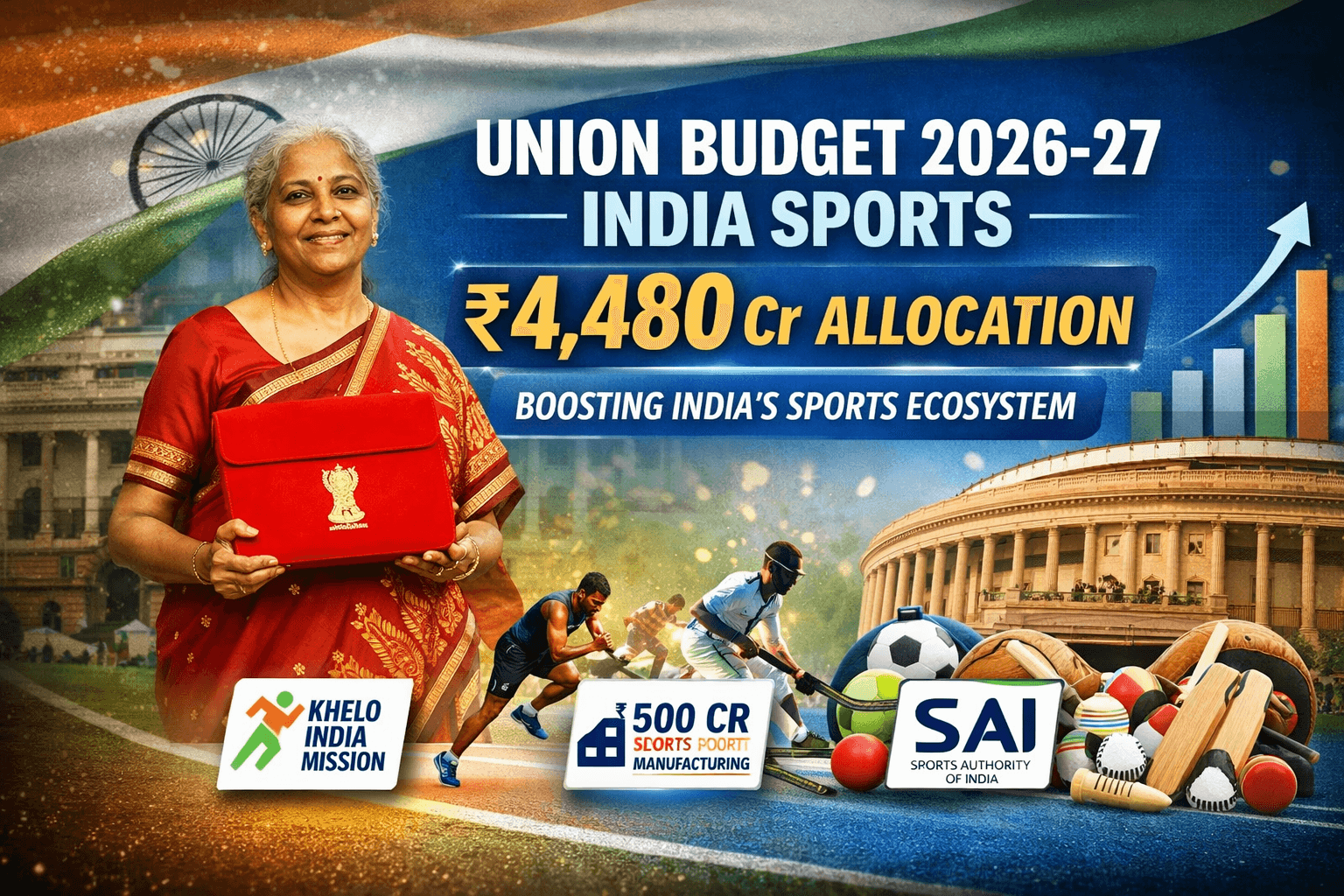
| KEY HIGHLIGHTS India’s Union Budget 2026-27 allocated ₹4,479.88 crore to the Ministry of Youth Affairs and Sports an 18% increase year-on-year and the highest absolute budget jump in five years anchored by the newly launched Khelo India Mission, a 10-year programme designed to create end-to-end development pathways from grassroots talent identification to Olympic-level performance.The Khelo India programme has already approved 326 sports infrastructure projects worth ₹3,124 crore, established 1,045 Khelo India Centres (KICs) across India, and accredited 306 academies making this the single most favourable policy environment for private sports academy development India has ever seen, with government co-funding, talent pipeline linkages, and competition infrastructure available to qualifying private partners.Private commercial sports academies in India now attract 18% GST on coaching services, making legal structure, pricing strategy, and operational model decisions at founding stage more consequential than ever a charitable trust structure can access GST exemption on training fees, while a for-profit entity must price its revenue model accordingly.The most common reason sports academies fail in India is not poor coaching — it is the absence of a structured talent pathway from beginner intake through to competitive placement, combined with over-reliance on a single revenue stream (monthly fees) that collapses during school holidays, exam seasons, and off-peak months. A sustainable academy requires at least three distinct revenue pillars from Day 1. |
Why 2026 Is the Best Time in Indian History to Build a Sports Academy
India has always produced exceptional sporting talent. What it has historically lacked is the infrastructure to find that talent, develop it systematically, and convert raw potential into competitive performance at national and international levels. That gap is now being closed — rapidly, deliberately, and with serious public money behind it.
The Union Budget 2026-27 launched the Khelo India Mission as a 10-year programme, allocating ₹4,479.88 crore to the Ministry of Youth Affairs and Sports — an 18% increase on the previous year, and the largest absolute budget jump in five years. The government has approved 326 sports infrastructure projects worth ₹3,124 crore, established 1,045 Khelo India Centres across India, and accredited 306 private and institutional academies into the national ecosystem. Finance Minister Nirmala Sitharaman explicitly positioned sports as a pillar of India’s economic development agenda, linking talent development to employment generation, manufacturing, and the country’s 2036 Olympic hosting bid.
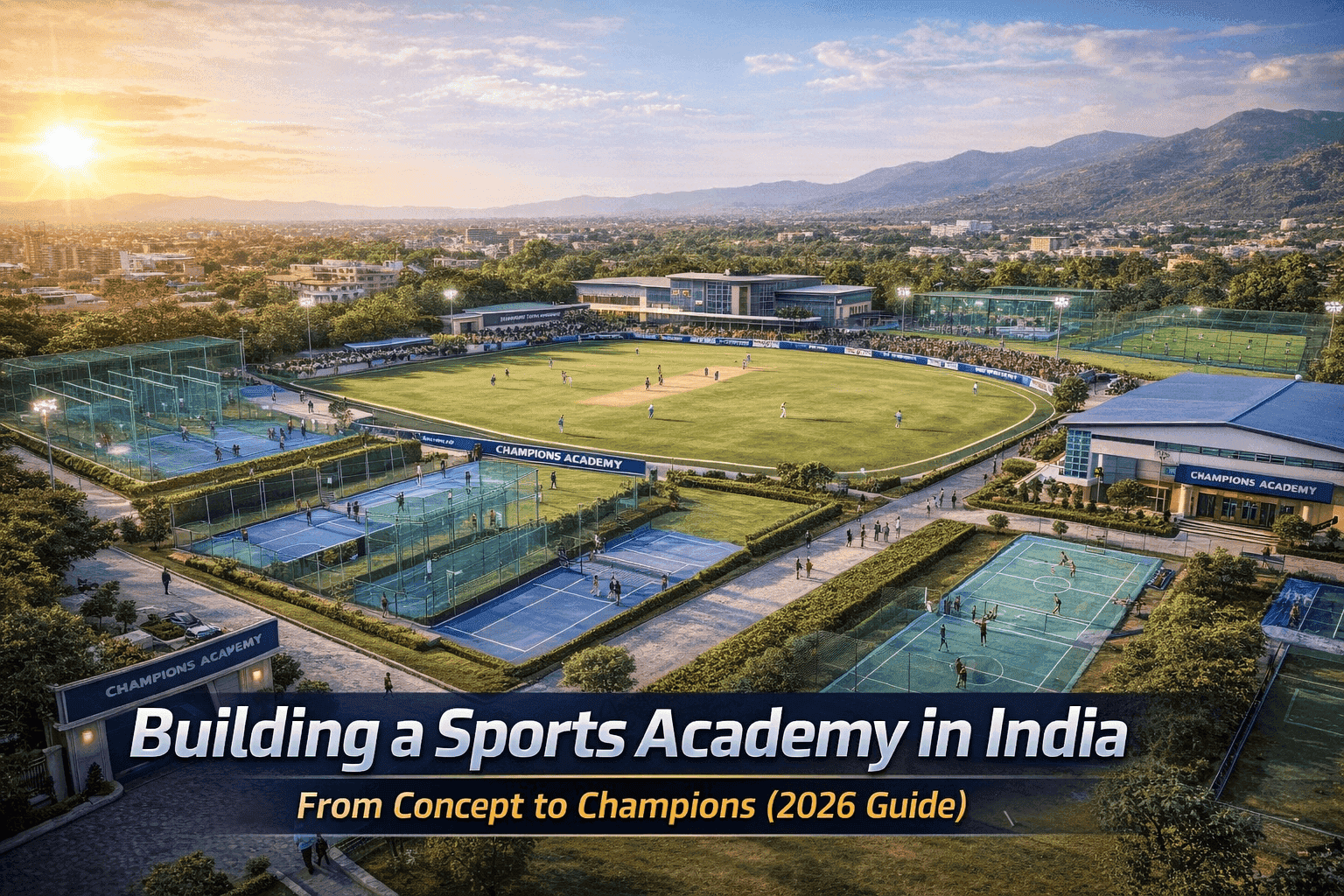
For anyone seriously considering building a sports academy in India — whether you are a former athlete, an educational institution, a corporate CSR department, a state government, or a private investor — 2026 represents a policy and market alignment that has never existed before. This guide covers everything: sport selection, land and infrastructure planning, coaching system design, legal structure, government funding access, revenue modelling, and the specific mistakes that cause most Indian sports academies to stall before they produce a single champion.
The Market Opportunity: Why Sports Academy Demand Is Outpacing Supply
A Country of 65% Youth with Nowhere Near Enough Quality Training Infrastructure
India’s population is 65% under the age of 35. The country has over 250 million children in the 6-17 age bracket — the primary demographic for structured sports development. Against this demand, the Sports Authority of India (SAI) operates just 12 regional centres, 23 national centres of excellence, and 67 sports training centres nationally. Even with the 1,045 Khelo India Centres added under the Khelo India programme, the ratio of quality training infrastructure to youth population is dramatically insufficient. The demand gap is not a niche business opportunity — it is a structural deficit of national scale.
Cricket academies remain the most commercially mature segment, with top urban academies charging ₹3,000-50,000 per month in fees depending on tier and location. Football is the fastest-growing sport by academy development, with clubs like Barça Academy India, Reliance Foundation Young Champs, and Tata Football Academy establishing premium benchmarks. Badminton, basketball, hockey, and tennis are all experiencing surging enrolment demand as India’s success in these sports at international level — Paris 2024 hockey bronze, multiple Commonwealth medals in badminton and shooting — inspires the next generation of aspirants.
The Government Tailwind: Khelo India Mission Changes the Economics
The launch of the Khelo India Mission as a 10-year programme fundamentally changes the economics of private sports academy development. Where previously a private academy operator had to self-fund all infrastructure, coaching, and competition exposure, the Khelo India framework now offers structured co-funding pathways for qualifying academies. Accredited Khelo India Centres receive government support for coaching staff, equipment, and athlete stipends. Khelo India Athletes (KIAs) — of whom 2,845 are currently supported nationally — bring their per-athlete funding from the government to whichever accredited facility trains them.
The new Khelo India Mission explicitly positions private academies as ecosystem partners, not competitors to government infrastructure. The five pillars of the Mission — talent identification, coach development, sports science integration, competition infrastructure, and facility development — create co-investment opportunities at every stage of the academy development lifecycle. For a private academy builder, the question is no longer whether the government will support sports development; it is how to structure your academy to access that support most effectively.
The Eight-Stage Framework: Building a Sports Academy from Concept to Operations
Stage 1: Sport Selection and Market Positioning
The single most consequential decision in academy development is sport selection — and in India, it is a decision most founders get wrong by defaulting to cricket without properly analysing their specific market, geography, and competitive landscape.
Cricket academies are the most populated segment in Indian sports academy development, which means competitive differentiation is hardest, coaching talent is most expensive, and the pathway to producing nationally recognised talent (essential for reputation-building) is longest. Non-cricket sports — football, badminton, hockey, wrestling, boxing, athletics, shooting — have dramatically lower competitive density among academies, clearer government funding pathways, and in many cases stronger talent supply from Tier 2 and Tier 3 cities and rural areas. The Khelo India Mission’s ‘One State-One Sports’ framework further incentivises state governments to co-fund academies in their identified priority sport — making sport selection partly a function of where you are building.
Multi-sport models minimise seasonal revenue gaps and occupy facility infrastructure more efficiently across the calendar year. An academy that runs cricket in winter, football in monsoon, and indoor sports like badminton and basketball year-round generates more consistent revenue and builds a broader talent pipeline than a single-sport facility. GSK’s academy design philosophy consistently recommends a primary sport with 2-3 supplementary sports, sized to the facility and local demographics.
Stage 2: Legal Structure — The Decision That Affects Everything Else
India’s GST framework creates a consequential legal structure decision at the academy founding stage. Private commercial sports academies attract 18% GST on coaching services. Academies registered as charitable trusts or non-profit entities are exempt from GST on training fees — a significant competitive advantage in fee-sensitive Tier 2 and Tier 3 markets. The trade-off is that charitable trust structures restrict profit distribution and impose audit and governance requirements that some founders find constraining.
The three most common legal structures for Indian sports academies are: a private limited company (full commercial flexibility, 18% GST on fees, access to external investment), a Section 8 company (non-profit company structure, GST exemption potential, corporate governance standards), and a charitable trust or society (GST exemption on training services, eligibility for FCRA foreign funding, required for some government grant categories). Legal counsel specific to sports and education organisations is essential at this stage — the choice made at incorporation cannot be easily reversed and has 5-10 year financial consequences.
Stage 3: Land, Location, and Infrastructure Planning
Land is the largest single cost and the longest-lead-time decision in academy development. The practical options in India are outright purchase, long-term lease from state or municipal authorities, partnership with educational institutions (schools and colleges often have underutilised sports grounds), and PPP (public-private partnership) arrangements with sports departments. The Khelo India Scheme specifically encourages PPP models and offers viability gap funding for private partners working with government sports infrastructure — a mechanism GSK has used directly in the CHL 2026 framework for Raipur, where the Chhattisgarh government’s VGF contribution (₹3.5 Crore) made the event’s infrastructure economics viable.
Infrastructure requirements depend on sport and scale, but every viable academy needs at minimum: regulation-standard playing surfaces (sport-specific, certified where international standards apply — FIH-approved turf for hockey, ITF sand base specification for clay courts, etc.); a fitness and strength-conditioning space; a physiotherapy and recovery area; changing facilities with adequate capacity for peak enrolment periods; a coaching and video analysis classroom; administration office space; and parking with spectator gallery capacity for hosting matches and trials. Phased infrastructure investment — building core facilities first and adding supplementary elements as revenue stabilises — is almost always smarter than attempting a complete build before the first student enrolls.
Stage 4: Building the Coaching System
Coaching quality is the primary driver of academy reputation — and in India, coaching quality is the resource most often compromised in the name of cost reduction. An academy that cuts corners on coaching staff typically stagnates within 18 months: initial enrolment grows on the strength of marketing and facilities, but retention collapses when parents and athletes recognise that development is not actually happening at the rate promised.
A sustainable coaching system requires three layers. The head coach (or performance director in a multi-sport model) must have verifiable national or international competitive credentials, ideally with formal coaching certification from the relevant national federation or SAI-recognised programmes. The supporting coaching staff can be at an earlier career stage but must be on a structured education pathway — attending coaching clinics, pursuing Level 1/2/3 certification, being formally mentored by the head coach. The third layer is sports science support: a physiotherapist (either in-house or on a retained services basis), a nutritionist (full-time above 100 enrolled athletes, part-time below), and access to a sports psychologist for performance conditioning work.
The Khelo India Mission’s coach development pillar specifically funds certified coaching appointments at accredited centres. Aligning your coaching staff certification programme with the accreditation requirements is both a quality standard and a direct cost-reduction mechanism — the government funds a portion of certified coaching appointments at qualifying facilities.
Stage 5: Talent Identification and Intake Systems
The quality of your intake system determines the quality of your athletes — and the quality of your athletes determines the national results that build your academy’s reputation. A talent identification system is not simply an open tryout. It is a structured, repeatable process for assessing physical potential, sport-specific movement patterns, coachability, and character against age-appropriate benchmarks.
For academies targeting national competition pipeline (the highest-value reputation segment), talent identification should extend beyond the immediate city. GSK’s CHL 2026 talent hunt model — scouting across all 33 districts of Chhattisgarh with 5-6 zonal finals feeding into a central selection — is a replicable template for any state-level academy serious about building a genuine talent pipeline rather than simply enrolling students who can afford fees. Khelo India’s annual Youth Games create ready-made talent identification opportunities: athletes who perform at district and state level in KIYG are pre-validated prospects who your academy can target proactively.
Intake structure matters too. Most successful Indian sports academies operate a three-tier intake system: beginner batches (foundational skills, maximum enrolment volume, primary fee revenue source), development batches (intermediate athletes showing measurable progress, selective admission), and elite/residential batches (scholarship or subsidised places for highest-potential athletes who will represent the academy at state and national level). All three tiers are financially important: beginner batches fund the operation; elite batches produce the results that justify the beginner batch fees.
Stage 6: Competition Calendar and Pathway Design
An athlete who trains without competing stagnates. An academy that does not put athletes into competition has no performance data to validate its coaching system and no results to build its reputation. Designing a structured competition calendar — from internal academy leagues at beginner level through to state championships and national qualifiers at elite level — is as important as designing the training programme itself.
In 2026, the competition infrastructure available to Indian academies has never been richer. Khelo India Youth Games, Khelo India University Games, Khelo India Para Games, and sport-specific national federation competitions create a year-round calendar that a well-organised academy can fully exploit. Associations with state sports departments — often formalised through MOU agreements — open access to state trial pathways that can fast-track your athletes toward national selection consideration. The academy’s role is not to host all competition internally; it is to map the external competition calendar and position athletes optimally within it.
Stage 7: Revenue Model — Never Rely on a Single Stream
The most common financial failure mode for Indian sports academies is structural: 100% dependence on monthly coaching fees from enrolled students, with no alternative revenue in holiday periods, examination seasons, or economic downturns when parents deprioritise discretionary spending. A sustainable academy revenue model requires at least three distinct income streams from the first year of operations.
Coaching fees remain the core revenue driver — typically ₹3,000-15,000 per student per month for non-residential programmes, ₹8,000-25,000 for residential programmes, depending on sport, city tier, and facility quality. Beyond coaching fees, the six most viable supplementary revenue streams for Indian sports academies are: residential programmes and vacation camps (high per-student revenue, utilise infrastructure during school holidays); facility rental to clubs, corporate groups, and other sports organisations during off-training hours; branded merchandise (jerseys, training kit, branded equipment — builds academy identity and generates 30-40% margin revenue); tournament hosting (district and state-level events generate gate receipts, sponsorship, and hospitality revenue); corporate CSR partnerships (companies with Chhattisgarh, rural, or tribal development mandates are natural academy sponsors under CSR compliance frameworks); and government grants and stipend income (accredited Khelo India Centres receive direct government co-funding for athlete support, coaching staff, and equipment).
Stage 8: Measurement, Reputation, and Scaling
An academy’s reputation is built on one thing: the careers it produces. Every athlete who represents your academy at a state championship, earns a Khelo India scholarship, gets selected for a national junior camp, or signs a professional contract is a living endorsement that no marketing budget can replicate. Systematic tracking of athlete outcomes — not just at the academy stage but for years after alumni leave — is the performance data that justifies fee premiums, attracts coaching talent, and draws government partnership interest.
Scaling a sports academy in India requires a decision at the outset: will this be a single flagship facility or a multi-location model? The franchise model — licensing your curriculum, coaching system, and brand to operators in new locations — is the fastest-growing scaling mechanism in Indian sports academy development. It requires a documented, transferable coaching system, a quality assurance framework, and a brand strong enough to command a franchise fee. An academy that has not systematically documented its own processes cannot franchise successfully. Building the documentation discipline from Day 1 — training manuals, assessment frameworks, coach education syllabi — is both an operational best practice and the foundation of eventual franchise value.
Sports Academy Investment: Indicative Cost and Revenue Reference (India 2026)
| Cost/Revenue Element | Entry Scale (50-100 students) | Growth Scale (200-500 students) | Notes |
| Land (long-term lease, urban) | ₹5-15L/year | ₹20-40L/year | PPP/school partnership reduces or eliminates this cost |
| Infrastructure: Playing Surfaces | ₹20-60L (capex) | ₹80L-2Cr (capex) | Depends on sport; FIH turf, cricket nets, multi-court flooring |
| Infrastructure: Support Facilities | ₹10-25L (capex) | ₹30-80L (capex) | Gym, physio room, changing rooms, admin office, classroom |
| Head Coach (annual salary) | ₹6-18L/year | ₹15-40L/year | National-level credentials; higher for Olympic sports specialists |
| Support Coaching Staff | ₹8-20L/year (2-4 coaches) | ₹25-60L/year (5-12 coaches) | Scaled to enrolled batch sizes |
| Sports Science (physio + nutrition) | ₹3-8L/year (part-time) | ₹10-24L/year (in-house) | Part-time viable below 150 athletes |
| Equipment and Consumables | ₹3-8L/year | ₹12-25L/year | Annual replacement budget; varies by sport |
| Marketing and Admissions | ₹2-5L/year | ₹5-15L/year | Digital, school outreach, tournament presence |
| Administration and Operations | ₹4-10L/year | ₹12-28L/year | Staff, insurance, utilities, maintenance |
| TOTAL ANNUAL OPEX (indicative) | ₹26-74L/year | ₹79-2.32Cr/year | Excluding debt service on infrastructure capex |
| Coaching Fee Revenue (indicative) | ₹30-90L/year | ₹1.5-5Cr/year | At ₹5,000-15,000/student/month |
| Supplementary Revenue Potential | ₹5-15L/year | ₹25-80L/year | Camps, rental, tournaments, merchandise, CSR |
| Khelo India Accreditation Support | Reduces capex and coaching costs | Reduces capex and coaching costs | Subject to accreditation qualifying criteria |
Note: All figures are indicative estimates for planning purposes. Actual costs vary significantly by city tier, sport, land model, and facility specification. A detailed project report (DPR) prepared by qualified professionals is essential before committing capital to infrastructure investment.
Accessing Government Funding: Khelo India and the Accreditation Pathway
What the Khelo India Mission Actually Offers Private Academies
The Khelo India Mission’s five pillars — talent, coaches, sports science, competitions, and infrastructure — each carry funding mechanisms that private academy operators can access. Infrastructure co-funding under the Khelo India Scheme covers creation and upgradation of sports facilities, with grant amounts determined by the Project Approval Committee based on a detailed project report. Recent infrastructure project announcements by the Ministry of Youth Affairs and Sports — including ₹120 crore in projects announced in early 2026 — confirm that the capital is flowing, not merely promised.
The Khelo India Athlete (KIA) scheme is particularly valuable for residential academies. Each KIA brings a government stipend covering boarding, education, equipment, and competition travel — meaning a residential academy that can attract and retain KIA designations for its top athletes has a meaningful portion of its elite programme costs subsidised directly. The 2,845 KIAs currently supported nationally represent a talent pool that private academies with the right infrastructure, coaching credentials, and Khelo India accreditation can compete to host and develop.
The Accreditation Process: What It Requires and Why It Is Worth It
Khelo India Academy accreditation (306 academies are currently accredited) requires meeting standards across five dimensions: facility quality (compliant with national federation specifications for the relevant sport), coaching qualifications (certified head coach with national federation recognition, structured staff education programme), athlete welfare (insurance, nutrition, healthcare, and accommodation standards for residential athletes), competition participation (documented history of athletes competing at district, state, or national level), and governance (transparent financial management, athlete registration with state sports body, and regular reporting to SAI/Ministry).
The accreditation process is not instant — typically 6-18 months from initial application to formal recognition, depending on facility readiness and documentation quality. However, the downstream benefits are substantial: access to KIA stipends, government equipment grants, inclusion in the Khelo India competition pipeline, and the credibility signal that government recognition provides to parents, athletes, and institutional partners. For any academy with national competition ambitions, accreditation is not optional — it is the architecture that makes the rest of the ecosystem accessible.
Why Most Sports Academies in India Fail: The Eight Critical Mistakes
| Mistake | What Goes Wrong | What to Do Instead |
| No talent pathway beyond coaching | Students improve but have nowhere to go — no competition, no selection, no career connection | Design a structured pathway from beginner intake to state competition before opening |
| Single revenue stream (fees only) | Revenue collapses during school exams, holidays, and economic downturns | Build 3+ revenue streams: fees + camps + facility rental + merchandise minimum |
| Under-investing in coaching quality | Technical progress stalls; retention falls; reputation never builds beyond local | Hire one exceptional head coach before hiring three average ones |
| Wrong legal structure for the market | Commercial structure in a fee-sensitive Tier 2 market loses on price to non-profit competitors indefinitely | Match legal structure to market: non-profit/trust for fee-sensitive markets, company for premium urban markets |
| Building full infrastructure before validating demand | ₹1-3 Cr invested in a facility that then enrols 30 students instead of 200 | Lease or partner for Year 1; build owned infrastructure only after demand is validated |
| No data tracking or athlete outcome measurement | Cannot demonstrate results; loses accreditation eligibility; alumni network has no pride anchor | Track every athlete from intake: assessments, competition results, selection milestones, post-academy careers |
| Ignoring Khelo India accreditation | Competes without government co-funding, KIA stipends, or competition infrastructure access | Begin accreditation process in Year 1 — it takes 6-18 months but changes the financial model fundamentally |
| Founder-dependent operations | Academy functions when the founder is present and struggles when they are not | Document every system, training curriculum, and coaching protocol; build for institutional continuity from Day 1 |
How GSK Approaches Academy Design and Grassroots Development
GSK’s academy and grassroots development work is built on a principle that sounds simple but is rarely executed: a sports academy is not a coaching service — it is an athlete pathway system. The difference between these two framings determines almost every decision that follows.
A coaching service asks: who can we teach, and what will they pay? An athlete pathway system asks: where do we want athletes to be in 2 years, 5 years, and 10 years — and what does every element of the programme need to look like for that outcome to happen at scale? The former builds a stable local business. The latter builds the institutions that produce national champions and state-level sporting cultures.
In our work on the CHL 2026 hockey league, GSK designed the talent identification process — a zonal hunt across all 33 districts of Chhattisgarh — as the grassroots foundation of a league that is also simultaneously the apex competitive event. The athletes who enter through the talent hunt pathway are connected, through the league structure, to professional contracts, broadcast exposure, and the kind of visible competitive career that inspires the next cohort of young athletes in the state to begin training seriously. This is what a genuine athlete pathway looks like: every element connected, no dead ends, no talent wasted.
GSK’s academy design services cover the full development lifecycle — from initial concept and feasibility assessment through facility planning (including DPR preparation for government funding applications), coaching system design, talent identification programme creation, competition calendar development, and operational systems documentation. We bring the same integrated approach to academy development that we apply across all ten of our service pillars: every element of the programme connected, with measurable outcomes at every stage.
Frequently Asked Questions
How much does it cost to build a sports academy in India?
The investment required depends heavily on scale, sport, location, and land model. A lean entry-scale academy serving 50-100 students can be operational for a total first-year investment of ₹30-90 Lakhs including infrastructure capex and annual operating costs, particularly if land is secured through a lease or institutional partnership rather than outright purchase. A full-scale residential academy with 200-500 athletes requires ₹1-4 Crore in infrastructure capex plus ₹80 Lakh-2.3 Crore in annual operating expenditure. PPP arrangements with state governments, Khelo India infrastructure co-funding, and CSR partnerships from corporate sponsors can significantly reduce the private capital requirement. A detailed project report (DPR) is essential before committing capital.
What sports should I choose for an academy in India in 2026?
Cricket is the most commercially mature but most competitive academy segment — differentiation is hardest and coaching talent most expensive. The highest-opportunity sports for academy development in 2026 are football (fastest-growing academy segment nationally), badminton (proven commercial model in urban markets with rapid Tier 2 expansion), hockey (strong government support, CHL-type league development creating professional pathway demand), wrestling and boxing (deep rural talent supply, strong government funding through SAI), and athletics (fastest-growing Olympic medal sport, clear pathway from Khelo India to national competition). Multi-sport models — primary sport plus 2-3 supplementary disciplines — reduce revenue seasonality and utilise infrastructure more efficiently year-round.
How do I access Khelo India funding for a private sports academy?
The primary pathways for private academies to access Khelo India funding are: (1) Khelo India Academy accreditation — apply through the SAI portal with a DPR demonstrating facility compliance, coaching credentials, athlete welfare standards, and competition history; (2) Khelo India Centre designation — lower-threshold accreditation for grassroots training facilities, available to academies serving district and block-level populations; (3) Infrastructure co-funding through the Khelo India Scheme — submit a DPR through the state sports department to the Ministry of Youth Affairs and Sports for facility creation or upgradation grants; (4) PPP arrangement with a state government for a specific sport aligned with the state’s ‘One State-One Sports’ priority. The accreditation and grant process typically takes 6-18 months; begin in Year 1 of operations.
What legal structure is best for starting a sports academy in India?
The optimal legal structure depends on your market, scale ambitions, and funding sources. A charitable trust or Section 8 company provides GST exemption on training fee income — a significant competitive advantage in price-sensitive Tier 2 and Tier 3 markets — and enables certain government grant eligibility categories. A private limited company offers commercial flexibility, easier external investment, and cleaner profit distribution for founder-investors, but attracts 18% GST on coaching services. Most academy operators in premium urban markets (Delhi, Mumbai, Bengaluru) operate as companies; most in Tier 2/Tier 3 markets or with government partnership ambitions operate as trusts or Section 8 entities. Specialist legal advice specific to sports and education organisations is essential before deciding.
How long does it take for a sports academy to become profitable?
With a realistic demand-validated business model, most Indian sports academies reach operational cash-flow positive in 18-30 months. Full return on infrastructure capex typically takes 3-5 years depending on scale and revenue model diversification. Academies that achieve Khelo India accreditation within Year 1-2 materially accelerate this timeline through government co-funding of coaching and athlete costs. The most common cause of extended loss-making periods is premature full-scale infrastructure investment before demand is validated — a risk that phased development and lease-first strategies effectively mitigate. Academies with residential programmes and corporate CSR partnerships typically reach profitability faster than fee-only day academies due to higher per-athlete revenue and more stable income streams.
Do I need to register my sports academy with any federation or government body?
Mandatory registrations depend on the legal structure chosen (company registration, trust deed, society registration). Beyond legal entity registration, you should: register with your state sports association in the relevant sport (required for athletes to participate in state-level competitions); affiliate with the national federation for your sport if hosting national-level trials or competitions; apply for Khelo India accreditation through SAI as early as your facility meets the qualifying criteria; and obtain standard local authority approvals (building plan approval, fire NOC, occupancy certificate for any residential facilities). Sports science and physiotherapy services within the academy may trigger additional professional registration requirements under relevant state health regulations.
| Build Your Academy With India’s Most Experienced Sports Ecosystem Partner GSK’s academy and grassroots development services cover every stage of sports academy creation — from initial feasibility and DPR preparation through facility design consultation, coaching system development, talent identification programme design, Khelo India accreditation support, and revenue model structuring. Whether you are starting from a concept or scaling an existing facility, we build the systems that produce champions. Relevant GSK services: globalsportskonnect.com/services/academy-grassroots/ | globalsportskonnect.com/services/infrastructure/ | globalsportskonnect.com/services/analytics/ Book a free intro call: calendly.com/globalsportskonnect | info@globalsportskonnect.com | +91 9873777697 |
© 2026 Global Sports Konnect | globalsportskonnect.com