
By Global Sports Konnect (GSK) | February 2026
| KEY HIGHLIGHTS India’s esports market is valued at $203.6 million in 2025 and projected to reach $640.9 million by 2032 at a 17.8% CAGR — making it one of the fastest-growing esports economies in the world, built on a base of 488 million gamers and 120 million esports viewers (Source: Coherent Market Insights; KRAFTON India).The career ceiling is no longer theoretical: Jonathan ‘JONATHAN’ Amaral earns an estimated ₹20 Crore annually from BGMI, YouTube, and Red Bull sponsorship; Naman ‘Mortal’ Mathur earns ₹16 Crore/year; and the BGIS 2025 Grand Finals distributed ₹3.21 Crore (~$375,000) in prize money across a single tournament.Indian esports is shifting from entertainment vertical to structured sport in 2026 — with regulatory clarity post-2025 skill-based gaming rules, Khelo India Youth Games inclusion of esports, regional-to-national league structures developing, and S8UL becoming the first Indian org to qualify for the Esports World Cup 2025.The ecosystem now supports 10+ distinct career paths beyond professional playing — from coaching and analytics to tournament operations, brand management, content creation, and esports journalism — making esports India’s most structurally diversified new sports profession. |
India’s Esports Moment Has Already Arrived The Question Is What You Do With It
Five years ago, telling your parents you wanted a career in esports in India would have earned you a concerned family meeting. Today, the conversation is different. Jonathan Amaral, a 21-year-old BGMI player for GodLike Esports, earns an estimated ₹20 Crore annually from tournament prize money, his YouTube channel, and a Red Bull athlete sponsorship. Naman ‘Mortal’ Mathur — co-founder of S8UL Esports, India’s most recognised esports organisation — earns ₹16 Crore a year from competitive play, streaming, and brand partnerships. The BGMI India Series 2024 alone distributed over ₹6 Crore in prize money.
These are not outliers in a system that doesn’t work. They are the visible top of a pyramid that now has real, measurable career infrastructure at every level. India has 488 million gamers. Corporate sponsorship in Indian esports grew 200% between 2022 and 2025. The BGMI Masters Series became the first mobile esports broadcast on mainstream Indian television, airing on Star Sports. S8UL qualified for the Esports World Cup 2025 the first Indian organisation to do so competing against the world’s elite teams in BGMI and Valorant.
This blog is the complete ecosystem map of esports in India in 2026. It covers the market size, the career paths at every tier, the key organisations and titles, the income structure, the gaps, and the realistic steps for anyone player, parent, brand, or investor trying to understand where Indian esports actually stands and where it is going.
The Indian Esports Market in 2026: Scale, Speed, and Structure
Market Size and Growth Trajectory
The Indian esports market was valued at $203.6 million in 2025 and is projected to grow at a 17.8% compound annual growth rate, reaching $640.9 million by 2032 (Coherent Market Insights). This growth rate positions India among the top five fastest-growing esports markets globally behind only China (24.3% CAGR) and certain Southeast Asian markets. The global esports industry as a whole is valued at approximately $4.5 billion in 2026, projected to reach $30.7 billion by 2036 at a 21.1% CAGR (Future Market Insights, 2026).
India’s growth is overwhelmingly mobile-first. Mobile esports globally is the fastest-growing segment at 27.6% annually, and in India, it is the dominant competitive format. This matters because India’s smartphone penetration over 750 million devices — means competitive gaming access is not limited to households with expensive gaming PCs. A player in Patna, Indore, or Raipur can compete at a national level on a mid-range smartphone. This is the structural advantage that distinguishes Indian esports from the US, European, or Korean markets.
Viewership: 120 Million and Growing
Indian esports viewership crossed 120 million in 2024 a 50% year-on-year increase (KRAFTON India data). The BGIS 2025 Grand Finals achieved over 500,000 peak concurrent viewers. The BGMI Masters Series, the first mobile esports broadcast on mainstream Indian television (Star Sports), demonstrated that the audience is large enough to justify national TV investment. For context, 120 million esports viewers makes India’s esports audience larger than the total population of most European countries — and it is still in early-stage growth.
Revenue Structure: Sponsorship Leads, But the Mix Is Diversifying
Sponsorship and advertising represent approximately 61.2% of Indian esports revenue in 2025 (Coherent Market Insights), reflecting the market’s early-stage commercial structure. Mature esports markets like South Korea generate substantial media rights revenue; India is not there yet. However, the diversification is accelerating: prize pool revenues have grown dramatically (₹6 Crore from BGIS 2024 alone), streaming and content creation monetisation is growing alongside YouTube and Twitch ecosystem development, and merchandise and ticketing are emerging as live event infrastructure improves.
| Indian Esports: Key Market Statistics (2024-2026) | Data | Source |
| India esports market value (2025) | $203.6 Million | Coherent Market Insights |
| India esports market value (2032 projected) | $640.9 Million (17.8% CAGR) | Coherent Market Insights |
| Total Indian gamers | 488 Million | KRAFTON India / Industry |
| Indian esports viewers (2024) | 120 Million (+50% YoY) | KRAFTON India |
| Corporate sponsorship growth (2022-25) | 200% increase | Desportz / Industry |
| BGIS 2024 prize pool distributed | ₹6 Crore+ | BGIS official data |
| BGIS 2025 Grand Finals prize pool | ₹3.21 Crore (~$375,000) | KRAFTON India |
| BMPS 2025 prize pool | ₹4 Crore (~$466,000) | NODWIN Gaming |
| BGIS 2025 Grand Finals peak viewers | 500,000+ concurrent | Esports Charts India |
| Sponsorship share of revenue (2025) | 61.2% | Coherent Market Insights |
| Mobile esports global CAGR (2026-36) | 27.6% | Future Market Insights |
| Global esports market (2026) | $4.5 Billion | Future Market Insights |
The Complete Indian Esports Ecosystem: Every Layer Explained
The Indian esports ecosystem in 2026 is not a single career track — it is a multi-layer structure with distinct roles, different income levels, and varying entry requirements. Here is the complete map.
Layer 1: The Titles — Where Competition Happens
Indian esports is dominated by four primary competitive titles, each with its own professional circuit, organisational ecosystem, and career economics. BGMI (Battlegrounds Mobile India) developed by KRAFTON is the anchor title, driving the largest prize pools, the highest viewership, and the most professional team infrastructure in India. Valorant (Riot Games) anchors India’s PC esports scene, with Global Esports pioneering India’s international representation. Call of Duty Mobile (CODM) offers a third major mobile competitive circuit. Free Fire maintains a large grassroots player base particularly in Tier 2 and Tier 3 cities.
These four titles sit above a second tier of growing competitive games: Pokémon Unite (S8UL and Revenant have competed at World Championship level), eFootball, and World Cricket Championship the last specifically Indian in design and appeal. The WAVES Esports Championship 2025 featured over 35,000 participants across eFootball and WCC, backed by government support, demonstrating that non-international titles can build significant grassroots competitive depth in India.
Layer 2: The Organisations Teams, Management, and Brands
India’s professional esports organisation ecosystem is anchored by five major players. S8UL Esports, co-founded by Naman ‘Mortal’ Mathur and Animesh ‘Thug’ Agarwal, is India’s most recognised organisation the first Indian org to be included in the Esports World Cup 2025 club partner programme. GodLike Esports home to Jonathan Amaral and Clutchgod is consistently among India’s top BGMI performers. Global Esports is the pioneer for India’s PC/Valorant presence internationally. Revenant Esports takes a multi-vertical approach across BGMI, Valorant, and Pokémon Unite. Velocity Gaming, founded in 2017, excels in Valorant.
Below this Tier 1 layer are dozens of Tier 2 and Tier 3 organisations providing competitive infrastructure for developing players. New organisations are being created as KRAFTON’s invitation to ‘celebrated public figures, sports legends, investors, and visionary corporates’ to bid for esports initiatives signals a corporate investment wave into team ownership similar to what happened in PKL and ISL during their early franchise sale phases.
Layer 3: The Platforms Where Audiences Are Built
Indian esports content lives primarily on YouTube, which hosts both tournament broadcasts and individual creator channels. Top players like Mortal (10 million+ subscribers), Jonathan, and Scout have built audience platforms that generate ₹5-15 Lakh per month from YouTube ad revenue alone — before accounting for brand deals, Super Chats, or streaming income. YouTube’s dominance in India (particularly for Hindi-language esports content) is a structural advantage over the Western markets where Twitch holds a larger share; YouTube’s monetisation and discoverability tools are better suited to India’s content economics.
JioStar, which now controls the merged Star India and Viacom18 sports streaming landscape, has shown interest in esports through BGMI Masters Series airings on Star Sports. This is the beginning of a mainstream broadcast integration that will become more significant as esports viewership grows.
Layer 4: The Institutions — Regulation, Federation, and Education
The Esports Federation of India (ESFI) is the official governing body, affiliated with the Asian Electronic Sports Federation and International Esports Federation. ESFI’s most significant recent achievement was securing esports inclusion in the Khelo India Youth Games — a government sports development programme — which triggers Khelo India funding pathways for esports athletes and creates a formal state-to-national competitive structure. The 2025 skill-based gaming regulatory clarification removed significant policy uncertainty that had chilled investment; esports is now legally distinguished from real-money gambling in India’s regulatory framework, opening the door for stable institutional investment.
Every Career Path in Indian Esports: Roles, Salaries, and Entry Points
Career Path 1: Professional Player
The professional player career in Indian esports operates across four distinct tiers with dramatically different economics. Understanding which tier you are targeting — and what it takes to move between them — is the most important framework for anyone pursuing a playing career.
| Player Tier | Profile | Monthly Income (est.) | How to Enter |
| Grassroots / Semi-Pro | Weekend tournament player; local/state competitions; no org contract | ₹0–20,000 (prize winnings only) | Win local tournaments; build online presence |
| Tier 3 / Rising Pro | Signed to smaller org; participates in regional qualifiers | ₹20,000–50,000 (salary + prize share) | Consistent tournament performance; org trial |
| Tier 2 / Established Pro | Signed to recognized org; competes in national leagues (BGMS, VCT Challengers) | ₹50,000–2,00,000/month | National tournament results; org scouting |
| Tier 1 / Elite | Top org (S8UL, GodLike, Global Esports); national champion calibre | ₹2,00,000–8,00,000/month (salary alone) | Top 5 national finishes; org direct approach |
| Star / Household Name | Jonathan, Mortal, Scout tier — playing + content + brand deals | ₹16–20 Crore/year (all income) | T1 performance + content platform build |
Career Path 2: Content Creator and Streamer
Content creation is the career path that has produced India’s highest-earning esports personalities — and it runs parallel to, rather than dependent on, competitive performance. Mortal’s ₹16 Crore annual income comes primarily from his 10 million+ YouTube subscribers and brand deals, not tournament prize money. The content creator career in Indian esports has a lower skill barrier than elite competitive play but requires consistency, personality development, and a distinct content identity.
Income for established creators ranges from ₹5-15 Lakh per month in YouTube ad revenue plus ₹10-50 Lakh per year in brand deal income for mid-tier creators with 500K-2M subscribers. Entry requires a smartphone, basic recording setup, and willingness to produce consistent content for 6-18 months before significant monetisation begins.
Career Path 3: Esports Coach and Analyst
Professional esports teams now employ dedicated coaches, data analysts, and support staff. Tier 1 coaches in Indian esports earn a minimum of ₹50,000 per month, with experienced coaches at established organisations earning significantly more. The coaching career requires deep game knowledge — typically a former competitive career at Tier 2 or above — combined with communication skills, tactical analysis capability, and the ability to manage team dynamics under tournament pressure. As organisations professionalise, demand for qualified coaches exceeds supply.
Career Path 4: Tournament Organiser and Operations
NODWIN Gaming, Skyesports, and ESL India are the primary professional esports event companies in India, employing hundreds of people across operations, production, talent management, and commercial roles. Tournament organisation is one of the fastest-growing employment sectors in Indian esports — the increase in prize pool sizes (BGIS, BMPS, WAVES WESC) requires professional operations teams with sports event management skills. Entry points include internships at event companies, production crew roles at regional tournaments, and broadcast operations.
Career Path 5: Brand and Sponsorship Manager
As corporate sponsorship in Indian esports grew 200% between 2022 and 2025, organisations need professionals who can manage brand relationships, structure sponsorship packages, measure ROI, and pitch new partners. This role sits at the intersection of sports business and digital marketing — and it is one of the most transferable career paths in the industry. Brands like Red Bull, Monster Energy, JioStar, Airtel, and gaming hardware companies (ASUS ROG, Razer, Logitech) all have active esports sponsorship programmes in India.
Career Path 6: Esports Journalist, Broadcaster, and Commentator
India’s esports media ecosystem includes dedicated outlets (Sportskeeda Esports, Outlook Respawn, Dot Esports India), YouTube analyst channels, and tournament broadcast teams. Commentators and casters — the voices of esports broadcasts — are in high demand as tournament production quality rises. Entry paths include fan commentary channels, regional tournament broadcast experience, and formal journalism backgrounds combined with game knowledge. The BGMI Masters Series airing on Star Sports created mainstream broadcast demand for professional gaming commentators for the first time.
The Key Players Shaping Indian Esports in 2026
Top Esports Organisations to Watch
S8UL Esports is India’s most globally recognised esports organisation — the only Indian org selected for the Esports World Cup 2025 club partner programme, competing against the world’s elite in BGMI and Valorant. GodLike Esports, home to India’s highest-earning esports player Jonathan Amaral, dominates the BGMI competitive landscape. Global Esports has built India’s strongest PC esports presence through Valorant and Counter-Strike, with consistent international representation. Revenant Esports and Velocity Gaming round out the top tier, with multi-game rosters that are building diversified competitive brands.
Critical Tournaments Defining the 2026 Competitive Calendar
The Battlegrounds Mobile India Series (BGIS) — organised by KRAFTON — is the flagship national championship with a ₹3.21 Crore prize pool and the path to international representation. The BGMI Pro Series (BMPS) — co-organised by KRAFTON and NODWIN Gaming with a ₹4 Crore prize pool — is the premier domestic league. The Valorant Champions Tour (VCT) Challengers India feeds into APAC regional competition, with Global Esports as India’s consistent standard-bearer. KRAFTON’s June 2025 invitation for bids on ‘revolutionary esports initiatives’ signals a major expansion of organised competitive infrastructure in the second half of 2026.
The Regulatory and Institutional Shift That Changes Everything
Two institutional changes in 2025 and 2026 fundamentally alter the Indian esports career landscape. First, the 2025 skill-based gaming regulatory clarification legally distinguishes competitive esports from real-money gambling — removing the compliance and investor confidence barrier that had suppressed institutional investment for years. Second, ESFI’s inclusion of esports in the Khelo India Youth Games creates a government-backed development pathway from grassroots to national level — with the funding, infrastructure, and formal recognition that enables state-level academies, national coaches, and structured athlete pathways equivalent to traditional Olympic sports.
What Brands and Investors Should Know About Indian Esports in 2026
The Audience You Cannot Reach Any Other Way
Indian esports’ 120 million viewers are overwhelmingly male, aged 16-28, from Tier 2 and Tier 3 cities, and disengaged from traditional sports media. This is the demographic that TV brands spend billions trying to reach through cricket — and often fail to meaningfully connect with because cricket’s audience skews older. For brands in gaming hardware, mobile devices, energy drinks, FMCG, and financial services targeting the under-30 consumer, esports offers the highest-concentration access available in Indian sports media.
Sponsorship Categories With the Best Entry Timing
The best-performing sponsorship categories in Indian esports currently are gaming hardware and peripherals (ASUS ROG, Razer, Logitech — category exclusivity is available at tournament, team, and player levels), energy and beverage (Red Bull and Monster dominate player deals; most major tournaments have open beverage category), mobile devices (BGMI is inherently mobile-first; handset brands get genuine product integration), and internet services (JioStar, Airtel’s esports investments signal telco sector conviction). Financial services and FMCG are early-mover categories with significant upside.
The Investment Window Before Valuations Rise
KRAFTON’s invitation to corporate India to bid for esports initiatives — open to ‘sports legends, investors, and visionary corporates’ — is the most direct signal that the franchise investment model is coming to Indian esports. The organisations that build meaningful esports partnerships before the franchise model formalises will enter at dramatically lower cost than those who wait. The PKL’s franchise evolution — from ₹20 Lakh entry equivalent in 2014 to JSW’s ₹320 Crore Bengaluru Bulls acquisition in 2024 — is the precedent that should inform every investor evaluating Indian esports team ownership in 2026.
The Honest Gaps: What Indian Esports Still Needs to Fix
A complete ecosystem map is only useful if it is honest about the gaps. Indian esports in 2026 has genuine structural weaknesses alongside its impressive growth story.
Infrastructure parity is the most significant gap. Only 35% of rural India has reliable high-speed internet — which means the mobile gaming talent base in Tier 2 and Tier 3 cities is competing on infrastructure that disadvantages them in latency-sensitive titles. Training facilities, dedicated gaming arenas, and standardised coaching programmes outside metro cities are almost entirely absent. The Tier 2 talent that NODWIN and KRAFTON leaders identify as the future of Indian esports cannot fully realise that potential without physical infrastructure investment.
Player protection and career security remain underdeveloped. Contract standardisation, minimum salary requirements, anti-exploitation protections for young players, and formal arbitration mechanisms are at an early stage. The story of players whose salaries were cut or eliminated during title bans — as happened with BGMI’s temporary unavailability — demonstrates that career risk management for esports professionals in India lacks the institutional frameworks that exist in cricket, football, and kabaddi. This is the next governance challenge the ecosystem must solve.
Monetisation depth beyond sponsorship is still thin. The 61.2% sponsorship revenue concentration means Indian esports remains vulnerable to advertiser pullbacks during economic downturns. Building media rights revenue, subscription models, merchandise depth, and live event ticketing as material revenue streams requires 3-5 years of audience development and commercial infrastructure investment — but it is the path every mature esports market has taken.
Frequently Asked Questions
How big is the esports market in India in 2026?
India’s esports market was valued at $203.6 million in 2025 and is projected to grow at 17.8% annually, reaching $640.9 million by 2032 (Coherent Market Insights). The broader gaming ecosystem supporting esports includes 488 million gamers and approximately 120 million active esports viewers — a 50% growth figure from the prior year. Corporate sponsorship in Indian esports grew 200% between 2022 and 2025, and major tournaments like BGIS and BMPS now distribute ₹3-4 Crore in prize money per event.
Can esports be a realistic career in India in 2026?
For a small number of players, esports is already an extremely lucrative career — Jonathan Amaral earns an estimated ₹20 Crore annually and Naman ‘Mortal’ Mathur earns ₹16 Crore, combining tournament income, streaming, and brand deals. For a larger number of professionals, esports careers in coaching, operations, analytics, content creation, brand management, commentary, and journalism are realistic and growing. The professional playing career requires exceptional skill and a realistic understanding of the tier system; most professional esports careers in India pay ₹20,000-2,00,000 per month at the non-elite level. The ecosystem around competitive play is where most sustainable careers are being built.
Which esports games have the best career opportunities in India?
BGMI (Battlegrounds Mobile India) offers the largest prize pools, highest viewership, and most professional team infrastructure for mobile esports. Valorant is the primary gateway to international PC esports competition from India, with Global Esports as the benchmark organisation. Call of Duty Mobile offers a third major competitive circuit. For career longevity and international exposure, Valorant is the stronger PC choice; for highest domestic earnings and audience reach, BGMI is unmatched in India. The WAVES Esports Championship’s inclusion of eFootball and World Cricket Championship also suggests growing scope for sports simulation titles.
What qualifications do I need for a career in esports in India?
For professional playing: demonstrable performance in ranked competitive modes plus tournament results. There are no formal qualification requirements — performance is the credential. For coaching and analytics: typically a former competitive playing background plus tactical knowledge; sports science or data analytics education is increasingly valued. For tournament operations: sports event management, project management, or media production backgrounds are all relevant entry points. For brand and sponsorship roles: marketing or business degrees combined with genuine esports knowledge and network. For journalism and broadcasting: media or communications education combined with game-specific knowledge and a content portfolio.
How is the Indian government supporting esports in 2026?
Government support for Indian esports has accelerated significantly. The Esports Federation of India (ESFI) secured esports inclusion in the Khelo India Youth Games — India’s premier government sports development programme — which triggers Khelo India funding and infrastructure pathways for esports. The 2025 skill-based gaming regulatory clarification legally distinguished competitive esports from gambling, enabling stable institutional investment. The WAVES Esports Championship, backed by government support, brought 35,000+ participants to a structured national competitive format. KRAFTON has also noted increasing regulatory clarity as a driver for its expanded investment in Indian esports infrastructure.
| Esports Is Indian Sport’s Fastest-Growing Opportunity — GSK Can Help You Navigate It Whether you’re a brand evaluating esports sponsorship strategy, an investor assessing esports team or tournament opportunities, or an organisation building the infrastructure for India’s gaming talent — GSK’s sports analytics, marketing, and brand development services give you the practitioner knowledge to make the right moves in the right sequence. Explore our relevant services: globalsportskonnect.com/services/analytics/ | globalsportskonnect.com/services/sports-marketing/ | globalsportskonnect.com/services/sports-brand-development/ Book a free intro call: calendly.com/globalsportskonnect | info@globalsportskonnect.com | +91 9873777697 |
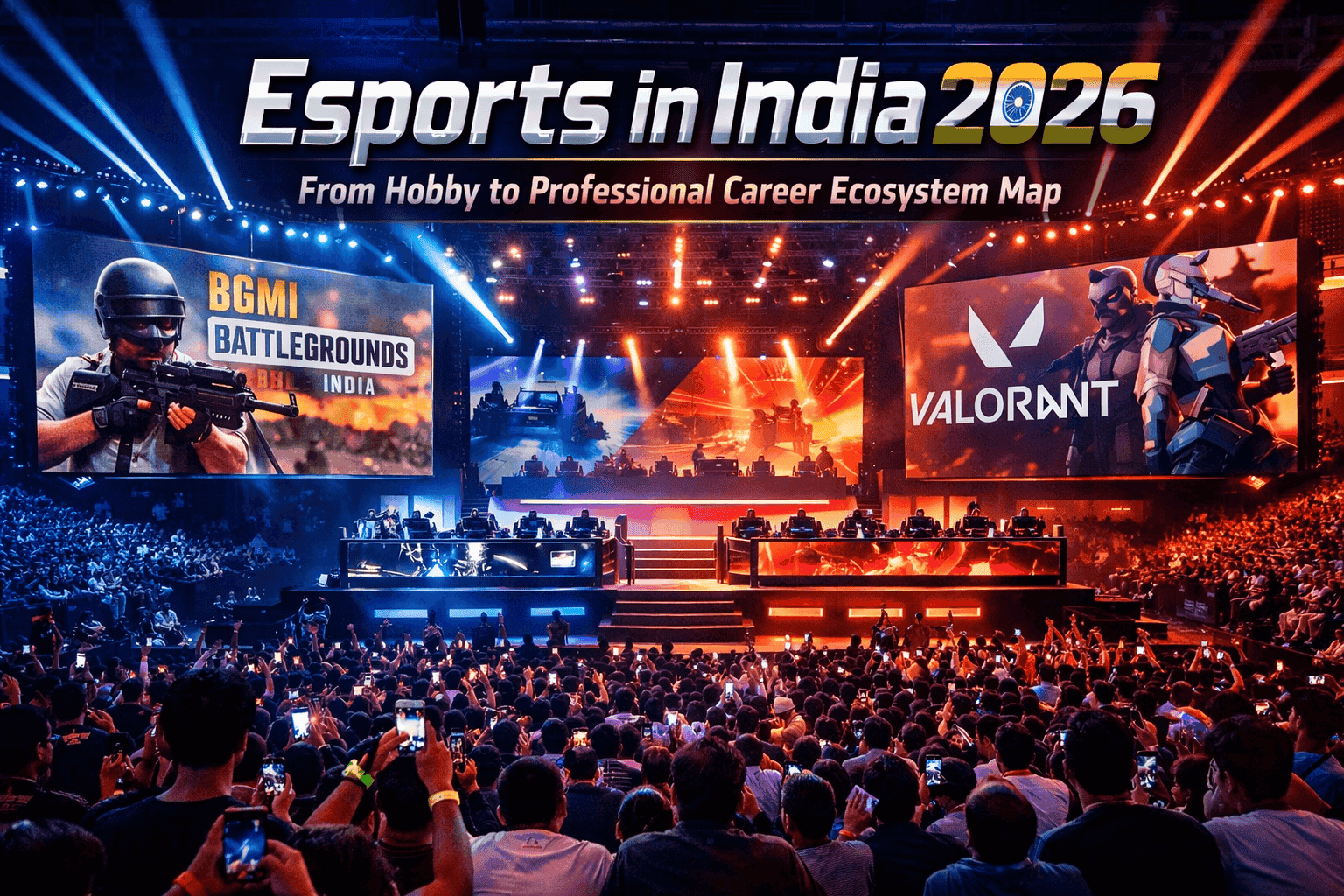
| SEO Checklist & Publishing Notes ✅ Primary keyword ‘esports in India 2026’ in title, opening paragraph, multiple H2s, meta title, meta description, conclusion paragraph, and at least 2 FAQ answers ✅ Secondary keywords: ‘Indian esports career’, ‘esports salary India’, ‘esports market India 2026’, ‘professional gaming India’ — distributed across H2/H3 headings and body ✅ Data table 1: Key market statistics (12 rows, 3 sources) | Data table 2: Player tier salary ladder (5 tiers, 4 columns) ✅ Internal links: /services/analytics/ | /services/sports-marketing/ | /services/sports-brand-development/ | /services/sponsorship-media-rights/ | /services/athlete-representation/ | /contact/ ✅ External references: Coherent Market Insights, KRAFTON India, Future Market Insights, Desportz, GamingNewsLab, Outlook Respawn, Esports Charts India, Exchange4media 🖼 Featured image: Packed esports arena with LED screens showing BGMI/Valorant action — ideally an Indian venue. Alt: ‘esports in India 2026 professional career ecosystem’ Tags: esports India 2026 | Indian esports career | BGMI esports salary | esports market India | Jonathan Gaming | S8UL Esports | NODWIN Gaming | esports ecosystem India | how to become esports player India | professional gaming India |
© 2026 Global Sports Konnect | globalsportskonnect.com