


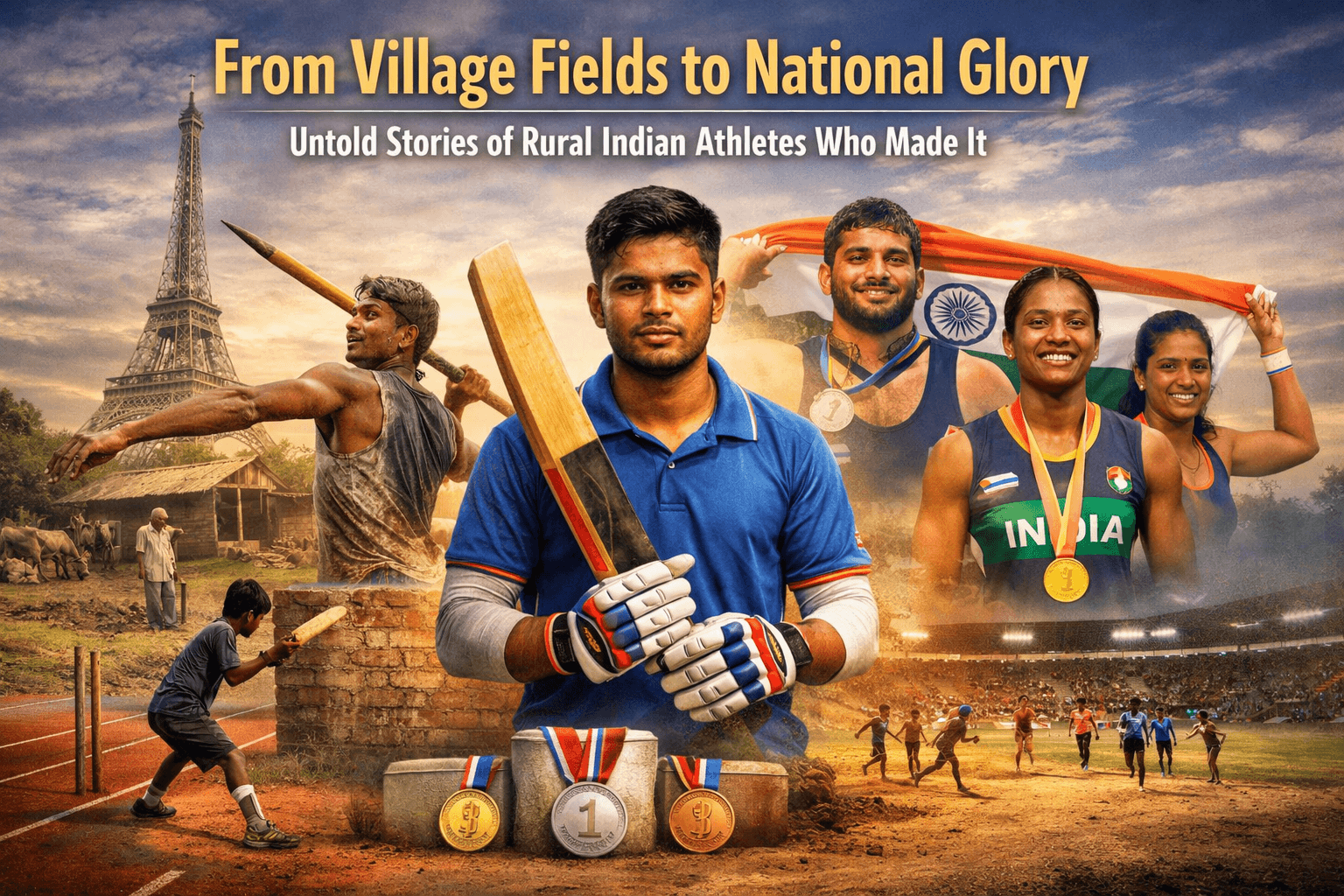
Every morning, as the sun breaks through the mist over India’s countless villages, thousands of young dreamers wake up to chase an impossible dream. With makeshift equipment, dusty grounds, and odds stacked impossibly high against them, they train. This is their story—a story of grit, sacrifice, and triumph that rarely makes headlines but deserves to be told.
The Dusty Track That Led to Paris
Animesh Kujur’s hands were calloused from years of farm work when he first touched a javelin. Not the sleek, perfectly balanced competition javelin that Neeraj Chopra throws, but a bamboo pole wrapped in cloth, weighted with whatever metal scraps he could find in his village in Jharkhand.
His training ground? A rough patch of land behind his father’s modest home, where cattle grazed and children played. His coach? YouTube videos watched on a borrowed smartphone with spotty internet. His support system? Parents who couldn’t understand why their son insisted on throwing sticks when he could be earning a steady income.
Yet in 2024, Animesh Kujur stood at the World Athletics Continental Tour, having qualified to represent India on the global stage. His throw of 81.05m didn’t just break records—it shattered perceptions about where champions can come from.
“I used to practice between farming duties,” Animesh recalls. “My father would say, ‘Puttar, yahaan khet hai, Olympics nahi.’ (Son, this is a farm, not the Olympics.) But I believed that talent knows no postcode.”
His story isn’t unique. It’s being repeated in villages across India, where raw talent meets impossible circumstances and somehow, against all odds, finds a way.
The Quiet Revolution in India’s Hinterlands
India has 6.5 lakh villages. Within them live nearly 65% of our population—833 million people according to the 2011 Census. Among these millions are athletes with Olympic-level potential, running on mud tracks, swimming in ponds, and dreaming dreams that seem impossibly far from their reality.
The Numbers Tell a Powerful Story
Recent data reveals that approximately 40% of India’s current national level athletes come from rural backgrounds. At the 2020 Tokyo Olympics, 7 out of India’s 15 medalists across recent Games had rural origins. In wrestling alone where India has won multiple Olympic medals over 70% of national champions come from villages.
But these success stories represent just the tip of the iceberg. For every Animesh Kujur who makes it, thousands of equally talented athletes never get the chance to prove themselves on the national stage.
The infrastructure gap is staggering. While urban India boasts 15,000+ registered sports facilities, rural India—home to 65% of the population—has access to fewer than 3,000 proper training centers. The athlete-to-facility ratio in rural areas is approximately 100,000:1, compared to 5,000:1 in urban centers.
Vishal Nishad: The Boy Who Turned Cricket Balls into Dreams
In the narrow lanes of a small town in Uttar Pradesh, a young boy named Vishal Nishad would wake up before dawn, not to study or help with family work, but to practice cricket. With a taped-up bat that had seen better days and a tennis ball wrapped in electrical tape, he would train alone against a wall, imagining himself playing for India.
Born on January 10, 2002, Vishal came from humble circumstances where cricket wasn’t seen as a realistic career path but rather a distraction from “real life.” His family couldn’t afford expensive coaching academies or branded equipment. What they had was a son with unwavering determination and a natural talent that refused to be ignored.
Vishal taught himself the nuances of wicketkeeping, studying matches on a neighbor’s television, practicing his reflexes with whatever equipment he could cobble together. His “coaching” came from watching MS Dhoni and Rishabh Pant, then spending hours trying to replicate their techniques behind the stumps.
The breakthrough came when he was spotted at a local tournament by scouts who recognized raw talent beneath the rough edges. He made his way into Uttar Pradesh’s cricket system, though the journey was anything but smooth. Every step required proving himself against players who’d had professional coaching since childhood, players whose families could afford specialized training camps and nutritionists.
In November 2021, Vishal Nishad made his first-class debut for Uttar Pradesh against Madhya Pradesh in the Ranji Trophy. For a boy who once practiced with a taped tennis ball, walking onto a proper cricket ground wearing Uttar Pradesh colors was a dream materialized.
His List A debut came in February 2022 during the Vijay Hazare Trophy against Vidarbha. But the moment that truly announced his arrival was yet to come—his T20 debut for Uttar Pradesh in the Syed Mushtaq Ali Trophy in October 2022 against Jammu & Kashmir.
As a wicketkeeper-batsman, Vishal represents a particularly challenging position in cricket—one that requires dual expertise. You must be excellent behind the stumps, anticipating every movement, every edge, every stumping opportunity. Simultaneously, you must be a reliable batsman, often coming in during pressure situations to stabilize the innings or accelerate the scoring.
“People thought I was wasting time playing cricket,” Vishal shares. “They said ‘cricket khelo ya coaching karo, isse ghar nahi chalta’ (you can play cricket or get proper education, you can’t run a household on this). But I knew that if you’re good enough, cricket finds you. You just have to be good enough for long enough.”
By 2025, Vishal had played 13 first-class matches, 6 List A matches, and 14 T20 matches for Uttar Pradesh, steadily building his reputation as a dependable wicketkeeper and a batsman capable of match-changing innings. His T20 batting average of 26.10 and strike rate of 158.53 demonstrate his aggressive intent—the kind of fearless approach often seen in players who’ve had nothing to lose and everything to prove.
Today, Vishal Nishad continues his journey in domestic cricket, each match a step closer to the ultimate dream that every Indian cricketer harbors—wearing the blue jersey with the Tricolor on their chest. His story inspires dozens of young cricketers from similar backgrounds, proving that talent combined with relentless determination can overcome the absence of privilege.
From practicing with a tennis ball against a village wall to keeping wickets in the Ranji Trophy—Vishal’s journey embodies the essence of rural athletic triumph: not the absence of obstacles, but the refusal to let obstacles define the outcome.
The Common Thread: What Makes Rural Athletes Unstoppable
After interviewing dozens of rural athletes who made it to national and international levels, patterns emerge. These champions share certain characteristics that often give them an edge over their urban counterparts:
Unbreakable Mental Toughness
When you’ve trained through 45-degree summers without air conditioning, practiced during monsoons because you can’t afford to miss a day, and continued despite every rational voice telling you to quit—you develop psychological resilience that no sports psychologist can manufacture.
Hima Das, the “Dhing Express” from rural Assam, trained on muddy fields where simply staying upright was a challenge. When she finally ran on proper tracks, she later said it felt like running on clouds. That adaptation to adversity became her competitive advantage.
Vishal Nishad’s journey from practicing with makeshift equipment to playing in front of thousands in the Ranji Trophy exemplifies this mental toughness. Every ball he kept, every innings he played at the domestic level, was validation of years spent training when everyone told him to quit.
Hunger That Fuels Performance
Rural athletes aren’t training for hobby or fitness. For many, sports represents the only realistic pathway out of poverty, the only chance to give their families a better life. This creates a motivation intensity that’s hard to match.
Raw Physical Conditioning
Before they ever touched specialized sports equipment, many rural athletes spent years doing physical labor—farm work, construction, fetching water from distant wells. This builds functional strength and endurance that’s difficult to replicate in a gym.
Mary Kom, perhaps India’s most celebrated boxer, spent her childhood helping in her family’s jhum fields in Manipur. The physical demands of agricultural work built the foundation for the legendary stamina she would later display in the ring.
Community as Support System
When formal support systems don’t exist, rural athletes create their own. Villages rally around their local heroes, contributing what little they can—sometimes it’s money, sometimes it’s encouragement, sometimes it’s simply believing when no one else does.
Stories That Deserve Headlines
Swapna Barman: The Girl Who Ran on Borrowed Shoes
From Jalpaiguri, West Bengal, Swapna Barman grew up in a one-room home with six siblings. Her mother sold vegetables to support the family. Swapna was born with six toes on each foot, making it nearly impossible to find properly fitting sports shoes.
She trained wearing borrowed shoes that didn’t fit, causing blisters and pain with every step. Yet in 2018, Swapna became the first Indian woman to win a heptathlon gold at the Asian Games.
“My feet bled regularly during training,” she remembers. “But my mother bled too—through her calloused hands, selling vegetables in all weather so I could eat enough to train. How could I give up?”
Today, Adidas designs custom shoes for her, and Swapna has become an inspiration for athletes with physical differences. But she hasn’t forgotten where she came from—she regularly visits rural schools, telling young athletes that their circumstances don’t define their potential.
Deepak Punia: From Wrestling on Mud to World Championship Silver
In the village of Chhara in Haryana, young boys wrestle in makeshift akharas—dirt rings under open sky, with no mats, no proper equipment, no amenities. Deepak Punia was one of those boys.
His daily routine involved waking at 4 AM, training until 6 AM, then walking 5 kilometers to school, returning for afternoon training, helping with farm work, and squeezing in evening training whenever possible.
In 2019, at just 20 years old, Deepak won a silver medal at the World Wrestling Championships in Kazakhstan, defeating top wrestlers from countries with far superior infrastructure. At the Tokyo Olympics, he reached the semi-finals, losing controversially to the eventual gold medalist.
“The akhara taught me to fight,” Deepak says simply. “When you learn wrestling on hard mud instead of soft mats, you learn to fall without getting hurt. That mental and physical toughness—it stays with you.”
Dutee Chand: The Sprinter Who Fought Society and Biology
Dutee Chand’s story is one of multiple barriers broken. Born into a weaver family in Odisha’s Chaka Gopalpur village, Dutee faced economic hardship, gender discrimination, and later, institutional barriers when she was dropped from the national team due to hyperandrogenism.
She fought back—not just on the track but in the Court of Arbitration for Sport, where she successfully challenged testosterone regulations that affected female athletes. Her legal victory changed international sports policy.
Meanwhile, she kept training in her village, often without proper coaching or facilities. In 2019, she became the first openly gay athlete in Indian sports, adding another dimension to her role as a barrier-breaker.
Today, Dutee holds national records in 100m and 200m sprint events, and her story has inspired thousands of young women from rural India to pursue sports despite social barriers.
The Cricket Dream: Why It’s Both Easier and Harder for Rural Athletes
Cricket occupies a unique space in India’s rural sports landscape. Unlike athletics, hockey, or wrestling, cricket enjoys massive popularity, media coverage, and financial rewards. This creates both opportunities and challenges for rural cricketers like Vishal Nishad.
The Opportunity Side
Cricket’s popularity means every village has players. Local tournaments, district leagues, and state-level competitions create a pathway from the most remote village to state teams. The BCCI’s infrastructure, though imperfect, is more extensive than any other sport in India.
The Indian Premier League has transformed cricket economics. Young cricketers now see realistic financial rewards if they can break through. State teams provide regular employment, and the possibility of an IPL contract—even as a bench player—can transform a family’s economic circumstances overnight.
The Challenge Side
But this same popularity creates intense competition. Every village produces talented cricketers, but only a tiny fraction make it to state teams, and an even smaller fraction reach the IPL or national team.
Rural cricketers face specific disadvantages. Urban players train at specialized academies from age 8 or 9, receiving professional coaching in technique, fitness, and match strategy. They play on quality pitches with proper equipment. They’re exposed to competitive cricket year-round.
Rural cricketers like Vishal often start later, train with basic equipment, play on rough pitches that don’t prepare them for quality wickets, and lack exposure to high-level competition until much later in their development.
The wicketkeeper position that Vishal plays is particularly challenging. It requires specialized training, constant practice with quality bowlers of different styles, and equipment that most rural cricketers can’t access. That Vishal developed his wicketkeeping skills in such circumstances speaks to exceptional dedication.
The Domestic Cricket Grind
Making it to state-level cricket is just the beginning. The domestic cricket circuit—Ranji Trophy, Vijay Hazare Trophy, Syed Mushtaq Ali Trophy—is brutally competitive. Established players protect their positions, selectors have their favorites, and opportunities for newcomers are limited.
Vishal’s statistics show steady performance: maintaining a presence in UP’s squad across formats over multiple seasons is itself an achievement. In domestic cricket, staying in the team is as challenging as getting selected initially.
His T20 strike rate of 158.53 demonstrates aggressive intent—the kind of fearless batting that catches selectors’ attention. In modern cricket, especially T20s, wicketkeepers who can accelerate scoring are highly valued. This positions Vishal well for potential IPL opportunities if he continues performing consistently.
The Ecosystem That Builds Champions (Or Doesn’t)
Understanding rural athletic success requires examining the ecosystem—or lack thereof—that these athletes navigate.
The Infrastructure Reality
In urban India, aspiring athletes have access to sports academies with qualified coaches, physiotherapists, nutritionists, sports psychologists, and state-of-the-art equipment. In rural India, they have determination and improvisation.
A study by the Sports Authority of India revealed that 78% of rural areas lack even basic sports infrastructure. Only 12% of rural schools have proper sports facilities beyond a basic playground.
Yet despite this 7:1 infrastructure disadvantage, rural athletes make up 40% of national-level competitors. This statistic alone speaks to the untapped potential lying dormant in India’s villages.
For cricket specifically, the BCCI has made efforts to spread infrastructure, but quality coaching and proper facilities remain concentrated in urban centers. Most rural areas have playing spaces but lack professional coaches, quality pitches, or equipment beyond the basics.
The Coach Gap
Coaching is perhaps the most critical gap. While urban centers have certified coaches with international exposure, rural areas rely heavily on self-taught athletes who become informal coaches, passing down knowledge through demonstration and experience.
Many rural champions speak of learning technique through YouTube videos, old sports magazines, and occasional visits from traveling coaches. This self-directed learning builds resourcefulness but also means many athletes never reach their full technical potential.
Vishal Nishad’s story of learning wicketkeeping by watching MS Dhoni and Rishabh Pant on television, then practicing alone, is common among rural cricketers. They develop skills through observation and self-correction rather than professional coaching feedback.
The Nutrition Challenge
Elite athletic performance requires precise nutrition—protein intake, calorie balance, micronutrient optimization. Rural athletes often train while undernourished, their families unable to afford the diet their bodies need for peak performance.
A national-level wrestler from rural Punjab revealed that he consumed 6,000 calories daily by eating subsidized food at the local gurudwara, his family unable to provide the nutrition his training demanded. He would eat his primary meals there, then train—grateful for the community support that made his dream possible.
For cricketers, nutrition is equally crucial. The physical demands of keeping wickets throughout long innings, then batting under pressure, require proper fuel. Many rural cricketers compromise their potential simply because they’re training and competing without adequate nutrition.
Financial Barriers
The cost of pursuing sports excellence—travel to competitions, equipment, coaching fees, medical support—creates insurmountable barriers for most rural families.
Cricket has specific financial demands: quality bats (₹5,000-20,000), wicketkeeping gloves and pads (₹3,000-10,000), training gear, regular pitch fees, and travel to matches. For rural families, these costs are prohibitive.
Many rural athletes speak of pivotal moments when their careers nearly ended due to lack of funds for competition travel, equipment purchase, or injury treatment. Often, it’s local community fundraising, a chance encounter with a sponsor, or government intervention that keeps their dreams alive.
How Some Rural Athletes Break Through
Despite overwhelming odds, some rural athletes do make it to national and international levels. Their pathways reveal potential models for systematic support:
Government Schemes and Talent Identification
Programs like Khelo India and state-level initiatives have identified talented rural athletes and provided support. For cricket, the BCCI’s zonal system and state associations create pathways, though access remains challenging for the most rural areas.
The success rate, however, remains low. For every athlete identified and supported, dozens remain undiscovered because talent scouts rarely venture deep into rural areas.
State Cricket Associations
State cricket associations like the Uttar Pradesh Cricket Association (UPCA) that gave Vishal Nishad his opportunity play crucial roles. They conduct trials, maintain teams across age groups, and provide exposure to quality cricket.
However, these associations often struggle with corruption, favoritism, and limited resources. Many talented rural players never get fair trials, their opportunities lost to players with better connections or ability to pay for exposure.
Private Academies and Coaching Centers
Academies run by former cricketers have scholarship programs, though these rarely reach the most rural areas. The cost of residential academies (₹50,000-200,000 annually) remains out of reach for most rural families.
NGOs and Corporate Initiatives
Organizations focused on rural sports development, along with corporate CSR programs, have created opportunities for some athletes. However, these remain scattered and insufficient relative to the talent pool.
Community Support Networks
Perhaps most important and least recognized: village communities that rally around their local athletes. In rural India, it’s common to see entire villages contributing small amounts to fund an athlete’s travel to trials, or local businesses providing equipment and nutrition support.
This informal support system—though insufficient by international standards—creates emotional and financial backing that keeps dreams alive during the hardest times.
For Vishal Nishad, this community support during his early years made the difference between giving up and persisting until he earned his Uttar Pradesh cap.
The Multiplier Effect: What Happens When One Makes It
When a rural athlete achieves state or national success, the impact extends far beyond their individual achievement.
Transforming Local Sports Culture
In Animesh Kujur’s village, dozens of children now practice javelin throw. In Hima Das’s Dhing, every girl suddenly saw track athletics as possible. In Vishal Nishad’s town, boys now believe that practicing with a tennis ball can eventually lead to the Ranji Trophy.
Local sports clubs emerge, parents become more supportive of athletic pursuits, and communities develop pride around producing athletes. This cultural shift—unmeasurable but profound—creates conditions for future champions.
Economic Impact on Families
A successful athlete transforms family economics. Prize money, sponsorships, government jobs through sports quotas, and in cricket’s case, match fees from domestic tournaments and potential IPL contracts—these opportunities lift entire families out of poverty.
A Ranji Trophy cricketer earns match fees plus potential state cricket association employment. If selected for an IPL team, even base contracts start at ₹20 lakhs—life-changing money for rural families.
The ripple effects extend further: siblings get better education opportunities, family homes get renovated, younger children receive proper nutrition. One athlete’s success becomes a family’s transformation story.
Policy Attention and Infrastructure Development
When rural athletes win major competitions or gain prominence, their regions often receive attention from politicians and administrators. Sports infrastructure gets developed, government schemes reach areas previously ignored, and systematic support begins flowing.
While opportunistic and insufficient, this attention does result in tangible improvements that benefit the next generation of athletes from that region.
What Rural Athletes Need: Beyond Inspiration Porn
It’s easy to romanticize rural athletic success—to celebrate the triumph over adversity while doing nothing to reduce the adversity itself. Real support requires systematic intervention:
Infrastructure Where Talent Lives
Instead of expecting rural athletes to migrate to urban centers for training, sports infrastructure must be developed in rural areas. District-level sports academies with proper facilities, equipment, and coaching can identify and nurture talent without forcing children to leave their families at young ages.
For cricket specifically, every district should have at least one quality pitch with proper practice facilities and qualified coaches accessible to talented players regardless of economic background.
The cost isn’t prohibitive—basic infrastructure for 100 athletes costs approximately what’s spent on a single corporate sports event. The question isn’t affordability; it’s priority.
Qualified Coaching Accessibility
Mobile coaching programs, where experienced coaches travel to rural areas regularly, can dramatically improve technical development. Additionally, training existing local coaches through certification programs creates sustainable knowledge transfer.
Digital coaching platforms, when combined with periodic in-person assessment, can provide rural athletes access to expertise previously available only in urban centers.
For cricket, retired domestic players could be engaged as coaches in rural areas, bringing professional expertise to grassroots levels.
Nutrition and Medical Support
Government initiatives that provide nutrition support for identified athletes similar to mid-day meal schemes but optimized for athletic performance can eliminate one major barrier to athletic development.
Similarly, sports medicine access through mobile medical units or partnerships with district hospitals can ensure injuries don’t end careers before they begin.
Financial Support Systems
Scholarship programs that cover not just training costs but also family economic security can allow talented athletes to focus on sports without guilt about family welfare.
For cricket, state associations could provide stipends to identified talent from economically disadvantaged backgrounds, ensuring they can train full-time instead of splitting time between cricket and income generation.
These needn’t be exorbitant—monthly support of ₹15,000-20,000 can be life-changing for a rural family, allowing their child to train full-time instead of balancing athletics with income generation.
Competition Exposure
Regular competitions at district and state levels, with travel and accommodation covered, can provide rural athletes the competitive experience they need to develop match temperament and performance under pressure.
Without this exposure, even technically strong rural athletes often underperform at major competitions simply because they’ve never experienced high-pressure competitive environments.
For cricketers, ensuring fair trial systems and opportunities to play in quality competitions regardless of background would allow talent to surface naturally.
The Untold Truth About Rural Athletic Potential
Here’s what data and anecdotal evidence suggests: India’s rural areas likely contain thousands of athletes with Olympic and international-level potential who will never even know they have it.
Research in sports science indicates that elite athletic ability—the genetic component—is distributed relatively evenly across populations. Yet opportunity, training, and development are distributed extremely unevenly.
Consider this: India’s rural population is 833 million. If we conservatively estimate that elite athletic potential exists in 0.01% of the population (likely a massive underestimate), that’s 83,300 potential Olympic-level athletes currently living in villages, the vast majority of whom will never receive any sports training.
For cricket, the numbers are even more striking. Cricket’s popularity means nearly every village produces talented players. Yet only a tiny fraction receive opportunities to develop that talent professionally.
The athletes whose stories we’ve shared—Animesh, Vishal, Hima, Deepak, Swapna, Dutee—they’re not exceptional in their rural origins. They’re exceptional in having somehow overcome the barriers that stop 99% of equally talented rural athletes.
That’s the real story: not just the triumph of those who made it, but the tragedy of thousands who could have but didn’t.
How many potential Virat Kohlis are currently practicing cricket with tennis balls in village lanes, never to be discovered? How many potential Olympic gold medalists are training on mud tracks, their talent invisible to the system?
Global Perspective: How Other Countries Develop Rural Talent
India’s struggle with rural sports development isn’t unique, but examining international approaches reveals potential models:
Kenya’s Running Revolution
Kenya—particularly the Rift Valley region—has become the global center for distance running excellence. This wasn’t accidental but resulted from systematic development starting in rural areas.
Village-level running clubs, altitude training advantages, and a culture that celebrates running success created an ecosystem where rural children see athletics as a viable pathway. Government and private academies systematically identify and develop talent at the grassroots level.
The result? A small East African nation consistently dominates global distance running, with many of its champions coming from rural backgrounds.
Australia’s Cricket Pathway System
Cricket Australia has invested in regional academies and pathways that bring coaching and competition to rural areas. Their talent identification programs specifically target regional and remote areas, recognizing that population centers don’t have a monopoly on talent.
Programs like the National Indigenous Cricket Championships ensure talent from remote communities gets identified and supported, creating pathways from the most isolated regions to the national team.
China’s Sports School System
China’s state-sponsored sports school system identifies talented children from rural areas and provides comprehensive support—coaching, education, housing, nutrition—from young ages.
While controversial due to intense pressure and limited choice, the system has successfully identified and developed rural talent into Olympic champions. The question for India is whether similar systematic identification and support can be implemented without the authoritarian aspects.
The Role of Technology in Democratizing Sports Development
Technology offers unprecedented opportunities to reduce rural-urban gaps in sports development:
Digital Coaching Platforms
Video analysis tools, AI-powered form correction, and virtual coaching sessions can provide rural athletes access to expertise previously available only through physical proximity to elite coaches.
For cricket specifically, apps that analyze batting technique, bowling actions, or wicketkeeping positioning could allow rural players like Vishal Nishad to receive technical feedback without access to professional coaches.
Several startups are developing apps specifically for athlete development, allowing remote coaching and performance tracking. When combined with periodic in-person assessment, these tools can dramatically improve training quality in rural areas.
Performance Monitoring Wearables
Affordable fitness trackers and sports-specific wearables can provide rural athletes with performance data that was once available only to elite urban athletes. Heart rate monitoring, distance tracking, sleep analysis—these insights enable self-optimization even without constant coaching supervision.
Live Streaming and Online Cricket Education
YouTube and streaming platforms have democratized access to cricket knowledge. Young players can watch international matches, study techniques, and learn strategies that were once available only to those with cable TV or stadium access.
Educational content from former players teaching specific skills—wicketkeeping techniques, batting against spin, reading bowling variations—provides free, high-quality instruction to anyone with internet access.
Online Sports Communities
Social media and specialized platforms allow rural athletes to connect with peers, access knowledge resources, share training videos for feedback, and build support networks beyond geographic limitations.
These communities provide motivation, advice, and sometimes tangible support, creating virtual versions of the urban sports ecosystem.
GSK’s Commitment: Building Pathways from Village Fields
At Global Sports Konnect, we’re not content with celebrating rural athletic success after it happens—we’re committed to making it happen more systematically.
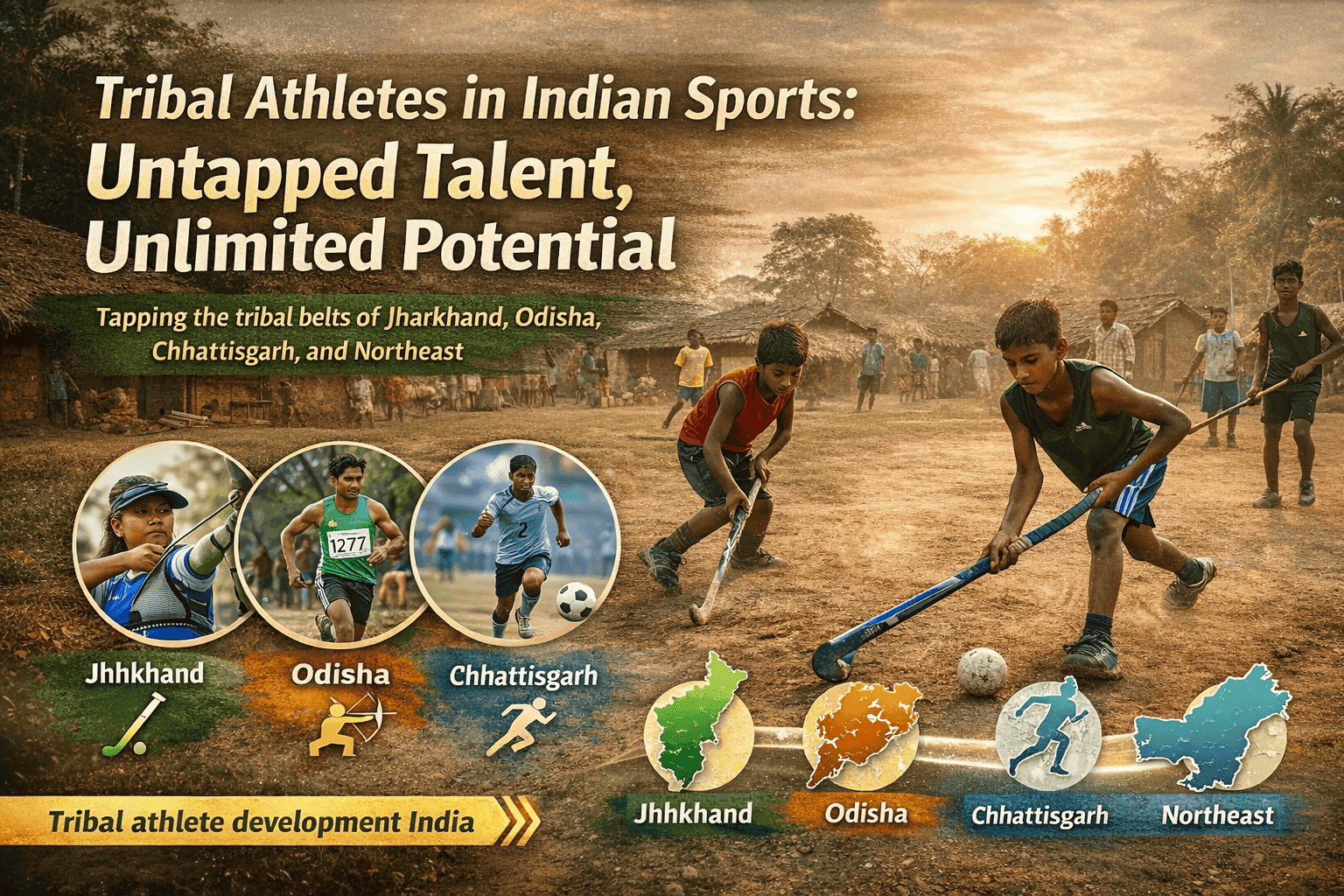
Our talent identification programs specifically target rural areas in Chhattisgarh, Jharkhand, Odisha, and other regions where potential often goes undiscovered. We’re developing infrastructure partnerships that bring coaching and facilities to rural areas rather than forcing talent to leave home.
Through our academy development initiatives, we’re creating regional training centers that serve surrounding villages, providing accessible excellence without requiring children to move to distant cities.
The Chhattisgarh Hockey League 2026 includes a 30% inclusion mandate specifically designed to create opportunities for underrepresented communities, including rural athletes. This isn’t charity—it’s recognition that talent distribution doesn’t respect economic geography.
Our athlete management programs include nutrition support, medical access, education continuation, and family economic assistance because we understand that supporting an athlete means supporting their entire ecosystem.
We’re also working to create similar pathways in cricket, recognizing that the sport’s popularity and economic potential make it an excellent vehicle for rural athletic development. Our vision includes creating talent identification and development programs that give rural cricketers systematic pathways to domestic and potentially international cricket.
Most importantly, we’re documenting these stories—like those shared in this article—because visibility matters. When rural families see athletes from similar backgrounds succeeding, it changes what they believe is possible for their children.
Stories like Vishal Nishad’s—from practicing with a tennis ball to playing Ranji Trophy cricket—need to be told and retold. They prove that the system can work when talent meets opportunity, and they inspire the next generation to believe that their dreams, however impossible they seem, are worth pursuing.
Conclusion: The Champions We’re Not Discovering
Late evening in another Indian village. A teenage boy finishes his farm work and goes to the local field. He picks up a worn cricket bat and a tennis ball, practicing his shots as the sun sets. He’s naturally gifted—genetic lottery blessed him with perfect hand-eye coordination, timing, and reflexes.
In another reality, he’d be training at a cricket academy, receiving professional coaching, preparing for state trials, being groomed for domestic cricket.
In this reality, he’ll likely never get that chance. He’ll play local tournaments, be the best cricketer in his district, but never receive the exposure and opportunity to prove himself at higher levels. His potential will remain potential, never actualized.
This story is repeating itself thousands of times across rural India. Not every rural athlete is a hidden champion, but every hidden champion is probably from a rural or underserved background.
The athletes whose stories we’ve celebrated—Animesh, Vishal, Hima, Deepak, Swapna, Dutee—they’re heroes not just for what they achieved but for achieving it against such impossible odds.
But here’s the uncomfortable truth: they’re also evidence of system failure. In a system that worked properly, their achievements wouldn’t require superhuman determination. Proper infrastructure, coaching, nutrition, and support would allow talent to develop naturally rather than requiring miracles.
India’s Olympic medal count doesn’t reflect our population size or our talent pool. Our domestic cricket system, despite being the world’s richest, still fails to identify and develop a significant portion of the talent that exists in rural areas.
These aren’t failures of talent—they’re failures of access, infrastructure, and systematic support.
The day when India’s Olympic contingent and cricket teams truly reflect the 65% of our population that lives in rural areas—that’s when we’ll know we’re discovering and developing the champions we’re currently leaving behind.
Until then, stories like those shared here serve a dual purpose: celebrating extraordinary triumph while highlighting the ordinary injustice of wasted potential.
The village fields have always held glory. The question is whether we’re looking closely enough to find it, and whether we’re committed enough to nurture it once we do.
Vishal Nishad made it from practicing with a tennis ball to keeping wickets in the Ranji Trophy. But for every Vishal who breaks through, how many equally talented cricketers never get the chance?
About the Author:
This article is part of GSK’s ongoing commitment to identifying, celebrating, and supporting athletic talent from all corners of India. Through our talent identification programs, rural academy partnerships, and inclusive league structures, we’re working to ensure that the next generation of Indian sports heroes includes proportional representation from the villages where 65% of our population lives and dreams.