



By Global Sports Konnect (GSK) | February 2026
| KEY HIGHLIGHTS A peer-reviewed three-year longitudinal study published in the Scandinavian Journal of Medicine & Science in Sports (2025) tracked elite cricketers through preseason, mid-season, and off-season and found that depression levels are highest during mid-season and reset to baseline during preseason — confirming that what happens in camp directly shapes a player’s psychological trajectory for the entire season ahead.Research shows that 59% of professional cricketers experience measurable anxiety or depression during competitive seasons (Cricket South Africa monitoring data), yet the majority of preseason camps in India still have no structured mental conditioning component — focusing almost entirely on technical skill sessions, net practice, and gym-based fitness.A landmark meta-analysis across 15 studies (Frontiers in Psychology, 2024) confirmed that team-building interventions lasting more than two weeks produce the most significant improvements in team cohesion — and high team cohesion is directly linked to stronger mental toughness, better stress management under competition pressure, and superior collective performance outcomes.India’s own cricketing history proves the point: when Gary Kirsten and Paddy Upton introduced structured mental conditioning and team culture work into the Indian national team’s preparation in 2008, the team achieved its first-ever ICC number-one Test ranking (2009) and won the 2011 World Cup — outcomes Upton has consistently linked to psychological and relational work done off the field, not just technical work on it. |
The Camp That Doesn’t Look Like Training And Why It Matters Most
Picture a standard cricket preseason camp. Nets from 7am, gym sessions midmorning, video analysis in the afternoon. Players arrive stiff from the off-season, coaches push fitness benchmarks, and the schedule is dense with technical drills. It is productive. It is also incomplete.
What this schedule misses is the work that actually determines whether a team performs when it matters — the psychological preparation, the trust between teammates, the mental habits that decide how a batter responds after a golden duck in Match 3, or how a bowling attack stays cohesive when they are leaking runs in a T20 final. Those outcomes are not built on the pitch. They are built in the sessions between the sessions: the evening debrief after a tough day, the team dinner where players from different backgrounds talk honestly, the recreational activity that has nothing to do with cricket but builds the kind of trust that survives pressure.
This is the gap GSK’s preseason camp design addresses and the gap that separates camps built around holistic player development from camps that simply restart the technical routine. Mental conditioning in cricket is no longer a luxury or a soft afterthought. It is, as the research and India’s own cricketing history confirm, one of the most decisive investments a team can make in the weeks before a season begins.
What the Research Actually Shows About Cricket and Mental Health
Preseason Is a Psychological Reset Window Use It or Lose It
A three-year longitudinal study published in the Scandinavian Journal of Medicine & Science in Sports (2025) tracked the mental health of elite cricketers — measuring depression, anxiety, alcohol use, problem gambling, and overall wellbeing — across preseason, mid-season, and off-season over three consecutive years. The findings were clinically significant. Depression levels were highest during the competitive mid-season and appeared to return to baseline during the preseason and off-season periods.
What this tells cricket administrators and coaches is straightforward: the preseason period is not just a technical rebuild — it is the last window before competitive pressure arrives to actively address psychological states, embed healthy mental habits, and build the relational infrastructure that will sustain a team through the inevitable stress of competition. Teams that treat preseason as purely a physical and technical preparation phase are, by the logic of this research, missing the most valuable mental health investment window in the entire sporting year.
The Anxiety Numbers No One Is Talking About
Prior monitoring of professional cricketers’ mental health in South Africa — a country with world-class cricket infrastructure and professional support systems — found that 59% of cricketers experienced measurable anxiety or depression during their competitive season, and 26% showed patterns of adverse alcohol use. These are not marginal percentages. They represent the majority of professional players on any given roster.
India’s own conversation about cricket and mental health has been accelerating. Yuvraj Singh publicly called for the Indian national cricket team to have dedicated psychological support for players like Rishabh Pant and Hardik Pandya, noting that every individual responds differently to pressure and that a one-size coaching approach is not adequate. Before the Women’s T20 World Cup 2024, the BCCI engaged a sports psychologist for the training camp at captain Harmanpreet Kaur’s repeated request — acknowledging that the team’s previous failures in finals and semi-finals were, in part, a psychological problem rather than a technical one. This is institutional acknowledgement at the highest level that the mind matters as much as the mechanics.
Team Cohesion Is Not a Nice-to-Have — It Is a Performance Variable
A comprehensive meta-analysis published in Frontiers in Psychology (2024), drawing on 15 separate studies examining team-building interventions in sport, found that structured team-building activities produce measurable improvements in team cohesion — and that the impact is most pronounced when interventions last more than two weeks and engage players in the 15-25 age bracket. These are precisely the conditions of a well-designed preseason camp.
Independently, research on team cohesion and precompetitive stress published in the Journal of Sport and Exercise Psychology (2025) found that high social cohesion — the quality of bonds and relationships between teammates beyond the performance task — is ‘universally beneficial’ for athletes managing competitive stress. Teams with high social cohesion showed better perceived coping prospects, more positive precompetitive emotions, and stronger mutual support behaviours under pressure. In cricket’s language: the team that has genuinely bonded is the team that backs each other when runs are not coming and wickets are not falling.
What Most Preseason Camps Include vs. What the Best Ones Do
| Camp Element | Standard Preseason Camp | GSK Holistic Preseason Camp |
| Net Practice | Daily sessions (primary focus) | Daily sessions integrated with scenario-based pressure drills |
| Fitness & Conditioning | Gym sessions, cardio, strength testing | Fitness programming that includes recreational sport, active recovery, and play-based activities |
| Mental Skills Training | Absent or a single one-off workshop | Structured daily sessions: visualisation, self-talk, pre-performance routines, anxiety management |
| Team Bonding | Incidental (shared meals, downtime) | Designed: structured activities, team challenges, conflict resolution, role clarity sessions |
| Recreation & Play | Unstructured free time | Purposeful recreational activities — cooking challenges, outdoor games, creative sessions — that build relational trust |
| Individual Check-Ins | Coaching feedback on technique | Regular 1:1 sessions with mental performance coach; player wellbeing assessed alongside skill |
| Video Analysis | Tactical debrief of footage | Combined tactical + psychological debrief: how did we respond under pressure, not just what did we do technically |
| Goal Setting | Season performance targets | Layered: team goals, individual performance goals, and personal growth goals — set collaboratively |
| Communication Work | Implicit (assumed to develop naturally) | Explicit: team communication frameworks, captain-player relationship building, feedback culture creation |
| Outcome Measurement | Physical fitness scores; technical benchmarks | Physical + psychological + relational benchmarks; cohesion survey at start and end of camp |
The Mental Skills That Preseason Camp Should Build
Visualisation: The Skill India’s Best Already Use — But Most Players Never Learn
Wasim Akram’s late wife Huma, a psychologist and psychotherapist, introduced him to visualisation during his playing career. Akram described how he would visualise most of the deliveries he planned to bowl before releasing them — seeing the ball trajectory, the movement, the batter’s response — and how that mental rehearsal made the physical execution under pressure more reliable. As Jeremy Snape, a former England cricketer who worked as a sports psychologist across six IPL editions, explains the mechanism: ‘What you’re trying to do in visualisation is build depth of experience even though you’re not physically doing it. When your brain has that conditioning, it’s more likely to respond in a favourable way under pressure.’
A structured preseason camp is the ideal environment to teach and embed visualisation as a daily practice — not as a standalone workshop but as a 10-minute routine integrated into the warm-up before net sessions. Batters visualise the bowlers they will face in the upcoming season. Bowlers mentally rehearse their plans against specific batting types. Fielders rehearse high-pressure catching scenarios. By the time competitive cricket begins, these routines are habitual rather than effortful.
Pre-Performance Routines: Making the Automatic Under Pressure
Between-delivery reset routines in batting — the step back, the exhale, the deliberate refocus before the next ball — are among the most practically effective mental tools in cricket. Research in sports psychology confirms that athletes who have established pre-performance routines demonstrate more consistent decision-making and less emotional reactivity under competitive stress. The reason is neurological: a habitual routine shifts the brain from reactive, emotionally-driven processing toward the calm, procedural processing that elite performance requires.
The preseason camp is where these routines are established, tested under simulated pressure, and made automatic. A routine that a player consciously chooses during camp becomes an unconscious anchor during the final over of a tense T20 chase six weeks later. This kind of practice cannot be self-taught in isolation — it requires structured instruction from a qualified mental performance coach, feedback from coaches and teammates, and repetition under the mild pressure of camp competition before the serious stakes of competitive cricket arrive.
Positive Self-Talk and the Inner Commentary That Determines Consistency
Every cricketer has a running inner commentary — a voice that interprets a dropped catch, a poor shot selection, a bad LBW decision. Left unaddressed, that voice defaults to criticism, rumination, and catastrophising under pressure. Professional mental performance work teaches players to identify their default self-talk patterns and systematically replace unhelpful commentary with process-oriented, realistic, and constructive language. This is not about false positivity — it is about accurate self-assessment that keeps focus on controllable actions rather than uncontrollable outcomes.
Preseason camp, when pressure is lower and learning is the explicit focus, is the right environment to develop this awareness. A player who arrives at a season opener with an established self-talk framework is fundamentally more resilient than one who is managing inner commentary reactively and instinctively.
Why Recreation and Team Bonding Belong Inside the Camp Schedule
The Paddy Upton Lesson: What Actually Built India’s 2011 World Cup Team
When Gary Kirsten took over as India’s head coach in 2008, he brought Paddy Upton with him as mental conditioning and strategic leadership coach. The Kirsten-Upton era ended in 2011 with India winning the World Cup and achieving the ICC number-one Test ranking for the first time in the team’s history. In the years since, Upton has spoken extensively about what that transformation actually involved — and it was not primarily a technical overhaul. It was relational and psychological work: building trust among players from different backgrounds, creating an environment where vulnerability was safe, and embedding shared cultural values around how the team would operate under pressure.
Upton has worked across over 20 professional cricket, rugby, and football teams since then, including multiple IPL franchises. His consistent finding is that teams that invest in the relational and psychological dimensions of preparation outperform teams of equal or greater technical ability who do not. The 2024 IPL champions KKR built their campaign around what their support staff explicitly called ‘big-match personalities’ — players and coaches who had done the psychological work to remain composed and decisive when the stakes were highest. That work does not happen spontaneously. It is designed.
What Recreation Actually Does to a Cricket Team
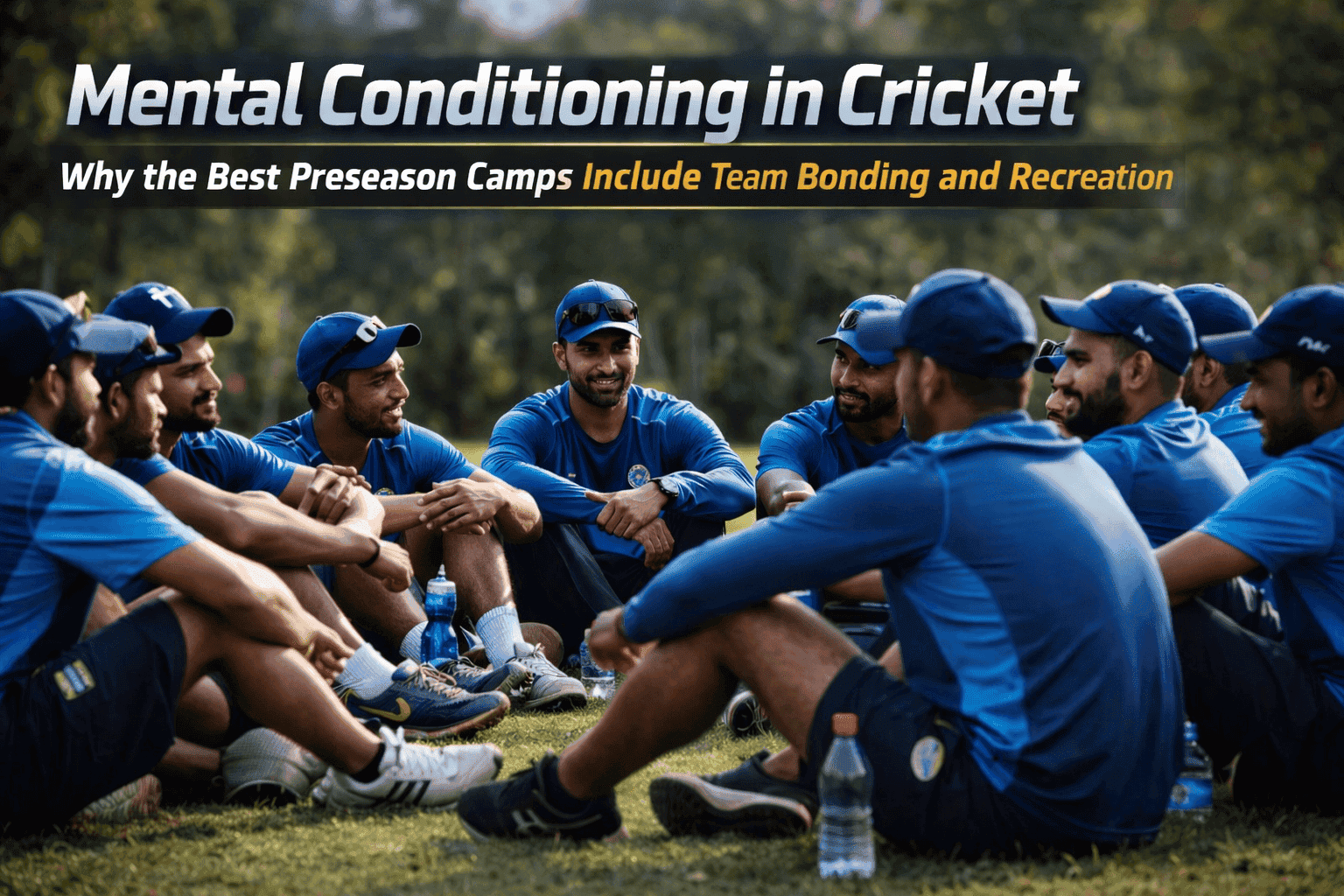
When a cricket team spends three days doing something together that has absolutely nothing to do with cricket — a cooking challenge, a white-water rafting day, a music evening, an escape room — several things happen simultaneously. Players who share a dressing room but do not genuinely know each other outside of their cricket roles discover each other as people. The young batter who has been deferential to the senior pace bowler in the nets suddenly outperforms him in a quiz night and earns a different kind of respect. The vice-captain who carries himself with natural authority finds, in an unstructured group activity, that the quietest player in the squad is the one everyone instinctively follows.
These discoveries — which sound informal and incidental — are the raw material of social cohesion. Research by sports psychology theorists identifies social cohesion (the bonds between teammates beyond the performance task) as ‘universally beneficial’ for precompetitive stress management. In the language of performance, a team with high social cohesion is one where players genuinely care whether their teammates succeed, where communication under pressure is honest rather than guarded, and where collective adversity — a batting collapse, a dropped catch at a critical moment — is managed with mutual support rather than individual retreat.
Structured vs. Accidental Team Bonding: The Critical Difference
The argument against structured team bonding is usually that it happens anyway — players share meals, spend time together in hotels, travel together. This is true but insufficient. Accidental proximity is not the same as deliberate relationship-building. Research on team-building interventions in sport consistently shows that the depth and durability of cohesion gains depends on the intentionality of the design, not simply the amount of time spent together. A team that has worked through a structured conflict resolution exercise together has a different quality of trust than one that has merely shared a bus.
The best preseason camps are designed with this in mind. Team bonding activities are chosen specifically for what they reveal and develop — not for entertainment value. A shared challenge that requires genuine interdependence (all team members must contribute for the group to succeed) builds task cohesion. An activity that requires players to share personal stories or creative work builds social cohesion. Both types matter. Both need to be present in a well-designed camp.
How GSK Designs Preseason Camps That Develop the Whole Player
The Integrated Approach: Mental, Physical, Technical, and Relational
GSK’s preseason camp design operates on a simple premise: high-performing cricket teams are not built from isolated technical excellence. They are built from players who are technically skilled, physically conditioned, mentally resilient, and relationally connected — and all four dimensions require deliberate attention in the preseason window. Our academy and grassroots development work is built around this integrated model, which is why GSK’s camps look different from standard coaching programmes that treat the mind as an afterthought and team culture as something that develops on its own.
A GSK-designed preseason camp begins before players arrive with a needs assessment — understanding where each player is psychologically coming in, what their individual pressure patterns are, and what the team’s relational health looks like after the off-season. It ends with a measurable baseline: not just fitness scores and technical benchmarks, but cohesion metrics and individual mental skill inventories that coaches can track across the season.
The Daily Camp Architecture: What Each Session Is Actually Building
In a well-structured preseason camp, nothing should happen accidentally. The morning net session is technical and physical — but the warm-up includes a brief visualisation component that begins building the player’s pre-performance routine. The gym session in the mid-morning is fitness-focused — but the team completes it together, creating shared physical experience and mutual accountability. The afternoon video session is tactical — but the debrief includes psychological dimensions: how did we respond to pressure situations, what was our communication pattern, where did individual anxiety affect collective decision-making?
The evening programme is where intentional recreation lives. Three nights per week, the team engages in a structured activity designed to build social cohesion — not themed around cricket, not competitive in a way that mirrors playing pressure, but genuinely recreational in a way that reveals personality and builds human connection. This is not a reward for a productive day’s training. It is a core component of the preparation programme, scheduled with the same intentionality as net practice.
The Role of Individual Mental Performance Sessions
Group cohesion work builds team culture. Individual mental performance sessions address what is unique to each player. The opener who has developed a fear response to short-pitched bowling after an injury. The off-spinner who has lost confidence after an expensive spell in the last tournament. The young fast bowler who plays brilliantly in practice but tightens up when cameras appear. These are psychological patterns that will not resolve themselves through technical coaching and they cannot be addressed in a group setting.
A structured preseason camp includes scheduled 1:1 sessions between players and a qualified mental performance practitioner — not crisis counselling, but proactive performance psychology: identifying patterns, building self-awareness, and developing personalised tools that the player can carry into the season. This is the standard at every elite franchise globally. It is the standard GSK brings to academy and state-level cricket programmes through our grassroots development and academy design services.
Mental Skills Preseason Camp Framework: What to Cover and When
| Camp Phase | Days | Focus Area | Key Activities |
| Arrival & Assessment | 1-2 | Psychological baseline; initial team building | Individual mental health check-ins; team cohesion survey; icebreaker activities (non-cricket); goal-setting workshop |
| Foundation | 3-5 | Core mental skills introduction; social cohesion | Visualisation training; self-talk awareness sessions; team recreational evening (cooking/outdoor challenge) |
| Integration | 6-9 | Embedding routines into technical work | Pre-performance routines practiced in nets; pressure scenario drills with debrief; team shared challenge (requires full participation) |
| Pressure Simulation | 10-12 | Testing psychological tools under simulated competition | Intra-squad matches with intentional pressure variables; individual 1:1 mental skills review sessions; team communication debrief |
| Camp Finale | 13-14 | Cohesion consolidation; season readiness | Team culture declaration (shared values, how we operate); end-of-camp cohesion survey; individual mental skill commitments for the season ahead |
Frequently Asked Questions
What is mental conditioning in cricket and why does preseason matter most for it?
Mental conditioning in cricket refers to the structured development of psychological skills — visualisation, self-talk management, pre-performance routines, pressure tolerance, and emotional regulation — that determine how players perform when technical execution meets competitive stress. Preseason matters most for this work because a longitudinal study published in the Scandinavian Journal of Medicine & Science in Sports (2025) found that cricket players’ depression and anxiety levels reset to baseline during the preseason period, before rising again through the competitive season. This means preseason is the last optimal window to establish healthy psychological patterns, mental habits, and team trust before competitive pressure arrives.
Why do team bonding activities belong in a cricket preseason camp?
Team bonding activities build social cohesion — the quality of bonds and trust between teammates beyond purely cricket-related roles. Research published in Frontiers in Psychology (2024) and the Journal of Sport and Exercise Psychology (2025) consistently links high social cohesion to better stress management under competitive pressure, stronger mutual support during adversity, and superior collective performance. In cricket’s context, a team with genuine social bonds is one where a top-order collapse is managed with collective composure rather than individual anxiety — because players trust each other enough to communicate honestly and support each other under pressure.
What mental skills should a preseason cricket camp include for junior players?
For junior players (Under-16 to Under-23), a preseason camp should introduce and embed four core mental skills: visualisation (mentally rehearsing successful shot or bowling execution before physical practice), positive self-talk frameworks (replacing self-critical inner commentary with process-focused language), pre-performance routines (a consistent 3-5 step reset sequence used between balls or before delivery runs), and goal-setting that distinguishes outcome goals from process goals. These skills are most effectively taught in a camp environment because they require instruction, supervised practice, feedback, and repetition before they become automatic — exactly the conditions a structured camp provides.
How is GSK’s preseason camp design different from standard cricket coaching camps?
Standard preseason cricket camps focus primarily on technical skill development (nets, batting drills, bowling sessions) and physical conditioning (gym, fitness testing, cardio). GSK’s approach integrates mental conditioning as a scheduled daily component — not a one-off workshop — alongside structured team bonding activities, individual mental performance check-ins, and a recreational programme designed to build social cohesion. The model is built on the research evidence that technical and physical preparation alone does not produce the psychological resilience or team trust that determines outcomes in high-pressure competitive cricket.
Is sports psychology relevant for state and club level cricket, or just international teams?
Sports psychology is most valuable at the point where talent meets pressure and that pressure exists at every level of the game. A Ranji Trophy debutant facing their first first-class innings has just as much need for a pre-performance routine as a Test cricketer, arguably more. The BCCI appointed India’s first IPL mental conditioning coach for Punjab Kings as recently as 2021-22, the first Ranji mental conditioning coach was also an Indian appointment, and the India women’s team’s captain formally requested a sports psychologist for their T20 World Cup preparation camp. The institutional momentum is clear: mental performance support is moving from international luxury to standard practice at every competitive level of Indian cricket.
How long does it take for team bonding activities to improve team performance?
Research from a comprehensive meta-analysis (Frontiers in Psychology, 2024) found that team-building interventions lasting more than two weeks produce the most significant and durable improvements in team cohesion. This aligns with the typical 10-14 day preseason camp format. Single-session team bonding activities show limited sustained impact; the durability of cohesion gains depends on consistent, progressive relational work across the camp period rather than one-off activities. This is why GSK designs team bonding as a structured, recurring element across camp days rather than a single event.
| Design a Preseason Camp That Builds Champions On and Off the Field GSK’s academy and grassroots development services include complete preseason camp design and delivery — integrating technical coaching, physical conditioning, mental performance work, and structured team bonding into a unified preparation programme. Whether you are managing a state-level squad, a franchise team, or an academy cohort, we build the full preparation environment, not just the net sessions. Explore GSK’s relevant services: globalsportskonnect.com/services/academy-grassroots/ | globalsportskonnect.com/services/athlete-representation/ | globalsportskonnect.com/services/analytics/ Book a free intro call: calendly.com/globalsportskonnect | info@globalsportskonnect.com | +91 9873777697 |
© 2026 Global Sports Konnect | globalsportskonnect.com