Table of Contents
- India’s Sports Tourism Boom — And Where Delhi NCR Fits In
- What Makes Delhi NCR the Go-To for International Teams
- The Venues That Actually Matter (sports tourism india)
- Delhi NCR vs Bengaluru vs Bhubaneswar — Honest Comparison
- Where GSK Comes Into the Picture
- FAQs on Sports Tourism in India
- Final Thoughts
India’s Sports Tourism Boom — And Where Delhi NCR Fits In
Here’s something most people don’t realise about sports tourism in India — it’s not some future opportunity everyone keeps talking about. It’s already here. Grand View Research pegged India’s sports tourism market at around $34.5 billion in 2025. Let that number sink in for a second.
And it’s not slowing down. We’re looking at a 19.3% CAGR through 2030, which would push the market well past $133 billion. Cricket alone drives about a third of that, but football, hockey, badminton, and motorsport are catching up fast. The Border-Gavaskar Trophy 2024-25 saw ticket sales from Indian fans that were six times higher than the previous edition. That’s not just fandom. That’s tourism money flowing across borders.
Now here’s where things get interesting for Delhi NCR specifically. While cities like Bhubaneswar have carved a niche in hockey and Bengaluru owns the football conversation, Delhi quietly sits on something no other Indian city can match — a ridiculously dense cluster of international-grade venues, all within a 30-minute metro ride of each other. For international teams planning training stints in India, that density matters more than anything.
What Makes Delhi NCR the Go-To for International Teams
I’ve spoken with coaches and team managers who’ve scouted training locations across India. The same four reasons come up every time when they pick Delhi NCR over other cities.
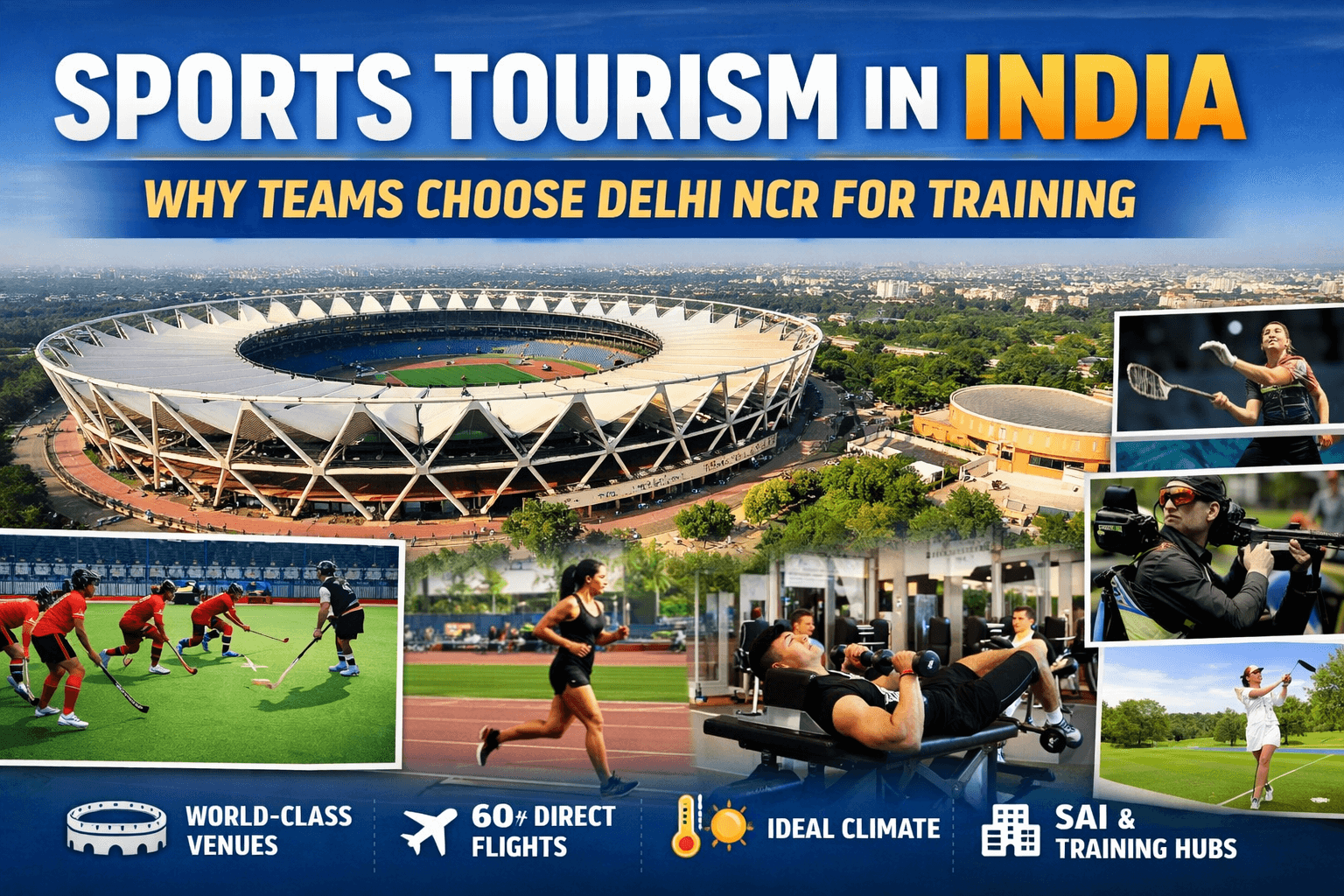
The Asian Games and Commonwealth Games left behind real infrastructure. This isn’t a talking point. It’s 15+ venues that were built or rebuilt to host global competition. The Jawaharlal Nehru Stadium seats 60,254 people and has an Olympic-standard athletics track. Major Dhyan Chand Stadium has three synthetic hockey pitches with 2,200 lux floodlighting. The Indira Gandhi Indoor Stadium covers 102 acres. R.K. Khanna Tennis Complex has 13+ courts and hosted Davis Cup ties. These aren’t plans on paper. They exist. Teams can walk in tomorrow.
Getting here is easy. IGI Airport connects to 60+ countries with direct flights. Try doing that from Bhubaneswar or even Pune. Once you land, Delhi Metro links most major venues. And accommodation? Pick your budget — from ₹2,000/night guesthouses near training grounds to five-star hotels in Lutyens’ Delhi.
The weather window is underrated. October through March gives you 15–25°C temperatures — perfect for outdoor training. That’s exactly when most international cricket, hockey, and athletics teams want to be here. And honestly, even the brutal Delhi summers have a purpose. Teams preparing for tournaments in Southeast Asia or the Middle East use June-August in Delhi for heat acclimatisation. Smart move.
SAI headquarters and NCoEs are right here. The Sports Authority of India runs its operations from the JLN Stadium complex. National Centres of Excellence provide sports science backup, medical support, specialised coaching, and nutrition planning. Visiting teams can tap into all of that. The newly established Delhi Sports University, India’s first school-university integrated sports institution, adds another layer to this ecosystem.
The Venues That Actually Matter
Let me skip the generic list and focus on what international teams actually care about — the facilities they’d use for serious training camps in Delhi NCR:
| Venue | Primary Sport | Why It Matters |
| JLN Stadium Complex | Athletics, Football | Olympic-grade track, 60K+ capacity, SAI headquarters on campus |
| Major Dhyan Chand Stadium | Hockey | 3 synthetic pitches, world-class floodlights, hosted 2010 Hockey World Cup |
| IG Indoor Stadium | Indoor Multi-sport | 102-acre complex, wrestling/gymnastics/badminton, CWG-upgraded |
| R.K. Khanna Tennis Complex | Tennis | 13+ courts, AITA headquarters, Davis Cup host venue |
| Dr. Karni Singh Shooting Range | Shooting | Rifle and pistol range, Asian Games standard, elite shooter training ground |
| CWG Village Sports Complex | Multi-sport | Swimming pool, badminton courts, open to professionals and public |
And here’s the kicker — the Ministry of Sports is planning to demolish and completely rebuild the JLN Stadium complex into a multi-purpose sports city. We’re talking about a 42-hectare redevelopment that would function as both a high-performance training base and a venue capable of hosting major international events. If that happens, Delhi NCR’s position as India’s sports training capital becomes basically unassailable.
It’s worth noting that 2026 alone brings the BWF World Championships in August, the Asian Championship Rifle/Pistol, the National Open Athletics Championships in October, and the Women’s Indian Open golf out in Gurugram. Each of these pulls international teams into Delhi NCR weeks before the event for acclimatisation and practice. That’s sports travel revenue flowing into local hotels, restaurants, and transport services.
Delhi NCR vs Bengaluru vs Bhubaneswar — Honest Comparison
I want to be fair here. Bengaluru and Bhubaneswar are doing impressive things. Odisha has committed over ₹5,000 Crore to sports development. Bengaluru’s football ecosystem around Bengaluru FC is genuinely strong. But when you stack them against Delhi NCR for sports infrastructure breadth, the gap is hard to ignore.
| What Matters | Delhi NCR | Bengaluru | Bhubaneswar |
| International Venues | 15+ | 5–7 | 3–4 |
| Direct Flights Abroad | 60+ countries | 25+ countries | Very limited |
| SAI/NCoE Presence | National HQ + NCoE | Regional centre | NCoE for hockey |
| Sports Covered | 12+ disciplines | 6–8 disciplines | Mostly hockey |
| Hotel & Stay Options | Every budget tier | Good range | Still growing |
Bhubaneswar will host India’s first-ever World Athletics Continental Tour Silver-level meet in August 2026. That’s a big deal for the city. But for a team that plays tennis, does shooting drills, and needs an indoor gymnasium — all in the same week — Delhi NCR is the only city in India that can deliver that without bus rides between cities.
Where GSK Comes Into the Picture
At Global Sports Konnect, we’ve learned something from building sports properties ground-up: events and tourism aren’t separate businesses. They’re the same thing. Every event we touch through our event management services (globalsportskonnect.com/services/events/) has a tourism layer baked into it from day one.
Our sports tourism packages (globalsportskonnect.com/services/sports-tourism/) don’t just book flights and hotels. We combine match access, training camp logistics, fan experiences, and hospitality into one cohesive package. And because we also handle sports infrastructure consulting (globalsportskonnect.com/services/infrastructure/) and sports marketing (globalsportskonnect.com/services/sports-marketing/), we understand venues from the inside out.
Take our Chhattisgarh Hockey League (CHL 2026), running June 10–22 in Raipur. It’s India’s first professional state-level hockey league with a franchise model, and we’ve projected a Year 1 economic impact of ₹38.6 Crore for Chhattisgarh — most of that driven by sports tourism: fan travel, team stays, media crews, and hospitality spending.
That’s the blueprint. Whether it’s Delhi NCR or Raipur, sports tourism works when you integrate it into the sports property itself — not bolt it on as an afterthought.
Frequently Asked Questions: Sports Tourism in India
Q1. What’s the actual size of India’s sports tourism market right now?
Grand View Research estimates it at roughly $34.5 billion as of 2025, with a projected jump to $133 billion by 2030 at 19.3% CAGR. Cricket accounts for about 33% of that. Football is the fastest-growing segment.
Q2. Why do international teams prefer Delhi NCR over other Indian cities for training?
Three words: venue density, connectivity, and institutional support. You get 15+ international-standard venues within metro distance, direct flights from 60+ countries, and the SAI headquarters right there. No other Indian city offers that combination.
Q3. Which sports facilities in Delhi NCR are open for international team training?
The big ones are JLN Stadium (athletics/football), Major Dhyan Chand Stadium (hockey with three synthetic pitches), IG Indoor Stadium (multi-sport, 102 acres), R.K. Khanna Tennis Complex (13+ courts), and Dr. Karni Singh Shooting Range. The CWG Village Sports Complex also provides swimming and indoor facilities.
Q4. What international sports events are happening in Delhi in 2026?
Delhi NCR hosts the BWF World Championships in August, the Asian Championship Rifle/Pistol, and the National Open Athletics Championships in October. Gurugram gets the Women’s Indian Open golf. These events bring international teams weeks early for pre-competition training.
Q5. Can brands tap into the sports tourism wave in India?
Absolutely. Deloitte projects India’s broader sports economy hitting $70 billion by 2030. Brands can enter through event sponsorships, hospitality activations, athlete collaborations, and fan experience partnerships. The ROI is measurable, especially around tent-pole events.
Q6. Are cricket training tour packages available in India?
They are, and they’re growing fast. Cricket tour packages covering IPL matches, international fixtures, and training camp experiences are one of the hottest segments in Indian sports travel. GSK designs end-to-end sports tourism packages that combine match access with travel and immersive experiences.
Final Thoughts
Sports tourism in India isn’t a slide deck projection anymore. It’s a $34.5 billion reality that’s compounding at nearly 20% a year. And Delhi NCR, sitting on top of Commonwealth Games-era infrastructure, SAI’s national headquarters, and an aviation network that connects to half the world — well, it’s hard to argue against it being the country’s natural training capital.
The 2026 calendar is stacked. The JLN Stadium redevelopment could reshape what’s possible. And with India eyeing a 2036 Olympic bid, the investments being made today in Delhi NCR’s sports infrastructure aren’t just for the next tournament. They’re for the next two decades.
If you’re a brand exploring sports sponsorship opportunities, a federation scouting training camp support, or a team looking for the right venue partner in India — we’d love to talk.
Reach out at info@globalsportskonnect.com or book an intro call at calendly.com/globalsportskonnect let’s figure out what’s possible