

Key Highlights
- SEBI’s Business Responsibility and Sustainability Reporting (BRSR) framework now mandates ESG disclosures for India’s top 1,000 listed companies — with mandatory Scope 3 value-chain reporting rolling in from FY 2025-26 and third-party assurance becoming compulsory by FY 2026-27. Every major Indian corporate that spends on sports sponsorship is simultaneously being legally required to justify that spend through an ESG lens. These two regulatory realities are converging, and the sports industry is not yet ready for what happens when they do.
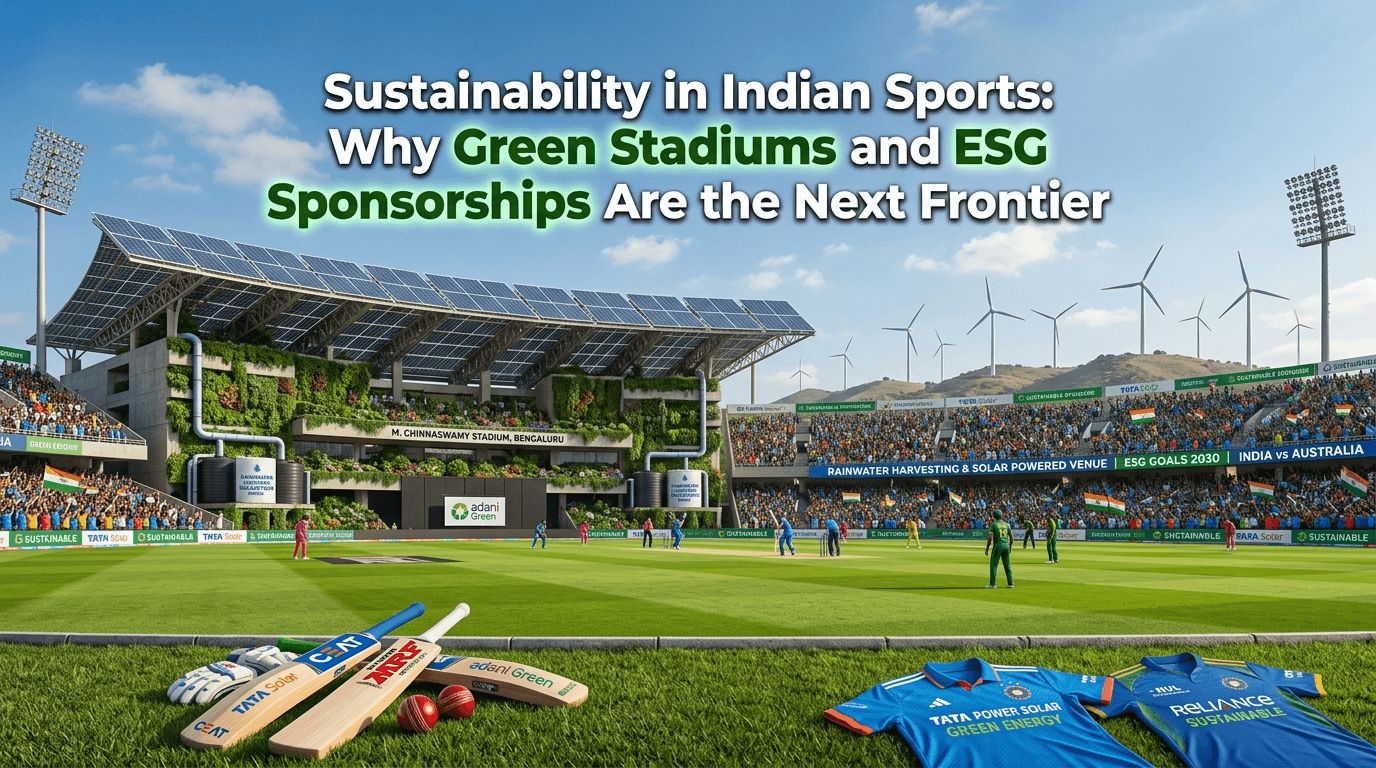
- Indian sports has already begun its sustainability transition — but in fragments. Bengaluru’s M. Chinnaswamy Stadium runs partially on 400 kilowatts of solar power, preventing an estimated 600 tonnes of CO2 emissions since installation. Rajasthan Royals managed 65,768 kilograms of waste during IPL 2024, setting a new league benchmark. Gujarat Titans’ Zero Waste to Landfill programme processed over 90,000 kilograms across two seasons. The BCCI partnered with UN Environment as far back as 2018. These are not marginal initiatives — they are the early infrastructure of an industry-wide shift that is still missing its commercial architecture.
- The global sports sponsorship market is projected to grow from $82.97 billion in 2025 to $191.08 billion by 2035 at an 8.70% CAGR — and ESG alignment is now among its primary growth drivers. The European Sponsorship Association voted ESG the top sponsorship trend for three consecutive years through 2024. India’s sports industry is operating without a comparable framework, without a green sports certification standard, and without the specialised sports management infrastructure to convert corporate ESG budgets into structured, measurable sports partnerships. That gap is the frontier.
Table of Contents
- Why This Conversation Is Happening Now
- The SEBI-Sports Sponsorship Collision
- What Indian Sports Has Already Built: The Green Audit
- The Global Benchmark: What World-Class Looks Like
- ESG Sponsorship: A Different Commercial Logic
- The Green Stadium Business Case
- CHL 2026: Designing Sustainability In from Day One
- The Five Categories of ESG Sports Sponsorship in India
- What Brands Get Wrong About Green Sports Partnerships
- A Framework for Sustainable Sports India: What Needs to Be Built
- FAQ: Sustainable Sports India and ESG Sponsorship
- Conclusion: The Commercial Case Is Already Here
There is a specific kind of gap in the Indian sports industry that nobody talks about because it looks like a future problem. It is not. It is a present commercial opportunity disguised as a future obligation.
Here is the situation. India’s top 1,000 listed companies are now legally required to measure, report, and have independently verified their environmental and social impact under SEBI’s BRSR framework. The top 250 must disclose Scope 3 emissions — the emissions generated not just by their own operations but by everyone in their supply chain — from FY 2025-26 onward. Every rupee spent on sports sponsorship is, for these companies, now a line item in a sustainability report that regulators, investors, and institutional fund managers will scrutinise.
Simultaneously, their customers — specifically, India’s 500-million-plus-strong youth demographic, aged 15-35 — are demonstrably shifting purchase behaviour toward brands that demonstrate environmental credibility. ESG-focused funds in India could see an additional $50 billion in assets under management by 2026, reflecting investor preference for companies that can show a coherent sustainability story.
Sports sponsorship in India is a ₹16,633 Crore market. Almost none of it is currently structured around ESG principles. The entire commercial architecture of Indian sports sponsorship — how deals are structured, what rights packages include, how activation is designed, how ROI is measured — was built for a world where sustainability was a PR afterthought rather than a commercial and regulatory imperative.
That world is ending. What replaces it is the subject of this analysis.
Why This Conversation Is Happening Now {#why-now}
Three forces have converged in 2025-26 to make sustainable sports India a commercially urgent topic rather than an aspirational one.
Force 1: Regulatory pressure on corporate India. SEBI’s ESG regulations have evolved from voluntary guidance into binding obligations faster than most corporate communications teams anticipated. What began as voluntary Business Responsibility Reports for the top 100 companies in 2012 is now mandatory BRSR Core reporting with independent assurance for the top 1,000 listed entities. Starting FY 2025-26, the top 250 companies must disclose Scope 3 greenhouse gas emissions on a comply-or-explain basis — meaning they must account for the environmental footprint of everyone they do business with, including the sports events and teams they sponsor. India’s Carbon Credit Trading Scheme, operationalised in June 2025, adds a further dimension: companies can now earn, trade, and report carbon credits as a measurable ESG asset. Sports sponsorships that generate verifiable carbon reduction or offset outcomes have a specific commercial value they did not previously possess.
Force 2: Consumer preference shifting at scale. India’s consumer research consistently shows that younger urban consumers — the primary target demographic for most IPL, PKL, and ISL sponsors — are increasingly making purchase decisions based on brand sustainability credibility. The shift is not yet as pronounced in India as in European markets, but the directional trend is unambiguous and accelerating. Brands that use sports sponsorships to signal genuine environmental commitment capture attention in a media environment saturated with conventional sports advertising.
Force 3: Global sports industry establishing the template. The European Sponsorship Association voted ESG the top sponsorship trend for 2024 for the third consecutive year. UEFA EURO 2024 avoided partnerships with oil, gas, and utility companies, choosing sponsors like BYD — an EV manufacturer — precisely because sponsor selection had become an ESG signal in itself. The EU’s Green Sports Hub Europe initiative is encouraging clubs to accept only sponsorships aligned with climate goals. These are not niche developments — they represent a structural shift in how the world’s most commercially developed sports markets are designed. India will follow, and the organisations that build the infrastructure now will have the commercial advantage when the shift arrives at scale.
The SEBI-Sports Sponsorship Collision {#sebi-collision}
The intersection of SEBI’s ESG regulatory architecture and Indian sports sponsorship is the most structurally important commercial dynamic in this space — and it is almost entirely unaddressed in current Indian sports management thinking.
Consider the practical situation of a major Indian FMCG company — let us call it a hypothetical mid-size listed brand with a ₹50 Crore annual sports sponsorship budget. Under current BRSR Core requirements, this company must disclose its environmental impact across its operations and, progressively, across its value chain. Its Scope 1 and 2 emissions (direct and energy-related) are already under scrutiny. By FY 2026-27, its Scope 3 emissions — including those generated by activities it funds — will require third-party verified disclosure.
What does this mean for a sports sponsorship? It means that the company’s association with a sports event that runs diesel generators, generates tonnes of single-use plastic waste, has no water management programme, and produces no measurable environmental offset is not just an ethical gap. It is a potential compliance risk — particularly if ESG rating agencies, institutional investors, or activist shareholders use the BRSR disclosure to question the coherence between the company’s stated sustainability commitments and its actual sponsorship spending.
ESG-focused funds in India may see an additional $50 billion in assets under management by 2026, representing clear investor preference for companies with credible sustainability narratives. A sports sponsorship that actively contradicts a company’s sustainability narrative is a liability in investor communications — and companies are beginning to understand this.
The inverse is also true, and more commercially interesting. A sports sponsorship that supports a company’s ESG commitments — because the event has certified environmental standards, because the franchise has a documented sustainability programme, because the partnership generates verifiable carbon offset credits — is not just a marketing asset. It is a sustainability disclosure asset. It appears positively in the BRSR report. It supports the ESG rating. It gives the company’s investor relations team something concrete to point to when institutional investors ask about the environmental dimension of the marketing budget.
This is the commercial logic that Indian sports properties have not yet built the infrastructure to capture.
What Indian Sports Has Already Built: The Green Audit {#green-audit}
Before diagnosing what is missing, it is important to give Indian sports credit for what has already been built — because the foundation is more substantial than most sustainability commentators acknowledge.
Infrastructure at the stadium level. The M. Chinnaswamy Stadium in Bengaluru has earned recognition as one of the most eco-friendly cricket stadiums globally. Solar panels generate approximately 400 kilowatts of energy — meeting a significant portion of the stadium’s electricity needs — while rainwater harvesting systems minimise water consumption. Cricket fans now call it “The Green Stadium,” a rare instance of sustainability becoming a brand asset for an Indian sporting venue. The Holkar Stadium in Indore followed in 2023 with 376 solar panels expected to save 277 tonnes of carbon emissions per year. Eden Gardens has installed advanced water management systems. The MA Chidambaram Stadium in Chennai incorporated intelligent lighting and improved drainage in its renovation.
IPL franchise sustainability programmes. The depth of franchise-level environmental commitment has grown substantially across IPL 2024 and 2025. Rajasthan Royals, in partnership with Schneider Electric as Official Sustainability Partner, ran the Green Yodha campaign and the Pink Promise initiative — which committed to solar-electrifying six rural homes in Rajasthan for every six hit during a designated match. By 2025, hundreds of homes in the Sambhar block had been solar-electrified through this programme. RR also set a new IPL waste management benchmark: 65,768 kilograms of waste professionally managed in IPL 2024.
Gujarat Titans partnered with NEPRA Resource Management to implement a Zero Waste to Landfill strategy. Across the 2024 and 2025 IPL seasons, this initiative enabled collection and processing of over 90,000 kilograms of waste. CSK partnered with Rayzon Solar for IPL 2025 to incorporate solar-powered stadium operations, EV and hybrid vehicles for team travel, and jerseys and fan merchandise made from recycled and biodegradable materials — alongside a collaboration with IIT Madras to explore technological solutions for reducing match-day environmental footprints. The BCCI’s Green Dot Balls campaign — launched during the 2023 playoffs in partnership with Tata Group and expanded across the full 2025 season — made sustainability visible to the entire IPL viewership through in-match engagement.
Governance-level commitments. The BCCI signed a letter of intent with UN Environment in 2018, the first major sports governing body in India to formally commit to greening operations and engaging fans in environmental initiatives. In Indore, the city implemented a Green Protocol for IPL matches based on 3Rs (reduce, reuse, recycle). In Bengaluru, the Karnataka Cricket Association replaced plastic cups and bottles with environment-friendly alternatives for over 32,000 fans at Chinnaswamy.
The gap in the architecture. The honest assessment is that these initiatives, collectively impressive, remain what a 2025 SportAndDev analysis described accurately: “many initiatives are led by private entities, NGOs, with some being community-driven projects — there is yet to be a comprehensive framework that covers climate action in sports at the national level.” The BCCI has not released a detailed long-term sustainability roadmap. There is no Indian sports sustainability certification standard. There is no structured ESG sports sponsorship packaging framework that allows a corporate brand to buy into a verifiable green sports partnership with measurable environmental outcomes. The raw material exists. The commercial architecture does not yet.
| Indian Sports Green Initiative | Organisation | Key Metric |
|---|---|---|
| Solar power installation | Chinnaswamy Stadium, Bengaluru | 400 kW, ~600 tonnes CO2 prevented |
| Solar panels, waste management | Holkar Stadium, Indore | 376 panels, 277 tonnes CO2/year savings projected |
| Zero Waste to Landfill programme | Gujarat Titans + NEPRA | 90,000+ kg processed, IPL 2024-25 |
| Waste management benchmark | Rajasthan Royals | 65,768 kg managed, IPL 2024 |
| Pink Promise rural solar homes | Rajasthan Royals + Schneider Electric | Hundreds of homes solar-electrified in Sambhar block by 2025 |
| Solar operations + recycled jerseys | CSK + Rayzon Solar | EV/hybrid team travel, biodegradable merchandise |
| Green Dot Balls campaign | BCCI + Tata Group | Full-season activation from IPL 2025 |
| BCCI-UNEP partnership | BCCI + UN Environment | Signed 2018; single-use plastic phase-out, stadium greening |
| National Games Go Green | Sports Authority of India | Medals from recycled metals, EV shuttles, zero-plastic zones |
The Global Benchmark: What World-Class Looks Like {#global-benchmark}
Understanding where India needs to go requires an honest comparison with what world-class sustainable sports looks like in 2025-26.
Forest Green Rovers and the certified carbon-neutral sports property. The English football club Forest Green Rovers became the world’s first UN-certified carbon neutral football club. Their planned Eco Park stadium — to be built entirely from sustainably sourced timber, powered by renewable energy, and serving only plant-based food on match days — represents the furthest point of the current sustainability ambition curve in sports. Their partnership with Adidas on the Green Stadium initiative, integrating sustainable materials and carbon-neutral branding, is what a fully architected ESG sports sponsorship looks like commercially.
Climate Pledge Arena, Seattle. Home of the NHL’s Seattle Kraken, Climate Pledge Arena is powered entirely by renewable energy, uses no fossil fuels, and has all internal mechanical systems run on electricity. The arena’s naming rights were sold to Amazon — and the name itself (Climate Pledge) is an ESG statement. The naming rights deal was structured around the arena’s sustainability credentials, not just its viewership numbers. This is the most commercially advanced example of ESG-as-sponsorship-architecture: the environmental commitment is the product, and the sponsorship is the brand alignment with that commitment.
UEFA EURO 2024’s responsible sponsorship framework. The EURO 2024 adopted responsible sponsorship practices, avoiding partnerships with gas, oil, and utility companies, and focusing on more environmentally conscious sponsors such as BYD, known for manufacturing electric vehicles and providing renewable energy solutions. UEFA also implemented a carbon contribution mechanism: for each tonne of CO2 produced in connection with EURO 2024, UEFA contributed €7 million to a climate fund supporting environmental projects run by amateur football clubs in Germany. This converts an event’s carbon footprint into a measurable community investment — precisely the kind of mechanism that Indian sports properties need to build for BRSR-compliant sponsorship packages.
The Rajasthan Royals model’s international precedent. The Royals’ Pink Promise — solar homes for sixes — is conceptually aligned with the best international practice: it creates a direct, measurable link between in-match sporting action and a verifiable sustainability outcome. Schneider Electric’s sponsorship of this programme is structured as an ESG partnership, not a conventional jersey placement deal. This is the template Indian sports management needs to systematise and scale.
ESG Sponsorship: A Different Commercial Logic {#esg-sponsorship-logic}
Standard sports sponsorship is bought and measured on reach metrics: how many eyeballs saw the logo, what was the media value equivalent, what was the brand recall lift. ESG sports sponsorship operates on a different commercial logic — and understanding the difference is essential for both properties and brands.
In a conventional sponsorship, the brand pays for visibility. In an ESG sponsorship, the brand pays for association with a credible sustainability programme — and what it receives in return is not just visibility but a BRSR-reportable environmental or social outcome that has value in regulatory compliance, investor communications, and consumer trust-building simultaneously.
The global sports sponsorship market reached $82.97 billion in 2025 and is projected to reach $191.08 billion by 2035. The key strategies driving this growth include aligning with ESG goals — explicitly identified alongside AI, digital activation, and fan personalisation as primary growth drivers. Members of the European Sponsorship Association voted ESG as the top sponsorship trend for 2024 for the third consecutive year.
What does this mean for how Indian sports properties should structure their offerings? It means that the most commercially valuable sponsorship packages in 2026 and beyond will not be the ones with the biggest logo placement. They will be the ones that can offer a brand:
A measurable environmental outcome (tonnes of CO2 offset, kilograms of waste diverted from landfill, litres of water conserved, kilowatt-hours of renewable energy generated) that can be reported in a BRSR filing with third-party verification.
A category exclusivity position as the official sustainability partner — a role that is more defensible, more differentiated, and more commercially durable than a conventional jersey sponsor slot, because no other brand in that category can claim the same ESG association.
A fan engagement activation that connects sustainability credentials with genuine audience interaction — because fans who participate in recycling programmes, tree-planting initiatives, or renewable energy awareness campaigns become advocates rather than passive viewers.
A narrative that works in three directions simultaneously: in the ESG report for institutional investors, in consumer marketing for brand preference, and in corporate communications for employer branding and talent attraction.
None of these are hypothetical. The Rajasthan Royals-Schneider Electric partnership delivers all four. The GT-NEPRA Zero Waste programme delivers the first and third. The BCCI-Tata Green Dot Balls campaign delivers the third and fourth. What is missing is the systematic packaging of these outcomes into structured, priced sponsorship products with standardised measurement frameworks.
The Green Stadium Business Case {#green-stadium-business}
The commercial case for green stadium investment in India is more straightforward than the sustainability conversation typically makes it sound — because it is primarily a cost reduction and asset appreciation story, not a pure values story.
Energy economics. The Chinnaswamy Stadium’s 400-kilowatt solar installation generates a significant portion of the stadium’s electricity needs and has prevented approximately 600 tonnes of CO2 emissions since installation. Over 1.6 million units of electricity are used annually at Chinnaswamy alone, at an estimated annual electricity cost of approximately $144,000. Solar panels that generate 40% of that electricity recover their capital cost in a defined number of years and then generate pure savings indefinitely. The Holkar Stadium’s 376-panel installation is projected to save 277 tonnes of carbon per year — which, under India’s Carbon Credit Trading Scheme operationalised in June 2025, represents a verifiable carbon credit asset with tradeable monetary value. Green stadiums are not just good environmental practice. They are capital investments with measurable financial returns and carbon credit upside.
Water management. Cricket pitches require substantial irrigation. Groundwater scarcity is becoming a documented operational risk for Indian cricket — in 2016, the Supreme Court of India ordered 13 IPL matches relocated from drought-hit parts of Maharashtra. Rainwater harvesting systems, wastewater recycling infrastructure, and water-efficient irrigation represent risk mitigation investments that reduce operational vulnerability to climate-driven water scarcity — a risk that will grow, not diminish, over the next decade.
Green stadium as a sponsorship premium. Climate Pledge Arena in Seattle demonstrates the ultimate expression of this logic: a stadium’s environmental certification is itself a premium sponsorship asset. Amazon paid for the naming rights specifically because the arena’s sustainability credentials aligned with Amazon’s corporate ESG commitments. In the Indian context, a venue that can certify itself as a LEED-rated, carbon-measured, renewable-powered facility can charge a premium for naming rights, title sponsorships, and official partnership designations — because the brand association is inherently more valuable than association with a conventional venue.
Infrastructure consulting as a sustainability enabler. The technical work of designing, certifying, and managing green stadium infrastructure — solar installations, rainwater harvesting systems, waste processing infrastructure, energy management systems, LEED certification processes — is a specialised capability that Indian sports properties need and that sports infrastructure consultants are positioned to provide. GSK’s sports infrastructure consulting practice, which includes Detailed Project Reports and venue sustainability auditing, is directly relevant to the green stadium transition.
CHL 2026: Designing Sustainability In from Day One {#chl-sustainability}
The Chhattisgarh Hockey League 2026 offers a specific and timely case study in the commercial opportunity that sustainability-by-design presents for new sports properties.
CHL 2026 — India’s first professional state-level hockey league with a franchise model, scheduled for June 10-22, 2026 in Raipur — is being built from the ground up. It has 6 franchise teams, 120 elite players, a 30% tribal inclusion mandate that is itself a social sustainability credential of the highest order, a government VGF funding partnership (₹3.5 Crore from Chhattisgarh state), and a projected ₹38.6 Crore Year 1 economic impact for the state.
A new sports property at this design stage has an advantage that established leagues do not: it can integrate sustainability standards into the core operational and sponsorship architecture before legacy systems are entrenched. The green design decisions available to CHL 2026 include: a match-day waste management programme with measurable diversion targets; partnership with renewable energy providers for venue power during the tournament; a zero single-use plastic policy for the entire event; a carbon footprint measurement framework for the tournament (covering venue energy, team travel, logistics, and fan transportation) that produces a verifiable annual environmental report; and a dedicated ESG sponsorship tier that offers brands a BRSR-reportable outcome alongside conventional sports marketing exposure.
The tribal inclusion mandate adds a social dimension to CHL’s ESG credentials that is genuinely differentiated. The 30% tribal athlete inclusion mandate — unprecedented in Indian professional sports — means that CHL’s “S” (social) in ESG is not a generic diversity statement. It is a documented, auditable commitment to community representation that directly addresses one of SEBI’s BRSR Core key performance indicators: inclusive development and employment generation in underserved communities. For a PSU sponsor like NMDC or SAIL — both of which operate extensively in tribal-community regions of Chhattisgarh — CHL’s social sustainability credentials are directly relevant to their own BRSR reporting obligations.
This is the commercial model that GSK’s events and tournament management platform is built to deliver: not just a sports competition, but a sports property with documented ESG credentials that makes it a more valuable and BRSR-compatible sponsorship asset for the brands that partner with it.
The Five Categories of ESG Sports Sponsorship in India {#five-categories}
For brands and sports properties building structured ESG sponsorship programmes in the Indian market, there are five distinct categories worth understanding — each with different commercial mechanics, different measurement frameworks, and different positioning in the BRSR reporting architecture.
Category 1: Official Sustainability Partner. The highest-tier ESG sponsorship designation, in which a brand’s core ESG commitment is structurally integrated into the sports property’s environmental programme. Rajasthan Royals-Schneider Electric is the current Indian benchmark. The brand co-designs the sustainability programme, contributes measurement infrastructure, and receives exclusive category rights alongside a co-branded sustainability narrative. Measurable outcomes include: verified carbon offset credits, rural electrification data, documented waste reduction metrics. BRSR value: high — measurable outcomes across multiple BRSR Core KPIs.
Category 2: Green Infrastructure Naming Rights. A brand sponsors a specific piece of green infrastructure at a venue — a solar installation, a rainwater harvesting system, a zero-waste processing facility — and receives naming rights over that infrastructure. “The [Brand] Solar Pavilion at Chinnaswamy Stadium.” This model is commercially underused in India but has strong precedent internationally, where stadium renewable energy installations carry dedicated naming rights separate from overall stadium naming. BRSR value: high for renewable energy brands; strong for sustainability-credentialed companies.
Category 3: Carbon-Neutral Match Activation. A brand sponsors specific matches or events designated as carbon-neutral — where the brand funds measurable offsets covering the event’s verified carbon footprint. The BCCI-Tata Green Dot Balls campaign is a simplified version of this. The full model includes independent carbon auditing of a designated match, brand-funded offset purchasing through India’s Carbon Credit Trading Scheme, and co-branded fan communication that makes the carbon-neutral designation visible. BRSR value: medium-high — generates carbon credit assets and Scope 3 offset documentation.
Category 4: Circular Economy Merchandise. A brand co-develops the sports property’s merchandise programme using recycled or sustainable materials, and positions its own products within that supply chain. CSK’s recycled jersey partnership in IPL 2024, where jerseys were made using recycled stadium waste, is the current template. The commercial extension includes fan merchandise from verified recycled materials, in-stadium food and beverage in fully compostable packaging, and branded recycling stations that tie the fan engagement action to the sponsor’s ESG narrative. BRSR value: medium — supports waste and circular economy KPIs.
Category 5: Community Sports + Environment Integration. A brand sponsors grassroots or community sports development programmes that are simultaneously environmental initiatives — sports facilities that generate renewable energy, academies that incorporate environmental education, community leagues that run zero-waste events. The social and environmental dimensions of CHL’s tribal inclusion and grassroots talent hunt are natural homes for this category. BRSR value: high for social KPIs, medium for environmental — strong for integrated ESG stories. This is where GSK’s academy and grassroots and sports marketing capabilities are directly applicable.
What Brands Get Wrong About Green Sports Partnerships {#brands-wrong}
The commercial opportunity in ESG sports sponsorship is real — but the current state of green partnerships in Indian sports reveals systematic errors that undermine both the sustainability impact and the commercial value of these investments.
Error 1: Treating sustainability as decoration rather than architecture. The most common failure mode is buying a conventional sponsorship and adding a green activation layer on top — a tree-planting event on one match day, a social media post about the partnership on Earth Day. This delivers neither meaningful environmental impact nor credible ESG value. Institutional investors and BRSR auditors are sophisticated enough to distinguish between a programme that generates verifiable, independently assessed environmental outcomes and one that generates good photographs. The former supports the ESG report. The latter risks attracting a greenwashing accusation, which under India’s emerging ESG debt securities framework carries specific regulatory consequences.
Error 2: Measuring reach instead of impact. Conventional sports sponsorship ROI metrics — impressions, brand recall, media value equivalent — are the wrong measurement framework for ESG sports partnerships. The relevant metrics are: tonnes of CO2 offset (independently verified), kilograms of waste diverted from landfill (third-party audited), number of rural households electrified, litres of water conserved, jobs created in underserved communities. These are the metrics that appear in BRSR disclosures and that institutional investors read. A brand that cannot report these numbers has not built an ESG partnership — it has bought a conventional sponsorship with a green badge.
Error 3: Single-season commitments. BRSR reporting is annual. ESG credibility is built over time. A one-season green sports partnership generates a single data point in a compliance report. A three-to-five-year structured partnership generates a trend line — demonstrating year-on-year environmental improvement — which is far more valuable in both regulatory and investor communications. Brands building serious ESG stories through sports need multi-year agreements with escalating impact commitments, not annual activation experiments.
Error 4: Ignoring the social dimension of ESG. Indian brands systematically underinvest in the “S” of ESG through sports. The environmental dimension gets most of the attention — solar panels, waste management, carbon offsets — but SEBI’s BRSR Core framework gives equal weight to social KPIs: gender diversity, employment generation, inclusive development, community welfare. Sports properties that have genuine social credentials — tribal athlete inclusion (CHL), rural talent development (grassroots academies), women’s sports investment — are as ESG-valuable as properties with strong environmental programmes. Brands that understand this have access to a much larger universe of ESG-compatible sports partnerships.
Error 5: Not structuring the sponsorship for BRSR disclosure. This is the most commercially costly error. A brand can do genuinely impactful work through a sports partnership and still get no BRSR value from it — because the partnership was not structured to produce independently verifiable, standardised, BRSR-reportable data. The solution is straightforward: engage your sports management partner to build the measurement framework and third-party verification process into the partnership design from the beginning, not as an afterthought. GSK’s sponsorship and media rights team designs partnership structures with measurement architecture built in — because a partnership that cannot be reported is a partnership whose commercial value is permanently limited.
A Framework for Sustainable Sports India: What Needs to Be Built {#framework}
India’s transition to a sustainable sports industry requires building institutional infrastructure that does not currently exist. This is a five-component framework for what that infrastructure looks like.
Component 1: A National Green Sports Certification Standard. India needs an equivalent to LEED certification but designed specifically for sports events and venues — a tiered certification framework that measures energy use, water management, waste diversion, carbon footprint, and social impact, with independent auditing and a publicly accessible rating. Such a standard transforms sustainability from a narrative claim into a verifiable credential — and creates a market for differentiated green sports products. The Sports Authority of India, working with bodies like the Bureau of Energy Efficiency and the Ministry of Environment, Forest and Climate Change, is the natural institutional home for this standard.
Component 2: Green Sports Infrastructure Investment Framework. The capital investment case for green stadium infrastructure — solar panels, rainwater harvesting, waste processing — needs to be systematised into a replicable Detailed Project Report (DPR) format that state governments, private developers, and federation venues can access. Under the existing Viability Gap Funding model (which CHL 2026 uses for tournament operations), a parallel green infrastructure VGF mechanism — where state governments co-fund renewable energy installations at sports venues — is feasible and would dramatically accelerate the green stadium transition.
Component 3: ESG Sports Sponsorship Packaging Standards. A standardised framework for how ESG sports sponsorships are priced, structured, measured, and reported — developed in consultation with SEBI’s BRSR reporting requirements — would allow Indian sports properties to package their sustainability programmes as BRSR-reportable products that corporate sponsors can plug directly into their annual disclosure process. This is not complex infrastructure: it is principally a measurement and reporting standardisation exercise, combined with clear rights packaging guidelines.
Component 4: Carbon Credit Integration. India’s Carbon Credit Trading Scheme, launched in June 2025, creates the regulatory infrastructure for sports events to generate, certify, and trade carbon credits. A sports event that installs solar power, implements zero-waste programmes, and offsets unavoidable travel emissions through CCTS-certified credits is not just operating sustainably — it is generating a tradeable asset. Sports properties that build carbon credit programmes into their operational model create a new revenue stream and a new category of ESG value for sponsors.
Component 5: GSK’s Role in the Ecosystem. GSK’s integrated sports management platform is specifically positioned to operate at the intersection of these five components. Infrastructure consulting capability for green venue design and DPR development. Sponsorship structuring expertise to design BRSR-compatible partnership packages. Analytics infrastructure to measure, verify, and report environmental and social outcomes. Event management execution that builds sustainability into operations rather than layering it on top. Brand development capability to position a sports property’s ESG credentials as a commercial differentiator. The gap in India’s sustainable sports ecosystem is not vision — it is integrated execution capability. That is what GSK is built to provide.
FAQ: Sustainable Sports India and ESG Sponsorship {#faq}
Q: What is ESG sports sponsorship and how is it different from conventional sports sponsorship?
Conventional sports sponsorship is bought and measured on audience reach metrics — impressions, brand recall, media value. ESG sports sponsorship is structured around verifiable environmental and social outcomes: tonnes of carbon offset, kilograms of waste diverted, rural communities reached, renewable energy generated. The commercial difference is significant: ESG sponsorships appear positively in a company’s BRSR sustainability report and support the ESG ratings that institutional investors use to make capital allocation decisions. Under SEBI’s current BRSR framework, India’s top 1,000 listed companies must disclose their environmental and social impact — making ESG-structured sponsorships commercially valuable in a compliance sense that conventional sponsorships are not. The sports property that can offer a brand a BRSR-reportable environmental outcome alongside conventional marketing visibility is offering a fundamentally more valuable commercial product.
Q: Which Indian cricket stadiums are most advanced in green infrastructure?
The M. Chinnaswamy Stadium in Bengaluru is currently India’s most advanced green cricket venue, having earned recognition internationally as one of the most eco-friendly cricket stadiums globally. Solar panels generate approximately 400 kilowatts of energy — meeting a significant portion of electricity needs — while rainwater harvesting and waste management systems complete the green infrastructure. The Holkar Stadium in Indore is following with a 376-panel solar installation projected to save 277 tonnes of carbon per year. Eden Gardens has implemented advanced water management systems. The MA Chidambaram Stadium in Chennai has incorporated energy-efficient lighting and improved drainage. These venues represent the current state of the art in Indian sports sustainability infrastructure, but none yet has a comprehensive, independently certified carbon-neutral status comparable to the international benchmark set by Climate Pledge Arena in Seattle or Forest Green Rovers’ planned Eco Park.
Q: How does SEBI’s BRSR framework affect sports sponsorship decisions for Indian companies?
SEBI’s Business Responsibility and Sustainability Reporting framework requires India’s top 1,000 listed companies to disclose environmental, social, and governance performance metrics annually. For the top 250 companies, Scope 3 emissions — which include the environmental impact of supply chain partners and, by extension, major spending partners including sports sponsors — must be disclosed on a comply-or-explain basis from FY 2025-26. Third-party verified BRSR Core reporting becomes mandatory for top 500 companies in FY 2025-26 and expands to the top 1,000 by FY 2026-27. This regulatory architecture creates a direct commercial incentive for listed companies to structure sports sponsorships around verifiable ESG outcomes — because a partnership that generates independently audited sustainability data has BRSR filing value that a conventional jersey placement deal does not.
Q: What is the Carbon Credit Trading Scheme and how can sports events use it?
India’s Carbon Credit Trading Scheme (CCTS), operationalised in June 2025 by the Ministry of Power, transitions India from voluntary carbon offsets to a legally binding, compliance-driven market for emissions trading. Sports events can participate in the CCTS by: implementing verified emissions reduction measures (renewable energy installations, waste diversion programmes, sustainable transport), having those reductions independently audited and certified, and receiving tradeable carbon credits that have monetary value on the exchange. A sports league that certifies its match-day carbon footprint and demonstrates verified year-on-year reduction through renewable energy and zero-waste programmes can generate CCTS credits that are either sold for revenue or transferred to sponsoring brands as part of their ESG partnership value. This mechanism directly aligns sports sustainability programmes with India’s national carbon market architecture.
Q: Why is the tribal inclusion mandate in CHL 2026 an ESG credential?
SEBI’s BRSR Core framework evaluates companies on social KPIs that include inclusive development, employment generation in underserved communities, and diversity metrics. The Chhattisgarh Hockey League 2026’s 30% tribal athlete inclusion mandate — which requires every franchise to field a minimum of six tribal players — is an auditable, documented commitment to professional employment opportunities for athletes from India’s most underserved communities. For PSU sponsors operating in tribal regions of Chhattisgarh (SAIL, NMDC, SECL all have major operations in the state), a CHL sponsorship that delivers on this social mandate directly supports their BRSR social disclosure obligations. This makes CHL’s tribal inclusion programme not just an ethical statement but a commercially structured ESG sponsorship credential — arguably the most powerful social ESG asset currently available in Indian sports.
Q: What can a smaller brand with a limited ESG sports budget do practically?
Entry-level ESG sports partnerships do not require large budgets. The most commercially efficient approach for a smaller brand is to sponsor a single, measurable sustainability initiative at a sport event — a designated zero-waste match, a stadium composting programme, an athlete-led tree-planting campaign with a documented target — rather than attempting a comprehensive sustainability partnership. The key is ensuring that the chosen initiative generates independently verifiable data that can be reported in the company’s sustainability communications, however informal, and that the brand’s association with the initiative is clearly communicated to audiences. Even a ₹25-50 Lakh sponsorship can generate meaningful ESG value if it is structured around a measurable outcome rather than a generic “green” association. GSK’s sports marketing team works with brands across budget ranges to structure partnerships that maximise both environmental impact and commercial ROI.
The Commercial Case Is Already Here {#conclusion}
The sustainability transition in Indian sports is not a future scenario. It is a present commercial reality that has not yet been fully monetised — and the distance between where Indian sports currently operates and where India’s corporate ESG obligations are pushing it is the exact size of the opportunity.
The Chinnaswamy Stadium runs on solar power. RR manages 65,000 kilograms of waste per IPL season with independent documentation. GT has processed 90,000 kilograms through a Zero Waste to Landfill programme. The BCCI planted trees for every dot ball in the 2023 finals in partnership with Tata Group. CSK runs its match day on renewable energy. The National Games 2025 issued medals made from recycled metals. India is not starting from zero.
What India is missing is the commercial architecture that converts these individual initiatives into a structured, scalable, BRSR-compatible market for sustainable sports partnerships — with standardised pricing, independent measurement, certified credentials, and product structures that match what corporate India’s ESG obligations now require from its sponsorship spending.
The global sports sponsorship market is heading toward $191 billion by 2035, with ESG alignment among its primary growth drivers. India’s ₹16,633 Crore sports sponsorship market is entering a period of structural regulatory pressure that will make sustainability credentials a condition of the most commercially valuable partnerships — not a differentiator but a baseline requirement.
The sports properties, events, and leagues that build this infrastructure now — green venue certification, carbon measurement programmes, BRSR-structured sponsorship packages, independently audited social impact data — will hold the commercial premium positions in the next five years. The ones that do not will find their sponsorship marketability diminished as corporate India’s ESG reporting requirements make non-sustainable partnerships incrementally harder to justify.
GSK’s integrated sports management platform is designed to help sports properties navigate exactly this transition — from event design and infrastructure consulting to sponsorship structuring and impact measurement. If you are building a sports property, managing a venue, or advising a brand on where sports fits in an ESG spending portfolio, the conversation about sustainable sports India is the most commercially important one you are not yet having.
Start it with us. Book a conversation at calendly.com/globalsportskonnect, reach our team at info@globalsportskonnect.com, or follow GSK’s ongoing analysis at LinkedIn