

By Global Sports Konnect (GSK) | February 2026
| KEY HIGHLIGHTS •The IPL 2025 mega auction involved 1,574 registered players, 574 shortlisted, 182 sold with a total purse of ₹641.5 Crore across 10 franchises, the largest in IPL history. • Rishabh Pant became the most expensive player in IPL history at ₹27 Crore; 13-year-old Vaibhav Suryavanshi was sold for ₹1.1 Crore both driven by data-validated role fit, not just star power. • Leading franchises now use AI-driven analytics, biomechanical monitoring, and ‘triple-lock’ decision models (analysts + scouts + coaches) before committing a single rupee at auction. • Academic research across 127 team-seasons shows that sustained strategic consistency not single-year spending is what predicts IPL success, underlining why data-driven squad planning spans 3-year cycles. |
The Most Expensive 48 Hours in Indian Sports
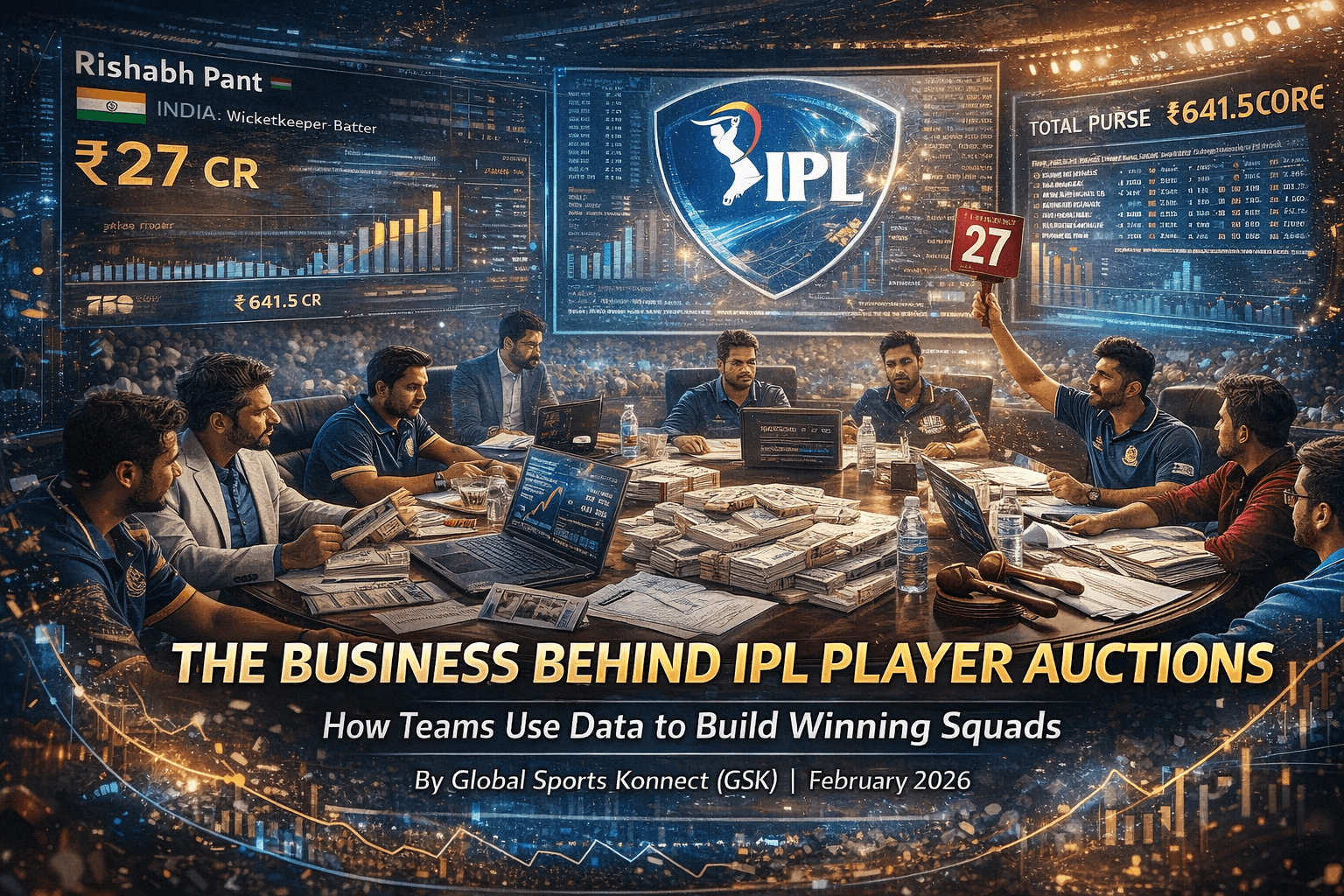
Twice a season (and in mega auction years, once in three), ten IPL franchise owners, their analytics teams, and their scouts sit in a room together and make billion-rupee decisions in real time. The IPL 2025 mega auction, held over two days in Jeddah, Saudi Arabia, saw 182 players sold for a combined ₹639.15 Crore. The highest bid: ₹27 Crore for Rishabh Pant the most expensive player in IPL history. The most surprising: ₹1.1 Crore for 13-year-old Vaibhav Suryavanshi, the youngest player ever sold at IPL auction. Both bids were driven by data.
The IPL auction looks, from the outside, like a room full of billionaires getting into bidding wars over cricketers. From the inside, it’s something far more structured: a high-stakes corporate capital allocation exercise where every franchise must balance player value, role fit, budget constraints, retention costs, and three-year squad strategy all in real time, against nine equally motivated competitors. And the teams that do it best consistently are the ones with the most sophisticated data infrastructure.
This is the business behind the spectacle. And it’s a template being studied and replicated by every franchise league in India that came after IPL.
The Auction Architecture: How the Rules Shape Strategy
The Purse and Retention System
Every franchise enters a mega auction with a ₹120 Crore purse the highest in IPL history for the 2025 cycle. Before the auction, teams can retain up to 6 players: the first three capped retentions cost ₹18 Crore, ₹14 Crore, and ₹11 Crore respectively from the purse. The fourth and fifth capped retentions cost another ₹18 Crore and ₹14 Crore each. A team retaining five capped players and one uncapped player spends ₹79 Crore of its ₹120 Crore purse before the auction starts leaving just ₹41 Crore for up to 19 additional players.
This structure creates a fundamental strategic tension: the teams with the most star power pay the most to keep it, and arrive at auction with the least budget flexibility. Teams with fewer retentions like Punjab Kings, which entered 2025 with the largest auction purse of ₹110.5 Crore have the budget power to dominate bidding on high-value targets and accumulate squad depth.
The Right-to-Match (RTM) Card
Teams that don’t retain their maximum player quota receive RTM cards the ability to match the highest bid for a released player during the live auction. Rajasthan Royals used their RTM to retain Yashasvi Jaiswal in 2025, a calculated move that gave them certainty on a franchise cornerstone while leaving their initial bid to competitors before matching. RTM strategy is itself a data exercise: franchises must pre-model which players are likely to attract high bids so they can position their RTM cards accordingly.
The Marquee Player System
The auction opens with two sets of marquee players the highest-profile names in the pool followed by 15 specialisation-based sets: batters, all-rounders, wicketkeeper-batters, fast bowlers, spin bowlers, each split between capped and uncapped. After player 116, an accelerated phase covers remaining players based on franchise preference. This structure forces franchises to commit to positions early (marquee bidding) while preserving optionality for niche role players later in the auction.
| IPL 2025 Mega Auction — Key Facts | Data |
| Total registered players | 1,574 |
| Players shortlisted for auction | 574 |
| Players sold | 182 |
| Total combined auction purse | ₹641.5 Crore across 10 franchises |
| Individual franchise purse | ₹120 Crore (highest in IPL history) |
| Most expensive player | Rishabh Pant — ₹27 Crore (LSG) |
| Highest-spending franchise | KKR — ₹64.3 Crore |
| Youngest player sold | Vaibhav Suryavanshi — ₹1.1 Crore (RR), age 13 |
| Retained players (all franchises) | 46 players, ₹558.5 Crore deducted |
| RTM cards used | Rajasthan Royals used RTM for Yashasvi Jaiswal |
| Auction venue | Jeddah, Saudi Arabia, Nov 24–25, 2024 |
How Franchises Use Data to Make Auction Decisions
The modern IPL auction is not a gut-feel exercise. By 2025, virtually every franchise operates a dedicated analytics cell that begins auction preparation months in advance. Here’s how the data pipeline works.
Step 1: Role Definition Before Player Identification
Sophisticated franchises don’t start with ‘which players do we want?’ they start with ‘what roles does our squad need to fill?’ This means profiling the specific batting positions, bowling type distributions, powerplay specialists, death-over options, and fielding configurations required across a full season. Only after role gaps are identified do franchises begin building player shortlists to fill them.
Step 2: Multi-Source Data Aggregation
Franchises draw on multiple data layers simultaneously: public data (Cricinfo, ESPN, official T20 databases covering balls faced, strike rates by phase, bowling economy, wicket types), private data (internal analytics tools integrating scouting reports, training performance, custom metrics), and biomechanical data (AI-powered systems like SportVU tracking body mechanics and fatigue signals). Mumbai Indians have been documented using AI-driven biomechanical monitoring to optimise bowling rotations and predict injury risk moving data use from selection to performance management.
Step 3: The Triple-Lock Model (Rajasthan Royals)
Rajasthan Royals — consistently recognised as one of IPL’s smartest analytical franchises operate a ‘triple-lock’ model described by their Director of Strategy and Analytics, Giles Lindsay. No player selection decision is finalised until analysts, scouts, and coaches are all aligned. The team creates data profiles for players before scouts observe them in person, using benchmarks from domestic T20 competitions to assess role suitability rather than raw aggregate statistics. This approach ‘role benchmarking before live scouting’ is what has allowed RR to repeatedly identify value players (Jaiswal, Suryavanshi) before the market bids them up.
Step 4: Auction Budget Simulation
Before entering the auction room, franchises run scenario simulations: if Target Player A is bid past ₹X Crore, what is the fallback? If we win Player A, what budget remains for positions B, C, and D? Tools like custom-built auction simulators and platforms like SAP Sports One allow franchise analytics teams to model thousands of auction scenarios and pre-set decision thresholds for every player on their shortlist. This is the equivalent of algorithmic trading brought to a cricket auction room.
Step 5: The Undervalued Player Thesis
Academic research analysing 127 team-seasons across 16 IPL editions found a consistent pattern: all-rounders and bowlers are systematically underpaid relative to their match impact, while batsmen are overpaid. Franchises that exploit this market inefficiency — targeting high-impact bowlers and all-rounders at lower price points build more balanced squads. The same research notes that sustained strategic consistency over multi-year cycles predicts performance better than single-year spending spikes.
Franchise Archetypes: Three Different Auction Philosophies
The Star Anchor Model (Mumbai Indians, CSK)
Build around one or two proven franchise icons retained at maximum price, then use remaining budget to add depth and specialists. The risk is budget concentration; the reward is continuity, fan identity, and leadership stability. CSK retaining MS Dhoni through his entire career regardless of form or auction value is the extreme version of this philosophy. It works because of the commercial value of star retention, not just on-field contribution.
The Budget Stack Model (Punjab Kings, early KKR 2022)
Retain fewer players, enter auction with maximum purse, and use budget dominance to outbid rivals on the specific 3–4 players most critical to your strategy. Punjab Kings entered IPL 2025 with ₹110.5 Crore the largest purse of any franchise having released most of their existing squad. This model works best when you have high analytical confidence in exactly which players you need and the budget to win those bidding wars.
The Pipeline Model (Rajasthan Royals)
Systematically identify players before the market prices them using data to find undervalued talent in domestic T20 circuits globally, then developing them within the franchise system. RR’s signing of Jaiswal (before his international debut), Suryavanshi (at 13), and routinely finding overseas players at low price points reflects this philosophy. It requires the deepest analytics infrastructure but delivers the highest ROI per rupee spent.
What the Auction Model Teaches Us About Sports Business
The IPL auction has become a masterclass in applied sports analytics but its lessons extend well beyond cricket. Every franchise league in India, from PKL to ISL to CHL 2026, faces the same fundamental challenge: how do you allocate limited capital across a squad to maximise performance over a multi-year horizon?
The principles are consistent across sports. Role-first squad design beats star-first shopping. Multi-source data outperforms traditional scouting alone. Budget discipline over multiple seasons predicts success better than single-year spending sprees. And the teams that institutionalise analytical processes rather than relying on individual genius are the ones that sustain competitive performance.
At GSK, our analytics and insights team helps sports organisations design these data-driven decision frameworks. From player evaluation models for emerging leagues like CHL 2026 to sponsorship ROI dashboards for brand partners, the same analytical rigour that IPL franchises bring to their auction rooms is now accessible to any credibly structured sports property.
Frequently Asked Questions
How much was the IPL 2025 mega auction purse?
Each of the 10 IPL franchises entered the 2025 mega auction with a purse of ₹120 Crore the highest in IPL history. The combined total auction purse was ₹641.5 Crore. Of the 574 shortlisted players, 182 were sold for a combined ₹639.15 Crore. Additionally, 46 players were retained pre-auction for a combined ₹558.5 Crore deducted from franchise purses.
Why did Rishabh Pant cost ₹27 Crore at the IPL 2025 auction?
Rishabh Pant’s ₹27 Crore bid by Lucknow Super Giants reflected multiple factors: wicketkeeper-batter scarcity (the rarest skill combination in T20 cricket), captaincy potential, match-winning record under pressure, India international status, and age (25 at time of auction peak performance years ahead). Data models across all franchises projected Pant as the highest-impact available player by multiple metrics, which drove a competitive bidding war above all pre-auction valuations.
How do IPL franchises decide which players to retain vs release?
Retention decisions involve comparing the cost of retaining a player (fixed ₹18/14/11 Crore) against their projected auction price (data-modelled) and their role fit within the next 3-year strategic cycle. Players are retained when their fixed retention cost is lower than their expected auction price AND their role is core to the squad design. Players are released when their auction value has declined below retention cost, their role overlap is high, or the budget is better deployed in the open market.
What data sources do IPL teams use to evaluate players?
IPL franchises use public cricket databases (ESPNcricinfo, Cricmetric), internal analytics platforms (SportVU for biomechanical tracking, SAP Sports One for AI-driven match modelling), private scouting networks across domestic T20 leagues globally (Ranji Trophy, Big Bash, CPL, SA20), and proprietary machine learning models tracking phase-wise performance, pressure situation data, and fatigue signals. Some franchises now combine performance data with psychological profiling and team fit assessments.
Can the IPL auction model apply to other sports leagues in India?
Yes — and it already is. Every major franchise league in India, from PKL to ISL to the Chhattisgarh Hockey League 2026, uses auction-based player selection inspired by the IPL model. The core principles salary caps, retention mechanics, auction purses, marquee player systems translate across sports. CHL 2026 uses a player auction modelled on Hockey India League format, with 120 players across 6 teams (20 per squad). GSK’s analytics team helps design and implement these auction systems for new leagues.
| Build a Data-Driven Sports Property with GSK’s Analytics Team.Whether you’re launching a franchise league and need a player auction framework, or managing an existing team and want data-driven squad optimisation, GSK’s Analytics & Insights team builds the systems that professional sports organisations use to make smarter decisions. From auction simulations to performance tracking to sponsorship ROI dashboards we bring IPL-grade analytics to every sport. globalsportskonnect.com/services/analytics/ | info@globalsportskonnect.com | +91 9873777697 Book a free intro call: calendly.com/globalsportskonnect |