
By Global Sports Konnect (GSK) | February 2026
| KEY HIGHLIGHTS• WPL 2026 total sponsorship revenue — team + central — is projected to hit ₹120 Crore this season, up from approximately ₹50 Crore in Season 1 (2023). That’s a 140% rise in three years.• Ad budgets around WPL 2026 have risen 30–50% vs prior seasons, with over 70 advertisers across 45 categories now active — including OpenAI, De Beers Group, L’Oréal Professionnel, and DHL.• Endorsement fees for leading women cricketers rose 20–30% post the 2025 World Cup win; in several cases they have nearly doubled — confirming that female athlete brand value is repricing structurally, not temporarily.• WPL viewership grew from 152 million (Season 1) to 325 million (Season 3) and is projected to exceed 520 million in Season 4 — a trajectory that brands can no longer treat as experimental. |
From Experimental Bet to Premium Sports Property
When the Women’s Premier League launched in March 2023, brand interest was real but cautious. Sponsors came to explore whether women’s cricket could deliver attention at scale. They got their answer within twelve months. By Season 3, WPL viewership had more than doubled to 325 million viewers. By Season 4 — WPL 2026 — the Women’s cricket’s sponsorship ecosystem has repriced entirely.
Total team and central sponsorship revenue is projected to reach ₹120 Crore in WPL 2026, according to industry estimates — compared to roughly ₹50 Crore in the inaugural season. Ad rates around the league are up 30%. Brand budgets allocated to women’s cricket have expanded 30–50% versus prior editions. Endorsement fees for marquee names like Smriti Mandhana, Harmanpreet Kaur, and Jemimah Rodrigues have risen 20–30% — and in several cases have nearly doubled following India’s 2025 Women’s World Cup triumph.
This isn’t a spike driven by sentiment. It’s a structural repricing of women’s sports sponsorship in India, and WPL is its most visible proof point. For brands, investors, and sports management professionals, understanding what’s driving this shift — and what it means for investment decisions in 2026 and beyond — is no longer optional.
WPL’s Commercial Trajectory: What the Numbers Actually Say
The WPL’s commercial story is best understood as three distinct phases compressed into four seasons.
Phase 1: Validation (Season 1, 2023)
Over 50 brands participated in WPL’s inaugural season, generating approximately ₹50 Crore in central sponsorship revenue. The key early sponsors came primarily from FMCG, beauty, and lifestyle categories — brands that had traditionally found women’s cricket’s female-skewed audience appealing, but had never had a credible, scalable platform to invest in. The season proved that the audience existed.
Phase 2: Expansion (Seasons 2 & 3, 2024–2025)
By Season 3, the WPL had 70+ advertisers across 45 categories — including BFSI brands like SBI and AMFI, jewellery (Tanishq), fintech, fashion (LoveChild), and beauty (Kay Beauty). TV ratings surged 150% mid-season during Season 3. Linear TV viewership grew 142% by mid-season. Reach expanded 80% across 2025. Central sponsorship revenues more than doubled to over ₹100 Crore. JSW Group acquired the Bengaluru Bulls Kabaddi franchise, and the entire non-cricket sponsorship landscape began to shift.
Phase 3: Premium Repricing (Season 4, WPL 2026)
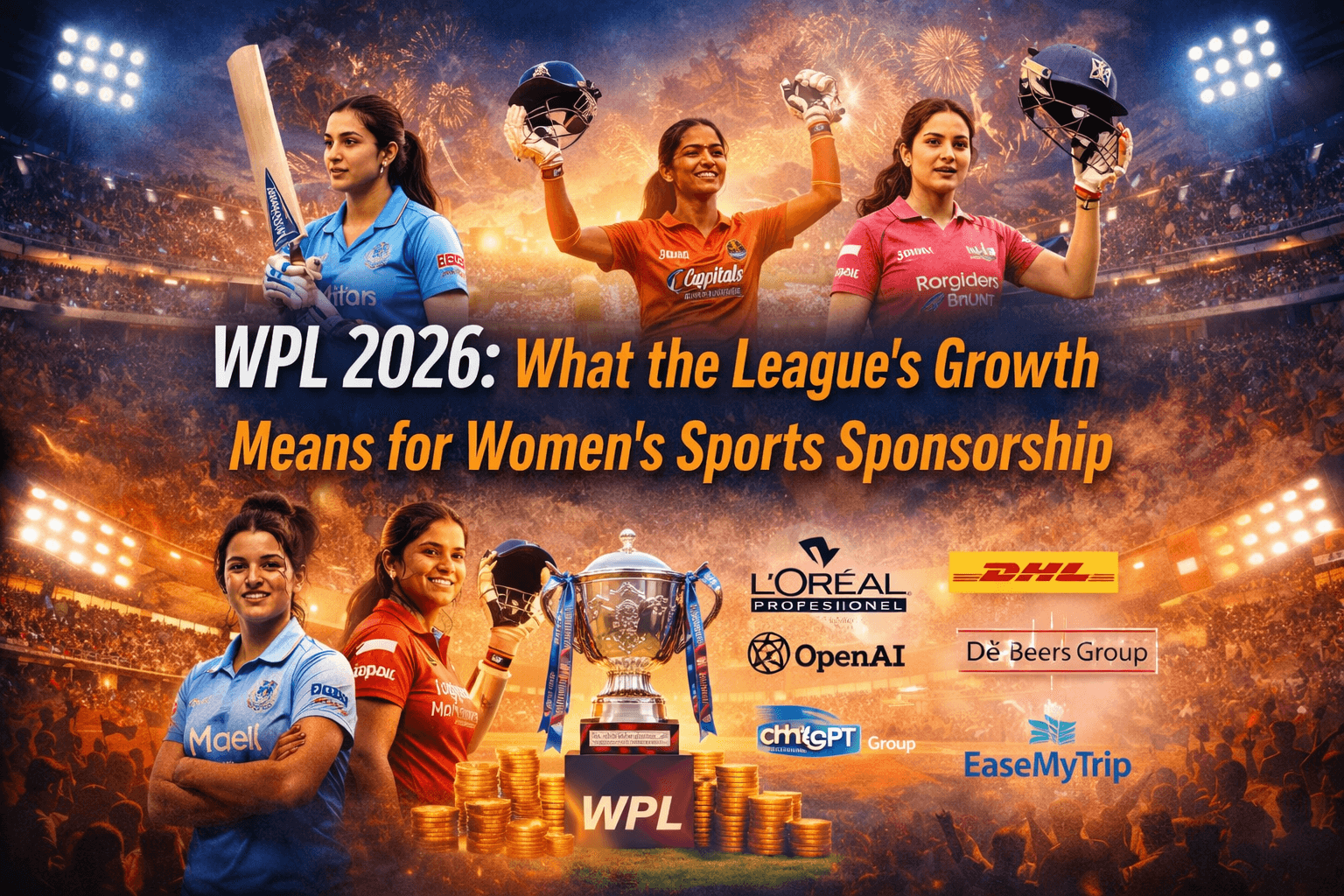
The 2025 Women’s World Cup changed everything. The tournament final drew 185 million viewers on JioStar — matching the viewership record set by the 2024 men’s T20 World Cup final. The WPL’s digital reach touched 446 million during the World Cup — the highest ever for a women’s ICC event, larger than the combined total of the three prior editions. When WPL 2026 opened on January 9, the commercial landscape had transformed: ad rates up 30%, sponsors up from 10 to 15+ at central level, brand new entrants including OpenAI, De Beers Group, L’Oréal Professionnel, BKT Tyres, DHL, and EaseMyTrip — categories entirely absent from women’s cricket three years ago.
| Metric | WPL Season 1 (2023) | WPL Season 3 (2025) | WPL Season 4 (2026 Proj.) |
| Total Viewership | 152 Mn | 325 Mn | 520 Mn+ (projected) |
| Central Sponsorship Revenue | ~₹50 Cr | ~₹100 Cr+ | ~₹120 Cr (proj.) |
| No. of Advertisers / Brands | 50+ | 70+ / 45 categories | 70+ / new categories added |
| Ad Rates (30-sec TV spot) | Baseline | Baseline + 20% | Baseline + ~30% |
| Sponsor Count (Central) | ~10 | ~10–12 | 15+ confirmed |
| Player Endorsement Growth | Baseline | +20–25% YoY | +20–30% post World Cup |
| Key New Sponsor Categories | FMCG, Beauty, Lifestyle | BFSI, Fintech, Jewellery | Tech, EV/Auto, Luxury, Global |
Sources: bestmediainfo.com, Social Samosa, ESPNcricinfo, WomensCricketIndia.com — January 2026
Why Brands Are Entering Women’s Cricket in 2026
1. The Audience Has Proven Its Scale — and Its Distinctiveness
WPL’s 325 million Season 3 viewers isn’t just a big number — its composition is what matters commercially. Nearly 60% of WPL’s viewership comes from male audiences, challenging the assumption that women’s cricket is a niche, female-only property. Meanwhile, 30–35% of its viewers are net-new compared to cricket — people who don’t regularly watch IPL or men’s cricket. This combination of mainstream male reach and new audience acquisition is precisely what makes WPL attractive to brands seeking broad demographic penetration, not just gender-targeted campaigns.
2. The World Cup Win Created a Structural Inflection Point
India’s Women’s World Cup win in 2025 did for women’s cricket what the 1983 men’s World Cup win did for cricket broadly — it created a cultural moment that permanently elevated the sport’s commercial standing. The WPL 2026 is the first domestic league season after that win. Every brand that sat out WPL Seasons 1–3 is now under competitive pressure to enter before the property becomes significantly more expensive. The BCCI has already secured ₹48 Crore in commercial agreements across the 2026 and 2027 seasons — a forward-booking signal that brands are now treating WPL as a long-term platform, not an annual decision.
3. WPL Offers IPL-Adjacent Reach at a Fraction of the Cost
JioStar’s sponsorship packages for WPL 2026 start at approximately ₹4 Crore for broadcast — versus IPL’s ₹300+ Crore for title rights and tens of crores even for associate positions. For mid-market brands, WPL represents the most credible premium cricket association available at an accessible price point. As one industry expert put it: ‘WPL inventory is now being valued as premium property. Sponsorship conversations are no longer about supporting the women’s game — they’re about buying into a proven, growing sports asset.’
4. The Female Athlete Endorsement Market Has Repriced
Female athletes generate 35% higher engagement per follower than male athletes globally (Nielsen Sports). In India, the trend is even more acute: sponsored posts from leading women cricketers deliver 2.8x the engagement of male equivalents. Post the World Cup, endorsement fees for several women cricketers nearly doubled — a correction that industry observers describe as structurally justified and long overdue. The women’s sports endorsement market in India was worth ₹1,224 Crore in 2024, growing 32% year-on-year, with non-cricket women’s sports endorsements growing at 46% — the fastest segment in the entire Indian sports sponsorship landscape.
What WPL’s Growth Means for Brand Investment Decisions
The WPL data carries three clear implications for brands evaluating women’s sports investment in 2026.
Implication 1: Entry Cost Will Only Increase — The Window Is Now
Between Seasons 1 and 4, central sponsorship revenue has grown 140%. Ad rates have risen 30%. Franchise partnership fees have increased 10–15% annually. The trajectory is clear. Brands that entered WPL in Season 1 secured premium inventory at discovery prices. Season 4 entries are paying market rate. Brands that wait for Season 5 or 6 will pay premiums — and compete with deeper, more established brand ecosystems. The WPL entry window is not closing immediately, but it is narrowing.
Implication 2: Category Exclusivity Is Becoming Strategically Important
WPL now has 70+ advertisers across 45 categories — which means category exclusivity positions are filling up. Brands in BFSI (SBI, AMFI), beauty (L’Oréal, Kay Beauty, Joy Skincare), beverages (Bisleri, Kingfisher Packaged Drinking Water), jewellery (Tanishq, De Beers), and technology (OpenAI, ChatGPT) have staked their positions. For brands in still-open categories — consumer electronics, healthcare, real estate, automotive — there is a narrowing window to secure category exclusivity before a competitor does.
Implication 3: Women’s Sports Investment Beyond Cricket Is the Next Frontier
WPL’s success is catalysing investment across all women’s sports, not just cricket. Women’s sports revenue in India is projected to reach $900 Mn by 2030. Women’s sports leagues in hockey, badminton, football, and kabaddi are in various stages of development or acceleration. Brands that build their women’s sports investment capability through WPL are building a transferable competency — one that can extend into women’s hockey leagues, women’s kabaddi properties, and the growing women’s athletics circuit.
WPL 2026 Sponsorship: What Each Entry Point Delivers
| Association Level | Estimated Cost (WPL 2026) | Key Benefits | Best For |
| Title Sponsor (League) | ₹150–250 Cr (multi-year) | Full league branding, broadcast integration, player access | Large national/global brands |
| Central Sponsor (JioStar broadcast) | ₹4 Cr+ per brand | Broadcast logo, digital rights, 70M+ viewer exposure | National FMCG, fintech, BFSI |
| Franchise Jersey Sponsor | ₹10–30 Cr (est.) | Primary jersey logo, team content, fan activation | Premium consumer brands |
| Official Partner (category) | ₹2–8 Cr | Category exclusivity, on-ground branding, digital content | Mid-market brands, D2C |
| Player Endorsement (top tier) | ₹2–5 Cr/year (post-WC) | Direct athlete association, social media, appearances | Brands targeting 18–35 female audience |
| Player Endorsement (emerging) | ₹25–75 L/year | Authentic association, high growth upside | D2C, start-ups, challenger brands |
What WPL’s Growth Signals for the Broader Women’s Sports Ecosystem
WPL’s commercial trajectory isn’t just a cricket story — it’s a proof point for the entire women’s sports investment thesis in India. Here’s what forward-looking brands and sports organisations should take from it.
State-Level Women’s Leagues Are the Next Growth Layer
WPL has created demand for women’s cricket at the grassroots level across every state. The talent pipeline is deepening — Madhya Pradesh, Jharkhand, and other non-traditional states are now producing WPL-ready players. This creates an opportunity for state-level women’s sports leagues that serve as feeders to national properties. The model CHL 2026 is demonstrating for men’s hockey has a direct equivalent for women’s sport: state-level women’s hockey leagues, women’s kabaddi leagues, and women’s athletics circuits are commercially viable at the ₹3–10 Crore budget level.
Female Athlete Management Is a High-Growth Business
As female athlete brand values continue to reprice, the demand for professional career management — contract negotiation, endorsement sourcing, personal brand strategy, social media management — is growing proportionally. The non-cricket female athlete market is the fastest-growing segment: women’s sports endorsements grew 46% year-on-year in 2024, and that growth is concentrated in hockey, badminton, wrestling, and athletics — not just cricket. This is where India’s sports management firms have the largest opportunity to differentiate.
The Fan Base Is Younger and More Digitally Engaged
WPL’s fastest-growing demographic is viewers aged 15–22 — the most commercially valuable cohort for brands building long-term loyalty. This is a generation that consumes sports primarily on mobile, engages with athletes as personal brands, and purchases merchandise driven by identity rather than just fandom. Brands entering women’s sports now are not just buying media — they’re building brand relationships with a generation of sports fans at the most influential stage of their consumer journey.
Frequently Asked Questions
How much has WPL sponsorship grown since Season 1?
WPL central sponsorship revenue grew from approximately ₹50 Crore in Season 1 (2023) to over ₹100 Crore by Season 3 (2025), with combined team and central sponsorship projected to hit ₹120 Crore in WPL 2026. The number of central sponsors has grown from around 10 to 15+ this season, while brand categories have expanded from 10 in 2025 to 45 distinct categories by WPL 2026.
What new categories of brands are entering women’s cricket sponsorship in 2026?
WPL 2026 has attracted brands in categories entirely new to women’s cricket: global technology (OpenAI, ChatGPT), luxury goods (De Beers Group), premium beauty (L’Oréal Professionnel), automotive, and logistics (DHL). This category expansion signals that WPL is no longer positioned as a women’s empowerment narrative play — it’s being bought as a scalable, premium sports media platform by mainstream brand decision-makers.
How has India’s Women’s World Cup win impacted WPL sponsorship?
India’s 2025 Women’s World Cup final drew 185 million viewers on JioStar — matching the 2024 men’s T20 World Cup final viewership. The World Cup’s digital reach hit 446 million, larger than the combined total of the three prior editions. Post the win, player endorsement fees rose 20–30%, and in several cases nearly doubled. Brand budgets allocated to women’s cricket expanded by 30–50% for WPL 2026 versus earlier seasons.
What is the best entry point for a mid-market brand looking to associate with WPL?
For brands with ₹2–8 Crore sponsorship budgets, official partner positions at the franchise or broadcast level offer the strongest ROI — particularly if category exclusivity is still available. Player endorsement deals with emerging WPL players (₹25–75 Lakhs) also offer high-growth upside: these are athletes with established followings and international credentials whose commercial value is still significantly below their true market level. GSK’s sponsorship consulting team can help identify and structure the right entry point for your brand.
Beyond WPL, what other women’s sports should brands be watching in India?
Women’s hockey, badminton, and kabaddi are the highest-growth areas for non-cricket women’s sports investment in India. Women’s sports revenue is projected to reach $900 Mn by 2030. Female athlete endorsements in non-cricket sports grew 46% year-on-year in 2024. State-level women’s leagues — in hockey, kabaddi, and football — are the next commercial layer being developed. Brands that invest in these properties now, before WPL-level scale is achieved, will secure the best rates and the deepest brand associations.
| Ready to Build Your Women’s Sports Investment Strategy?GSK’s Sponsorship & Media Rights team helps brands identify the right women’s sports properties, structure sponsorship packages, activate investments, and measure ROI — from WPL franchise partnerships to emerging women’s sports leagues across India.globalsportskonnect.com/services/sponsorship-media-rights/ | info@globalsportskonnect.com | +91 9873777697Book a free intro call: calendly.com/globalsportskonnect |